
Short answer: Bay County HOA boards can replace paper-based architectural review committee (ARC) workflows with a digital submission, tracking, and approval system that reduces approval times from weeks to days, creates an immutable audit trail, and eliminates the selective enforcement liability that plagues manual processes. The technology handles the data synthesis and workflow routing, while the manager provides the professional judgment and operational execution required for fiduciary compliance.

Architectural review committees exist to preserve property values and community character. In Bay County, where coastal developments in Panama City Beach and unincorporated areas draw both permanent residents and investors, the ARC process is one of the highest-volume governance functions an HOA board oversees. Yet most Bay County associations still manage this critical workflow with paper forms, manila folders, and email chains—a process that creates exactly the kind of liability and inefficiency boards are fiduciarily obligated to avoid.
For board members evaluating management options, the question is not whether digitization is coming. The question is whether your current management company has the operational sophistication to implement it. If your ARC process still involves physical file cabinets, hand-delivered submissions, or spreadsheets tracking incomplete records, that is a fiduciary gap—not an inconvenience.
What the Architectural Review Committee Actually Does in a Bay County HOA
Under Florida Statute 720.3035, HOA boards and their architectural review committees have the authority to review and approve or disapprove proposed changes to properties within the community. The statute requires that architectural review standards be based on the governing documents and applied consistently. Under FS 718.111(1), condominium associations have similar authority through their boards and architectural committees.
The ARC workflow typically involves four stages:
- Submission: Homeowners submit proposed exterior modifications—paint colors, fence installations, roof replacements, landscaping changes, satellite dish placement—along with supporting documentation.
- Review: ARC members evaluate the submission against community standards, governing documents, and applicable Bay County ordinances.
- Decision: The committee approves, conditionally approves, or denies the request with documented rationale.
- Tracking: Approved projects are monitored for completion, and records are archived for future reference and legal protection.
When this process runs on paper, every stage creates risk. Submissions get lost. Decisions take weeks. Inconsistent documentation makes the association vulnerable to selective enforcement claims—where a homeowner can demonstrate that the ARC approved a similar modification for a neighbor but denied theirs without clear justification.
Why Paper-Based ARC Processes Create Board Liability
The most common legal exposure for Bay County HOA boards is not from making wrong decisions—it is from making undocumented decisions. When an ARC denies a homeowner’s fence modification request but cannot produce a written record of the review criteria applied, the timeline of deliberation, or comparable approvals for neighbors, the board has created a liability that a plaintiff’s attorney will exploit.
Three liability patterns emerge from paper-based ARC management:
1. Selective Enforcement Claims
When the ARC approves modifications inconsistently—because there is no searchable record of past decisions—the association is exposed to selective enforcement lawsuits. Florida courts have recognized selective enforcement as a valid cause of action against HOAs. A digital system that catalogs every approval, denial, and the specific standards applied makes it possible to demonstrate consistent treatment across all submissions.
2. Statutory Deadline Violations
Florida Statute 720.3035(2) requires that an association respond to an architectural review submission within a specified period—often 30 or 45 days, depending on the governing documents. When the ARC process is manual, deadline tracking falls to whoever remembers to check the calendar. Miss the deadline, and the submission is deemed approved by default, regardless of whether it meets community standards. A digital system with automated deadline tracking eliminates this risk entirely.
3. Record Retention Gaps
Governing documents and Florida law require associations to maintain certain records for specific periods. Paper records are vulnerable to loss, damage (especially in coastal environments where humidity degrades paper), and the inevitable turnover of management personnel. Digital records stored in a structured, searchable system are inherently more durable and retrievable.
How a Digitized ARC Process Works
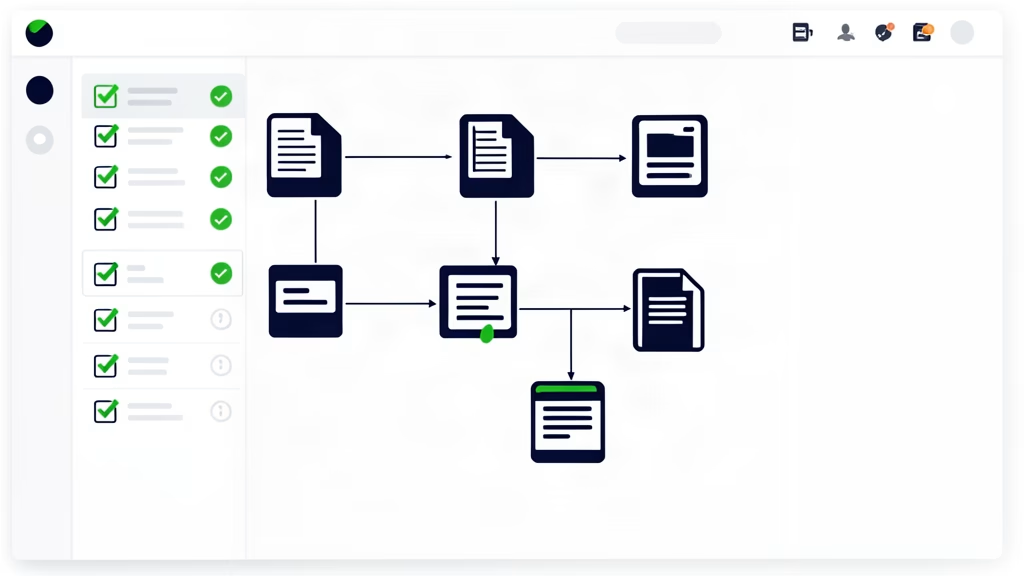
Digitizing the architectural review workflow does not mean putting a PDF form on a website. It means rebuilding the entire submission-to-archive pipeline with technology that creates accountability at every step.

Here is what a properly digitized ARC process looks like:
Stage 1: Digital Submission Portal
Homeowners submit modification requests through a secure online portal. The portal collects all required fields—property address, proposed modification, materials specifications, contractor information, and supporting photos or plans. Mandatory fields prevent incomplete submissions from entering the queue, eliminating the back-and-forth that delays paper-based reviews by days or weeks.
Stage 2: Automated Workflow Routing
Each submission is automatically routed to the appropriate ARC members based on the type of modification. The system assigns a unique tracking number, timestamps the submission for statutory deadline calculation, and notifies reviewers via email. No submission is lost in a paper tray or an inbox folder.
Stage 3: Structured Review and Decision
ARC members review submissions through a dashboard that displays the request alongside the relevant governing document provisions and community standards. Decisions are documented with specific references to the criteria applied—not just “approved” or “denied.” Conditional approvals include the specific conditions in a structured format that the homeowner can reference during project execution.
Stage 4: Automated Tracking and Archival
Approved projects are tracked through completion, with automated reminders to homeowners for progress updates. Every submission, decision, communication, and project completion record is archived in a searchable database that the board can access during any future legal proceeding or audit.
Traditional Management vs Maxet’s Tech-Driven Management
| Process Element | Traditional Paper-Based ARC | Maxet’s Tech-Driven ARC |
|---|---|---|
| Submission | Paper forms, in-person delivery, lost documents | Digital portal, mandatory fields, automatic timestamp |
| Deadline Tracking | Manual calendar, missed deadlines, deemed-approved risk | Automated countdown, escalation alerts, zero missed deadlines |
| Decision Documentation | Handwritten notes, inconsistent rationale, selective enforcement exposure | Structured decision template with governing document citations |
| Record Retrieval | File cabinet search, hours to locate, degraded paper | Instant keyword search across all historical submissions |
| Audit Trail | Fragmented, incomplete, personnel-dependent | Complete, timestamped, immutable digital record |
| Review Cycle Time | 2-4 weeks average | 3-5 days average with automated routing |
FS 720 vs FS 718: Architectural Review Authority Comparison
Bay County associations operate under different statutory frameworks depending on whether they are HOAs (FS 720) or condominium associations (FS 718). The digitization approach must account for the distinct requirements of each statute.
| Requirement | FS 720 (HOA) | FS 718 (Condominium) |
|---|---|---|
| ARC authority source | FS 720.3035 — Declaration covenants and restrictions | FS 718.111(1) — Condominium declaration and bylaws |
| Standards basis | Must be based on governing documents; cannot be arbitrary | Board may adopt reasonable rules; must comply with declaration |
| Response deadline | As specified in governing documents (typically 30-45 days) | As specified in declaration/bylaws |
| Default approval | Deemed approved if no response within deadline | Varies by declaration; some require explicit approval |
| Record retention | FS 720.303(4) — Official records must be maintained and available for inspection | FS 718.111(12) — Official records, including ARC records, retained for prescribed periods |
| Selective enforcement defense | Consistent documented standards required; digital records provide defense | Same principle; digital audit trail demonstrates consistent application |
The Board Member’s Decision: What to Demand from Your Management Company
For Bay County board members shopping for management or evaluating a current provider, the ARC digitization question cuts directly to the core of professional competence. A management company that cannot demonstrate a structured digital ARC workflow is either operating at a 2005 standard or is relying on individual managers to improvise—a model that breaks down the moment that manager leaves.
Ask these questions of any management company:
- Can you show me the digital submission portal my homeowners will use?
- How does your system track statutory deadlines and alert the board before they expire?
- Can I search every ARC decision from the past five years in under 30 seconds?
- What happens to our ARC records if our property manager quits tomorrow?
- How does your system document the specific governing document provisions cited in each approval or denial?
If the answers involve paper, spreadsheets, or “we’ll figure it out,” the association is carrying fiduciary risk that does not need to exist. The technology to eliminate that risk is available, proven, and expected by both board members and homeowners.
The Sovereign AI Approach: Synthesis Without Replacing Judgment
Digitizing the ARC process does not mean replacing committee judgment with an algorithm. The architectural review committee’s value is human judgment—evaluating whether a proposed modification fits the community’s character, weighing neighbor concerns, and making decisions that a board can defend.
What technology does is handle the data synthesis and workflow infrastructure that currently consumes committee time and creates liability. The system aggregates past decisions for consistency checking, routes submissions efficiently, tracks deadlines automatically, and maintains a searchable archive. The technology handles the data synthesis, while the manager and ARC members provide the professional judgment and operational execution.
This is the distinction that matters for Bay County boards: a management company that uses technology to amplify human judgment versus one that relies on memory and paper. The former is a fiduciary asset. The latter is a liability waiting to surface in a courtroom.
A Local Resource for the Vacation Rental Side
Some Bay County associations include units or homes used as short-term vacation rentals, particularly in Panama City Beach. While Maxet’s role is community association management—governing the ARC process, covenant enforcement, and board operations—we do not manage vacation rental properties. For property owners who need vacation rental management services alongside their HOA obligations, Vacations Perfected offers dedicated property management for the Panama City Beach area. The two services are complementary: Maxet ensures community standards are met through the ARC process, while Vacations Perfected handles the guest-facing rental operations.
Frequently Asked Questions
Does digitizing the ARC process eliminate the need for committee members?
No. The committee still reviews submissions and makes decisions. Digitization eliminates the administrative burden—paper handling, deadline tracking, record filing—so committee members can focus on substantive review rather than paperwork. The committee’s role in applying community standards remains fully human-driven.
What happens if a homeowner does not have internet access for the digital portal?
A well-designed system accommodates all residents. Paper submissions can be scanned into the digital workflow by management staff, ensuring every record enters the same tracking system regardless of how the homeowner submitted it. The audit trail and deadline tracking apply uniformly to all submissions.
How long does it take to transition from a paper-based to a digital ARC process?
For a Bay County association with an engaged board and a competent management company, the transition can be completed in 30-60 days. The timeline depends on the volume of historical records that need to be digitized and the complexity of the existing governing documents. The most important factor is whether the management company has an established digital ARC system or would need to build one from scratch.
Can a digital ARC system help defend against a selective enforcement lawsuit?
Yes. A digital system that records every submission, the standards applied, the decision rendered, and the specific governing document provisions cited creates a thorough defense against selective enforcement claims. The ability to instantly retrieve and compare past decisions demonstrates consistent application of community standards across all homeowners.
Related Maxet resources
For consistent architectural enforcement, pair a digital ARC workflow with Maxet’s covenant-enforcement strategy and Bay County HOA management support.
Legal disclaimer: Maxet is a professional community association management firm providing business operational efficiency and administrative support. We are not a law firm, and the information provided in this article does not constitute legal advice or create an attorney-client relationship. For specific legal interpretation of Florida Statutes or governing documents, we strongly recommend consulting with a licensed attorney specializing in Florida community association law.