
Short answer: Digital reserve fund dashboards give Panama City Beach condo boards real-time visibility into funding levels, projected shortfalls, and maintenance timelines — replacing static spreadsheets that are often months out of date by the time they reach a board meeting. For PCB condo associations operating under Florida Statute 718 and the post-SB 154 reserve requirements, a live dashboard transforms fiduciary oversight from a quarterly guess into a daily operational tool. The technology handles the data synthesis, while the board provides the policy direction and fiduciary judgment.

Why Panama City Beach Condos Face Unique Reserve Pressures
Panama City Beach condominiums sit at the intersection of coastal exposure and intense regulatory scrutiny. Salt air, hurricane risk, and aging infrastructure accelerate deterioration cycles, while Florida Statute 718 mandates fully funded reserves — especially after the structural integrity reserve study (SIRS) requirements introduced by SB 154. Boards that rely on a reserve study updated every three to five years, supplemented by a static spreadsheet presented at annual meetings, are flying blind between updates.
The problem is not a lack of data. Condo associations generate enormous amounts of financial data — vendor invoices, maintenance logs, insurance premiums, assessment collections, reserve account balances. The problem is that this data sits in disconnected systems: the management company’s accounting software, a shared drive of vendor proposals, the reserve specialist’s PDF report, and a board treasurer’s personal spreadsheet. By the time someone consolidates it for a board meeting, the numbers are already stale.
For PCB condos, the stakes are higher than inland communities. A delayed roof replacement on a 15-story Gulf-front tower is not a maintenance inconvenience — it is a structural safety issue and a fiduciary liability. Boards that cannot answer the question “How much is in reserves right now, and is it enough for the next scheduled replacement?” are exposing themselves and their owners to risk.
What a Digital Reserve Fund Dashboard Actually Does
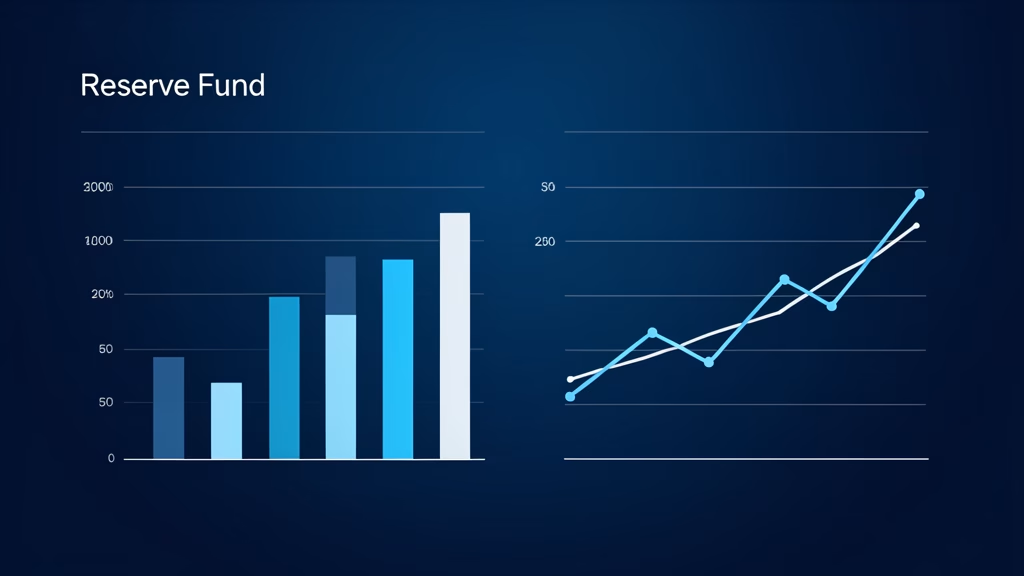
A reserve fund dashboard is not a glorified spreadsheet. It is a live data integration layer that pulls from multiple sources — the association’s accounting platform, the reserve study schedule, vendor contracts, and assessment collection records — and presents a unified view of reserve health. The key capabilities include:
Real-Time Fund Balance Tracking
Instead of waiting for a monthly financial packet, board members see current reserve account balances updated as transactions post. This means no more discovering at a board meeting that a major vendor payment three weeks ago dropped the reserve below the funding threshold.
Funding Progress Against Reserve Study Schedule
The dashboard maps current fund balances against the reserve study’s funding plan, showing whether the association is on track, ahead, or behind. For PCB condos with SIRS obligations under SB 154, this visibility is critical — the law requires specific funding levels, and falling short triggers mandatory corrective action.
Projected Shortfall Alerts
When a dashboard projects that current funding will not cover a scheduled component replacement — say, a roof replacement in 18 months that the reserve cannot fully fund — it flags the shortfall early. This gives the board time to adjust contributions, phase the project, or plan a special assessment without scrambling at the last minute.
Component-Level Condition Tracking
Beyond dollar amounts, the dashboard tracks individual reserve components — roofs, elevators, pool equipment, exterior paint — with remaining useful life, replacement cost estimates, and condition notes. This connects the reserve study’s projections to actual asset conditions on the ground.
The Gap: Traditional Management vs. Dashboard-Driven Oversight
Most Panama City Beach condo associations still operate under a traditional management model where financial information flows through a single channel: the management company’s monthly report. This creates structural blind spots that digital dashboards eliminate:
| Oversight Dimension | Traditional Management | Dashboard-Driven Oversight |
|---|---|---|
| Data Freshness | Monthly financial packet, often 2-4 weeks behind | Real-time balances updated as transactions post |
| Shortfall Detection | Discovered at budget review or after a crisis | Projected automatically, flagged weeks or months ahead |
| Board Accessibility | Board sees data only when management distributes it | Board members access dashboard anytime, from any device |
| Reserve Study Alignment | Reserve study is a PDF reviewed annually, then filed | Reserve study schedule integrated into live tracking |
| Fiduciary Documentation | Relies on meeting minutes and emailed reports | Audit trail of every decision with data timestamps |
| Owner Transparency | Owners see reserve status in annual budget meeting | Optional owner-facing summary view builds trust year-round |
FS 718 vs. FS 720: Reserve Requirements That Drive Dashboard Adoption
Panama City Beach condo associations fall under Florida Statute 718 (Condominium Act), not FS 720 (Homeowners’ Association Act). The reserve requirements differ significantly, and understanding these differences is essential for boards evaluating dashboard tools:
| Requirement | FS 718 (Condominium) | FS 720 (HOA) |
|---|---|---|
| Reserve Study | SIRS required for buildings 3+ stories (SB 154) | Reserve study recommended but not uniformly mandated |
| Funding Level | Must fully fund reserves per SIRS schedule | Board may waive or reduce funding by majority vote |
| Reporting Frequency | Annual financial reporting includes reserve status | Annual budget includes reserve schedule |
| Milestone Inspection | Required for 3+ story buildings (30-year, then 10-year cycle) | Not mandated by statute |
| Use of Reserve Funds | Restricted to designated reserve components | More flexible, board discretion permitted |
For PCB condo boards, the FS 718 requirements create a compliance environment where real-time tracking is not a luxury — it is a tool for meeting statutory obligations. A dashboard that maps SIRS funding schedules against live account balances directly supports the board’s fiduciary duty under the statute.
How to Evaluate a Reserve Fund Dashboard for Your PCB Condo Association
Not all dashboards are created equal. When evaluating a digital reserve fund solution, Bay County condo boards should assess:
1. Integration With Existing Accounting Systems
The dashboard must connect to your association’s accounting platform — not require double data entry. If your management company uses AppFolio, QuickBooks, CINC Systems, or another platform, the dashboard should pull reserve account data automatically. Manual exports defeat the purpose of real-time visibility.
2. Reserve Study Import Capability
The tool should accept your reserve specialist’s study as a baseline — ideally the full component schedule with replacement costs, useful life, and remaining life. This is what drives the funding progress comparison. If the dashboard requires manual recreation of the reserve study, it will be outdated within the first funding cycle.
3. Board-Level Access Controls
Dashboard access should be role-based: the treasurer sees full financial detail, other directors see summary views, and owners see a public-facing reserve health summary. This structure supports both fiduciary oversight and owner transparency without exposing sensitive vendor or contract details.
4. Alert Configuration
The dashboard should allow the board to set thresholds — for example, alert when reserve balance drops below 80% of the funding target, or when a component replacement is within 12 months and funding is insufficient. These alerts shift the board from reactive crisis management to proactive planning.
5. Audit Trail and Documentation
Every dashboard view, export, and decision logged in the system should be timestamped and attributable. This creates a fiduciary record that demonstrates the board was actively monitoring reserves — a critical defense if a fiduciary breach claim ever arises.
The Maxet Approach: Technology as a Fiduciary Tool, Not a Replacement for Judgment
At Maxet, we deploy digital reserve fund dashboards as part of our tech-driven management approach for Panama City Beach condo associations. The philosophy is straightforward: the technology handles the data synthesis — pulling from accounting, reserve studies, and vendor contracts — while the board provides the professional judgment and policy direction. The dashboard surfaces the data; the board makes the decisions.
This model directly addresses the fiduciary gap that leads to reserve shortfalls. When board members can see — at any time, from any device — whether their reserves are on track, whether a projected shortfall is emerging, and whether a component replacement is approaching, they make better decisions. Not because the dashboard tells them what to do, but because it gives them the information they need to act.
For PCB condos, this is especially critical. The combination of coastal asset deterioration, SIRS compliance requirements, and the financial pressure of insurance premium increases means that boards without real-time visibility are managing on assumptions. A dashboard replaces assumptions with data — and data is what fiduciary duty demands.
Frequently Asked Questions
What is a digital reserve fund dashboard for a condo association?
A digital reserve fund dashboard is a live, web-based tool that displays a condo association’s reserve account balances, funding progress against the reserve study, and projected shortfalls in real time. Instead of reviewing static spreadsheets at board meetings, directors access current data anytime and receive automated alerts when funding falls below set thresholds.
Do Panama City Beach condos need a reserve fund dashboard under Florida law?
Florida law does not mandate a specific software tool, but FS 718 requires condo associations to maintain fully funded reserves and conduct structural integrity reserve studies (SIRS) under SB 154. A dashboard is the most effective way to demonstrate ongoing compliance with these requirements, because it provides a continuous, auditable record of reserve fund monitoring.
How much does a reserve fund dashboard cost a PCB condo association?
Costs vary by platform and association size, but most dashboard solutions are priced as part of a management software package. For Panama City Beach condos, the cost of a dashboard is typically far less than the cost of a single surprise special assessment caused by an undetected reserve shortfall. Boards should evaluate cost against the fiduciary risk of continuing to operate with stale data.
Can a reserve fund dashboard replace our reserve study?
No. A dashboard tracks and visualizes the reserve study’s funding schedule against live account data, but the reserve study itself must be prepared by a qualified reserve specialist. The dashboard is a monitoring and oversight tool; the reserve study is the engineering and financial baseline. They work together — the study sets the plan, and the dashboard tracks execution against it.
Legal disclaimer: Maxet is a professional community association management firm providing business operational efficiency and administrative support. We are not a law firm, and the information provided in this article does not constitute legal advice or create an attorney-client relationship. For specific legal interpretation of Florida Statutes or governing documents, we strongly recommend consulting with a licensed attorney specializing in Florida community association law.