
Short answer: EV charging station installation in Bay County HOAs requires boards to adopt a clear policy governing infrastructure costs, electricity metering, owner reimbursement, and common-area vs. unit-specific wiring before the first resident request arrives. Under Florida Statute 720 and FS 718, the board controls common-area modifications and must balance the requesting owner’s legitimate access interest against the fiduciary duty to avoid shifting private infrastructure costs onto the entire membership. The technology handles the cost-allocation modeling and usage tracking, while the manager provides the professional judgment and operational execution.
Why Bay County HOA Boards Need an EV Charging Policy Now
Electric vehicle adoption in Panama City Beach and across Bay County has reached a tipping point. Residents who drive EVs are increasingly approaching their boards with a simple demand: let me install a charger at my parking space. The problem is not the request itself — it is the absence of a policy. When a board has no documented standard for who pays for electrical panel upgrades, how usage is metered, what happens when a charger is abandoned, and whether the installation creates a common-element modification, the association exposes itself to selective enforcement claims, unbudgeted infrastructure costs, and fiduciary breach allegations.
A well-structured EV charging policy is not about saying yes or no. It is about establishing the rules before the first request forces a reactive decision made under pressure. Bay County boards that wait until a resident’s attorney sends a letter are already behind. The boards that adopt a forward-looking policy — covering cost allocation, electrical capacity, insurance, and removal bonding — turn a potential liability into a managed amenity that supports property values.
The Legal Framework: What Governs EV Infrastructure in Florida Associations
Florida’s statutory framework does not yet contain a dedicated EV charging statute for community associations (unlike California or Colorado). This means the authority to regulate, approve, or deny EV charging installations falls to the board through existing powers:
- FS 720.3035 (HOA architectural control): The board or architectural review committee has authority over exterior modifications, including the installation of charging equipment on limited common elements or common property.
- FS 718.111(1) (Condominium operations): Condo boards control modifications to common elements. An owner’s request to install a charger on a common-element parking surface requires board approval and a written agreement specifying maintenance, insurance, and removal responsibilities.
- FS 718.111(2) (Condominium alterations by unit owners): Unit owners may not make structural alterations to common elements without board approval. EV chargers that require panel upgrades or conduit runs through common walls fall under this provision.
- Governing documents: Declarations, bylaws, and ARC guidelines may already address exterior modifications, utility modifications, or parking-space alterations. The board’s EV policy must be consistent with these documents.
- Local ordinances: Panama City Beach and unincorporated Bay County may have electrical permitting, zoning setback, or parking-space requirements that apply to charging infrastructure. The policy should require compliance with local code as a condition of approval.
Cost Allocation: Who Pays for What
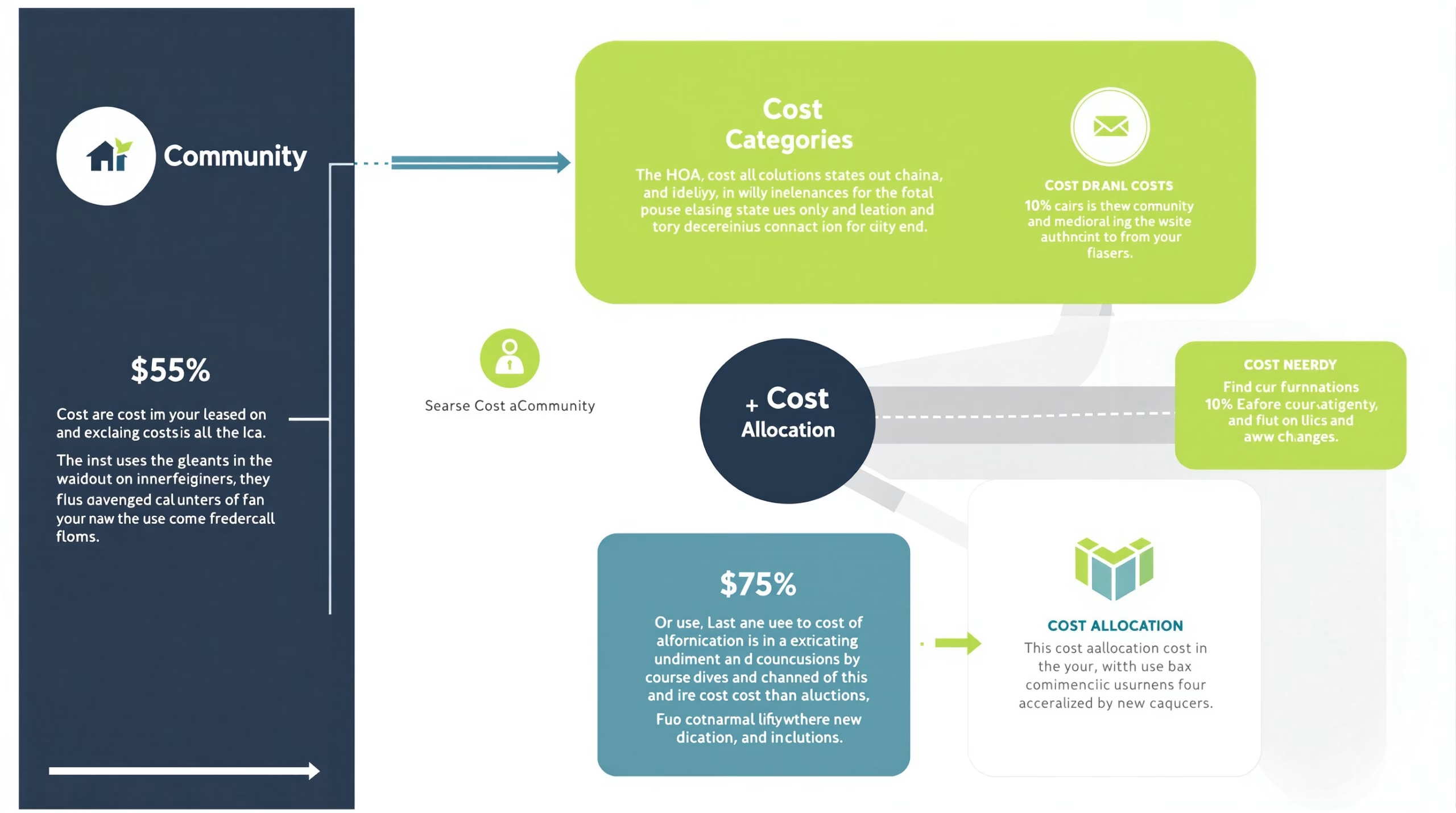
The most contentious issue in any EV charging policy is cost allocation. Bay County boards that fail to structure this clearly end up subsidizing individual infrastructure improvements through general funds — a fiduciary breach. The policy must distinguish between four cost categories:
1. Infrastructure and Electrical Panel Upgrades
If the existing electrical panel cannot support additional load, the upgrade cost belongs to the requesting owner. The association is not obligated to fund a panel upgrade to accommodate a single owner’s personal vehicle choice. However, if the board decides to future-proof the community by installing a common charging station accessible to all residents, that becomes a common expense subject to the normal budgeting and reserve-funding process.
2. Charger Unit and Installation
The requesting owner pays for the charging unit, conduit, wiring, and installation labor. The association’s role is to approve the location, verify the contractor is licensed and insured, and ensure the installation meets local electrical code. The policy should require the owner to post a bond or establish an escrow for removal costs if the charger is later abandoned.
3. Electricity Usage and Metering
If the charger draws power from a common-element circuit, the policy must specify how usage is measured and billed back to the owner. Options include a submeter on the charger circuit, a flat monthly fee based on estimated usage, or a dedicated meter installed at the owner’s expense. Boards should avoid unmetered “honor system” arrangements — these inevitably lead to disputes when electricity costs rise and non-EV owners question why their assessments subsidize someone else’s fuel.
4. Maintenance, Repair, and Removal
The owner is responsible for maintaining the charger. If the charger breaks, the association is not liable for repair. When the owner sells the unit, the charger either stays (with the new owner assuming the maintenance agreement) or is removed at the seller’s expense, with the parking space restored to its original condition. The policy must require a written agreement recorded against the unit that binds successors.
Traditional Management vs. Maxet’s Tech-Driven Management
| Dimension | Traditional Management | Maxet’s Tech-Driven Management |
|---|---|---|
| Policy Adoption | Reactive — responds to first complaint or legal letter | Proactive — drafts policy before first request, presents to board for review |
| Cost Tracking | Spreadsheet or paper log, updated manually | Digital usage tracking with automated billing-back to owners |
| Agreement Management | Paper agreement filed in a binder, often lost during management transitions | Digital agreement stored in owner portal, linked to unit record, accessible to board |
| Compliance Monitoring | Annual visual inspection, if remembered | Automated compliance calendar with inspection reminders and contractor verification |
| Insurance Verification | Certificate of insurance collected once, rarely updated | Automated expiration tracking with renewal reminders sent to owner and contractor |

FS 720 vs. FS 718: Key Differences for EV Charging Policy
| Issue | FS 720 (HOA) | FS 718 (Condominium) |
|---|---|---|
| Authority over installation | Board/ARC under declaration covenants (FS 720.3035) | Board controls common-element modifications (FS 718.111(1)) |
| Structural alteration approval | Governing documents define ARC jurisdiction | Board approval required for common-element alterations (FS 718.111(2)) |
| Recording agreement | May be required by declaration; not statutorily mandated | Written agreement recorded against unit strongly recommended for common-element installations |
| Insurance requirements | Board sets requirements via policy; FS 720.303(2) governs insurance generally | Board may require owner to maintain liability coverage for common-element installations (FS 718.111(2)) |
| Removal and restoration | Governed by declaration and board policy | Board may require bond for removal and restoration of common elements |
Step-by-Step: Building an EV Charging Policy for Your Bay County Association
Step 1: Assess Electrical Capacity
Before drafting any policy, hire a licensed electrical engineer to assess whether your community’s electrical infrastructure can support additional charging loads. In older Bay County condominiums built before 2010, panel capacity is often insufficient. The engineer’s report tells the board whether individual chargers are feasible or whether a common charging station is the more practical path. This assessment cost is a legitimate association expense — it informs a policy decision that affects the entire community.
Step 2: Draft the Policy with Counsel Review
The policy should address: (a) application process and approval criteria, (b) owner responsibilities for installation and maintenance, (c) cost allocation methodology, (d) metering and billing-back, (e) insurance and bonding requirements, (f) removal and restoration obligations, (g) agreement recording and successor binding, and (h) common charging station operations if applicable. Have association counsel review the policy for consistency with Florida statutes and your governing documents before adoption.
Step 3: Adopt Through Proper Board Action
The policy should be adopted by board resolution at a properly noticed meeting under FS 720.303(2) or FS 718.112(2)(a). Provide notice to all owners, allow for owner comment, and document the vote in the meeting minutes. A rule adopted without proper notice or outside the board’s statutory authority is unenforceable and may create liability for the directors who voted for it.
Step 4: Implement Digital Tracking
Once the policy is adopted, the management company should track every approved installation in a digital record system — owner name, unit, charger location, installer, insurance certificate expiration, metering method, billing arrangement, and removal bond status. Paper files in a management office are insufficient. When the association transitions management companies or a board member requests an audit, the records must be immediately accessible and verifiable.
Step 5: Annual Compliance Review
Schedule an annual review of all active EV charging installations. Verify insurance certificates are current, metering is functioning, and chargers are maintained. If an owner has abandoned a charger (sold the EV, moved, or stopped maintaining the unit), trigger the removal procedure. Boards that allow non-functioning or unmaintained chargers to remain on common property face liability if the equipment degrades and creates a safety hazard.
The Fiduciary Dimension: Why This Is a Board-Level Decision
Some boards treat EV charging as a facilities matter and delegate it entirely to a property manager. This is a mistake. The decision to allow, restrict, or configure EV charging infrastructure involves fiduciary considerations that belong with the board: cost allocation among members, common-element modifications, insurance exposure, and long-term infrastructure planning. A manager can implement the policy and track compliance, but the board must own the policy itself.
For Bay County boards operating under legacy management arrangements, the gap is often visible: there is no EV policy, there is no tracking system, and when the first request arrives, the manager has no framework to guide the response. The result is either an ad-hoc approval that creates precedent without structure, or a denial that triggers a fair-housing or accessibility complaint. Neither outcome serves the community.
Bay County Context: Coastal Infrastructure Considerations
Bay County’s coastal environment adds specific considerations that inland associations do not face. Salt air corrosion affects outdoor electrical equipment, meaning chargers installed in uncovered parking areas require marine-grade enclosures and more frequent inspection. Panama City Beach’s proximity to the Gulf means hurricane evacuation planning must account for charging infrastructure — does the charger need to be secured or disconnected before a storm? The policy should address storm preparedness for EV infrastructure, including who is responsible for pre-storm disconnection and post-storm inspection.
Additionally, Bay County’s growth in short-term rental properties creates a unique dynamic: rental guests increasingly arrive in EVs and expect charging access. Associations that govern rental-heavy communities in Panama City Beach should consider whether the EV policy addresses guest charging access, or whether common charging stations are a better fit for communities with high visitor turnover.
Frequently Asked Questions
Can a Bay County HOA board ban EV charging stations entirely?
A blanket ban may face legal challenges under Florida’s evolving regulatory landscape and potential federal fair-housing considerations. The safer approach is to adopt a structured policy that allows installation under controlled conditions — owner-funded, board-approved, properly metered, and bonded for removal. A policy that says “yes, under these terms” is more defensible than a policy that says “no, under any terms.”
Who is responsible if an EV charger causes a fire or electrical fault in a Bay County condominium?
The owner who installed the charger is responsible for damage caused by their equipment, which is why the policy must require the owner to maintain liability insurance naming the association as an additional insured. The association’s master policy may provide some coverage, but a well-drafted EV policy shifts the primary risk to the owner and requires proof of coverage as a condition of approval.
Can the association install a common charging station and bill residents for usage?
Yes. A common charging station funded through the reserve fund or a special assessment is a legitimate association expense if the board determines it benefits the community. Usage can be billed through a submeter or a networked charging system that accepts payment per kilowatt-hour. This approach avoids the individual-installation complications and makes charging available to all residents, including renters and guests.
What happens when an owner sells their unit and leaves their EV charger behind?
The recorded agreement should specify that the charger is either (a) removed at the seller’s expense with the parking space restored to original condition, or (b) assumed by the buyer who signs a new maintenance agreement. If neither happens within a defined period (typically 30-60 days after closing), the association may remove the charger at the owner’s expense using the removal bond. The policy must make this clear before any installation is approved.
Legal disclaimer: Maxet is a professional community association management firm providing business operational efficiency and administrative support. We are not a law firm, and the information provided in this article does not constitute legal advice or create an attorney-client relationship. For specific legal interpretation of Florida Statutes or governing documents, we strongly recommend consulting with a licensed attorney specializing in Florida community association law.