
Short answer: Florida HOA boards in Bay County must hold a budget ratification meeting with proper notice and member voting under FS 720.303(2)(b) and FS 718.112(2)(f). Technology-driven tools — digital notice delivery, automated quorum tracking, and secure electronic voting — reduce procedural errors, increase member participation, and create an auditable compliance record that protects the board from fiduciary challenges.
Every year, Bay County HOA and condominium boards face the same procedural bottleneck: the budget ratification meeting. Under Florida Statute 720 and 718, boards must provide advance notice, hold an open meeting, and — in the case of condominiums — give owners the opportunity to reject a budget that exceeds prior-year assessments by more than 115%. In practice, the process breaks down at three points: notice delivery, quorum attainment, and vote tabulation. Paper ballots go missing. Notice affidavits sit unsigned in a binder. Quorum falls short because nobody knew the meeting was happening. The result is a budget that passes on a technicality — or one that fails to pass at all, leaving the association without approved funding.
For Bay County communities — from Panama City Beach condos to unincorporated HOAs along the coast — the stakes are real. A failed budget ratification can delay reserve funding and budget correction, postpone maintenance projects, and expose board members to claims of fiduciary breach if the process wasn’t properly documented. Technology doesn’t replace the board’s professional judgment; it handles the procedural compliance so the board can focus on the financial decisions that actually matter.
What Florida Law Requires for Budget Ratification Meetings
Florida law treats HOA and condominium budget ratification differently, and Bay County boards must know which statute applies.
HOA Budgets Under FS 720.303(2)
Under Florida Statute 720.303(2), the board must provide notice of any meeting where assessments will be considered. For a board meeting to adopt the annual budget, the notice must be posted conspicuously at least 48 hours in advance and must specifically state that assessments will be considered. If the annual membership meeting is where the budget is ratified, 14 days’ written notice is required under FS 720.306, delivered by mail, hand delivery, or electronic transmission to members who have consented to electronic notice. The person providing the notice must execute an affidavit attesting to compliance, and that affidavit goes into the association’s official records.
Quorum for the annual membership meeting is 30% of voting interests unless the bylaws specify a lower number. If quorum is not met, the board may adjourn and reconvene with a reduced quorum — typically 20% — but this statutory provision depends on the association’s governing documents.
Condominium Budgets Under FS 718.112(2)(f)
Under Florida Statute 718.112(2)(f), any meeting where the proposed annual budget will be considered must be open to all unit owners. The board must hand-deliver, mail, or electronically transmit a notice and a copy of the proposed budget to each unit owner at least 14 days before the meeting. The budget must be detailed, showing amounts by account and expense classification, including reserve accounts for roof replacement, painting, pavement resurfacing, and any deferred maintenance item exceeding $25,000. The board must adopt the budget at least 14 days before the start of the fiscal year.
For condominiums, the board adopts the budget — owners do not vote to approve it. However, owners have a process to reject a budget if assessments exceed the prior year by more than 115% (excluding reserves and non-recurring items). Additionally, the board cannot waive or reduce reserve funding without a majority vote of unit owners at a duly called meeting.

Where the Traditional Process Fails Bay County Boards
The paper-driven budget ratification process has five structural failure points that Bay County boards encounter year after year:
- Notice delivery gaps: Mailed notices arrive late or not at all. Electronic notice requires prior owner consent under FS 720.303(4), and many Bay County associations haven’t built a consent registry.
- Quorum shortfalls: Annual meeting quorum (typically 30%) is hard to reach in communities with seasonal residents and investment properties. Without quorum, the budget can’t be ratified.
- Ballot integrity: Paper proxies and ballots are collected in a box, counted by hand, and stored in a binder. There is no audit trail if a member challenges the outcome.
- Notice affidavit compliance: The person providing notice must execute an affidavit. In practice, this affidavit is frequently missing from the official records, creating a compliance gap that DBPR examiners can cite.
- Post-meeting documentation: Meeting minutes, vote tallies, and the ratified budget must be recorded and made available to members. Legacy processes leave this to manual transcription.
Each of these failures creates fiduciary exposure. A board that adopts a budget without proper notice, without quorum, or without documented vote totals is vulnerable to a member challenge — and in Bay County’s coastal communities, where assessment levels and reserve funding are under scrutiny after recent hurricane seasons, that exposure is growing.
How Technology Closes the Compliance Gap
The technology handles the procedural compliance, while the board provides the professional judgment and financial decision-making. Here is how a tech-driven budget ratification process works for Bay County associations:
1. Automated Notice Delivery and Affidavit Generation
Digital notice platforms send meeting notices via email, SMS, and physical mail based on each owner’s consent preference. The system tracks delivery confirmations, generates a timestamped notice log, and auto-generates the FS 720.303-required affidavit — signed electronically by the person providing notice and stored in the association’s digital records repository. This eliminates the most common compliance gap: the missing notice affidavit.
2. Real-Time Quorum Tracking
Instead of counting heads at the door, a digital quorum tracker displays real-time attendance and proxy submissions as members arrive or log in. The system calculates whether quorum has been met under the association’s bylaws and flags the reduced-quorum provision if the initial threshold isn’t reached. Board members see the numbers before calling the meeting to order — not after 45 minutes of waiting for a room that never fills.
3. Secure Electronic Voting and Ballot Integrity
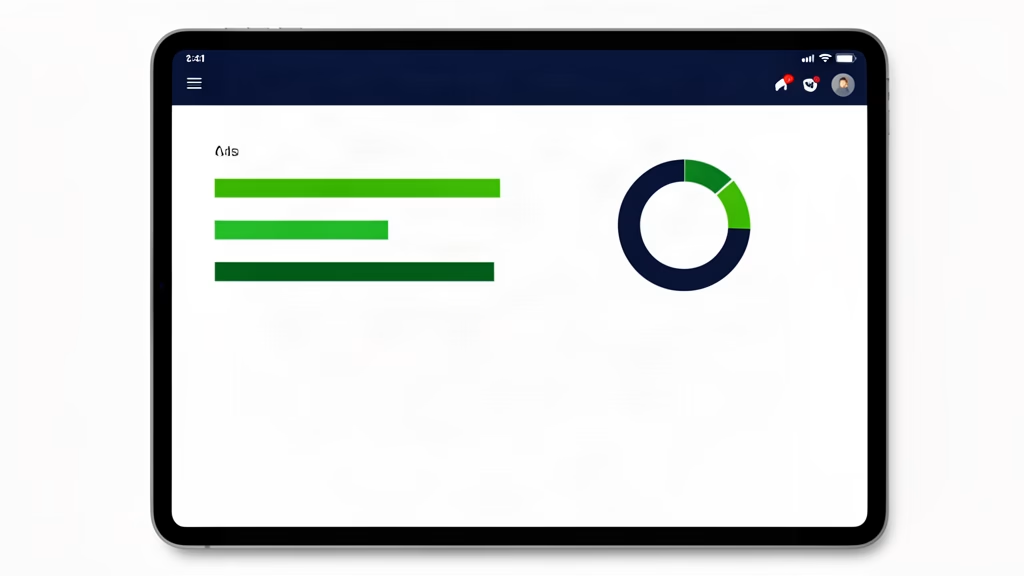
Electronic voting platforms allow members to cast ballots from a verified device, with each vote cryptographically logged and tied to the member’s parcel or unit. The system tabulates results instantly, produces an audit trail showing the vote count, the percentage of voting interests participating, and whether the 115% threshold was triggered (for condominiums). No hand counting. No lost ballots. No disputes about whether a proxy was valid.
4. Automated Meeting Minutes and Records Retention
After the meeting, the system generates draft minutes from the recorded agenda, attendance log, and vote results. The ratified budget, notice affidavit, proxy records, and minutes are stored in the association’s digital records portal — accessible to members under FS 720.303(4) or FS 718.111(12) inspection rights. This creates a single, auditable record that satisfies DBPR inquiry requirements and member records requests.
Traditional Management vs. Maxet’s Tech-Driven Budget Ratification
| Requirement | Traditional Management | Maxet’s Tech-Driven Process |
|---|---|---|
| Notice delivery | Mailed 14 days ahead; no delivery confirmation | Multi-channel delivery with timestamped confirmation |
| Notice affidavit | Manual affidavit, often missing from records | Auto-generated, electronically signed, stored in digital portal |
| Quorum tracking | Manual head count at the door | Real-time digital tracker with reduced-quorum alert |
| Vote tabulation | Paper ballots counted by hand | Cryptographic electronic voting with instant audit trail |
| Records retention | Binder in the management office | Digital records portal, member-accessible under FS 720.303(4) |
| DBPR audit readiness | Days of searching through paper files | One-click audit trail export |
FS 720 vs. FS 718: Budget Ratification Comparison
| Requirement | FS 720 (HOA) | FS 718 (Condominium) |
|---|---|---|
| Who adopts the budget | Board adopts; members may ratify per bylaws | Board adopts; owners may reject if >115% increase |
| Notice period | 48 hrs (board meeting) or 14 days (annual meeting) | 14 days with copy of proposed budget |
| Meeting open to members | Yes, under FS 720.303(2) | Yes, under FS 718.112(2)(f) |
| Reserve funding | Per governing documents; no statutory reserve mandate | Mandatory reserves unless owners vote to waive |
| Owner override | Per bylaws — some require majority vote | Owners can reject budget exceeding 115% of prior year |
| Notice affidavit | Required under FS 720.306 | Required under FS 718.112(2)(e) |
What Bay County Boards Should Demand From Their Management Company
If your current management company is still running budget ratification with paper notices and hand-counted ballots, you’re carrying fiduciary risk that technology has already solved. Here is what Bay County boards should demand:
- Multi-channel notice delivery: Email, SMS, and physical mail with delivery tracking and timestamped confirmation — not just a stamped envelope in a mailbox.
- Automated affidavit generation: The notice affidavit should be produced electronically, signed, and stored in a digital records system the same day the notice goes out.
- Real-time quorum display: The board should know whether quorum has been met before calling the meeting to order — not after 45 minutes of waiting.
- Secure electronic voting: Members should be able to vote from a verified device, with each vote logged to an audit trail that can be produced on demand.
- One-click records export: If DBPR sends an inquiry, the board should be able to produce the notice, affidavit, attendance log, vote tally, and minutes in a single export — not a week of digging through binders.
Decisions in minutes, not hours. Focus on strategy, not forensics. Proactive governance, not crisis management. That is the standard Bay County boards should hold their management company to.
Frequently Asked Questions
Do Bay County HOA members vote on the annual budget?
It depends on the governing documents. Under FS 720, the board generally adopts the budget, but some association bylaws require a membership vote to ratify. Condominiums under FS 718 give owners a rejection right only if assessments exceed 115% of the prior year. Check your bylaws to confirm whether your community requires a ratification vote.
What happens if quorum is not met at the budget ratification meeting?
If quorum is not met at a properly noticed annual meeting, Florida law allows the board to adjourn and reconvene with a reduced quorum — typically 20% of voting interests. However, this provision depends on the association’s governing documents. Some bylaws do not include a reduced-quorum clause, which means the meeting cannot proceed without the full quorum threshold.
Can Bay County HOAs use electronic voting for budget ratification?
Yes. Florida law permits electronic voting if the association’s governing documents allow it, or if the board has adopted a written resolution authorizing electronic voting under FS 718.112(2)(b) for condominiums. For HOAs under FS 720, electronic voting is permitted if the bylaws don’t prohibit it. The voting system must produce an audit trail and allow members to verify their vote was recorded.
How long must budget ratification records be kept?
Under FS 720.303(4) and FS 718.111(12), association records — including meeting minutes, notice affidavits, vote tallies, and the adopted budget — must be maintained and made available for member inspection. The retention period varies by record type but generally ranges from 7 years for financial records to permanent retention for governing documents. Digital records portals make compliance with these retention requirements automatic.
A Local Resource for the Vacation Rental Side
Maxet’s role is community association management — we help Bay County boards run compliant, well-governed communities. If your association includes short-term rental units and you need help with the vacation rental management side (guest services, bookings, property maintenance for rental purposes), Vacations Perfected handles that work for Bay County property owners. The two roles are distinct: association management serves the board and the community; vacation rental management serves the individual owner and their guests.
Legal disclaimer: Maxet is a professional community association management firm providing business operational efficiency and administrative support. We are not a law firm, and the information provided in this article does not constitute legal advice or create an attorney-client relationship. For specific legal interpretation of Florida Statutes or governing documents, we strongly recommend consulting with a licensed attorney specializing in Florida community association law.