
Short answer: Bay County gated communities upgrading security camera systems should audit their current coverage gaps, map camera placement to association liability zones, and select IP-based systems with remote monitoring and automated incident logging. Under Florida Statute 720, boards have a fiduciary duty to protect common-area assets, and modern camera infrastructure reduces both liability exposure and insurance premiums when deployed with clear privacy boundaries and documented vendor accountability.

Board members in Bay County gated communities face a growing question: is the security camera system installed five or ten years ago still adequate? Camera technology has shifted dramatically, and older analog systems that once seemed sufficient now leave gaps in coverage, produce footage too grainy to be useful in disputes, and lack the remote access that boards increasingly expect. Planning a camera system upgrade is not simply a matter of buying newer hardware. It requires a structured approach tied to the association’s governing documents, fiduciary obligations, and the specific security risks of Northwest Florida coastal communities.
Why Bay County HOAs Need a Security Camera Audit First
Before any upgrade decision, a board should commission a coverage audit of the existing system. This audit maps every camera location, identifies blind spots, and evaluates whether current footage quality meets the threshold for evidentiary use in dispute resolution or law enforcement coordination. In Bay County, where many gated communities share perimeters with public roadways, waterfront access points, and high-traffic tourist corridors, the audit must account for seasonal population surges that increase security demands.
The audit should produce three deliverables: a coverage map showing every camera and its field of view, a gap analysis listing unprotected access points, and a hardware condition report flagging failing or degraded cameras. The technology handles the data synthesis — aggregating camera feeds into a single coverage visualization — while the board and management provide the professional judgment to prioritize which gaps matter most based on historical incident patterns and community risk profiles.

Key Decisions for a Camera System Upgrade
A camera upgrade involves several interconnected decisions. Each one affects the total project cost, the ongoing maintenance burden, and the level of risk reduction the board achieves.
Camera Type: Analog vs IP-Based Systems
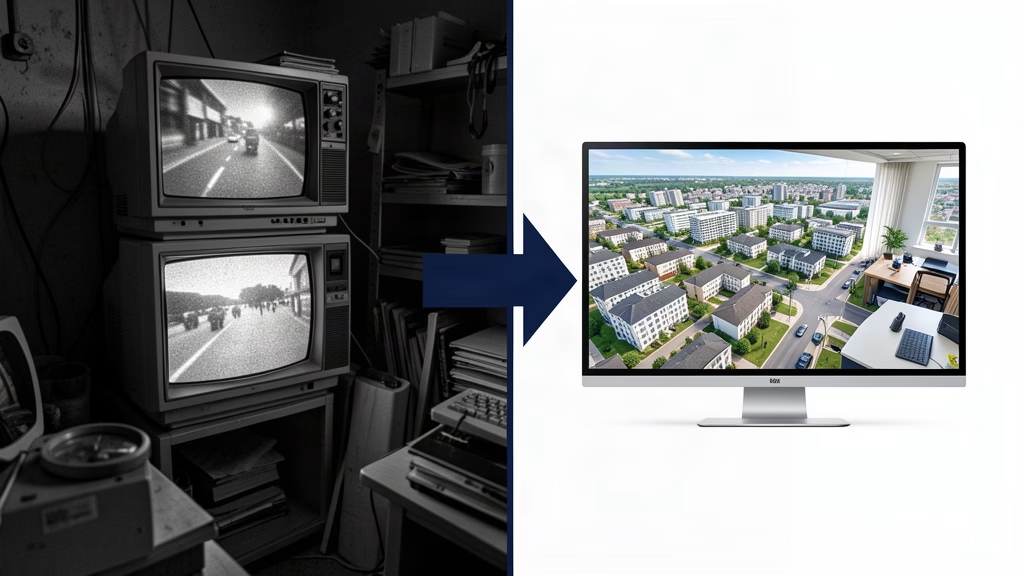
Most legacy systems in Bay County HOAs use analog cameras connected via coaxial cable. IP-based cameras transmit over standard network infrastructure, support higher resolution, and allow remote viewing from any authorized device. The upgrade from analog to IP is the single highest-impact decision. IP cameras produce footage clear enough to identify individuals and vehicle plates, which is the evidentiary standard most boards need for covenant enforcement and law enforcement coordination.
Storage and Retention Period
Florida associations should retain security footage long enough to cover the typical window for incident discovery and reporting. A 30-day retention minimum is common, but boards in high-traffic tourist areas like Panama City Beach may want 60 to 90 days to account for delayed complaints from seasonal visitors. Cloud-based storage eliminates the risk of on-site hardware failure destroying critical evidence.
Privacy Boundaries and Resident Notification
Security cameras in common areas must not capture private residential property in a way that creates a reasonable expectation of privacy violation. Boards should adopt a written camera policy that specifies camera locations, what is recorded, who has access, and how footage is used. Florida law does not require one-party consent for recording in public common areas, but governing documents may impose additional notice requirements. Documenting the policy protects the board from privacy-related disputes.
The Fiduciary Dimension: What Florida Statutes Require
Under Florida Statute 720.303, association boards have a fiduciary duty to maintain and protect common-area assets. A security camera system that fails to cover known vulnerability points — an unmonitored gate, a blind corner in a parking area, a pool entrance without coverage — represents a gap in that fiduciary duty. If an incident occurs in an area the board knew was uncovered, the association may face liability for negligence.
Florida Statute 718 (condominiums) and 720 (HOAs) both grant boards authority to install and maintain security equipment in common areas. However, the scope of that authority is defined by the governing documents. Before upgrading, the board should confirm that the declaration or CC&Rs authorize security infrastructure expenditures and that the budget process supports the capital outlay. For Bay County condominium associations under FS 718, reserve contributions may need to account for security system replacement cycles, particularly if the system qualifies as a common-area asset with a defined useful life.
FS 720 vs FS 718: Security Infrastructure Authority Comparison
| Aspect | FS 720 (HOAs) | FS 718 (Condominiums) |
|---|---|---|
| Board authority to install security equipment | Granted for common areas; scope defined by CC&Rs | Granted for common elements; declaration controls |
| Funding source | Operating budget or special assessment | Operating budget; reserve if classified as common element |
| Reserve study inclusion | Optional unless CC&Rs require it | Required if security system is a common element with replacement value |
| Resident notification | Governing docs control; best practice is written policy | Governing docs control; rule adoption process applies |
| Privacy limitations | No surveillance of private residential interiors | Same; unit interiors are private property |
Traditional Management vs Maxet’s Tech-Driven Approach
| Decision Area | Traditional Management | Maxet’s Tech-Driven Management |
|---|---|---|
| Coverage audit | Manual walk-through; verbal report | Digital coverage map with gap analysis and incident correlation |
| Vendor selection | Single quote; relationship-based | Competitive scoring matrix with technical specs and warranty terms |
| System monitoring | On-site DVR; physical retrieval needed | Cloud-based remote access with automated health alerts |
| Incident response | Footage review on request; hours or days later | Automated incident logging with timestamped export for law enforcement |
| Budget planning | Reactive; replacement when system fails | Reserve-scheduled replacement cycle with lifecycle cost projection |
A Step-by-Step Upgrade Roadmap for Bay County Boards
- Audit current coverage. Map every existing camera, its field of view, and its hardware condition. Identify blind spots at gates, parking areas, pool entrances, and perimeter walls.
- Define security priorities. Rank gaps by historical incident frequency and liability exposure. Bay County communities near tourist corridors should prioritize perimeter and gate coverage.
- Adopt a written camera policy. Specify what is recorded, retention period, access controls, and privacy boundaries. This protects the board and sets expectations for residents.
- Issue a competitive RFP. Require IP-based camera specs, cloud storage options, warranty terms, and integration with existing access control systems.
- Plan the budget. For FS 718 condos, determine whether the system should be added to the reserve study. For FS 720 HOAs, confirm CC&R authority for the capital expenditure.
- Phase the installation. Prioritize high-risk coverage gaps first. Install, test, and verify each zone before moving to the next phase.
- Document the turnover. Record system credentials, warranty registrations, maintenance schedules, and vendor contact information in the association’s digital records system.
Common Pitfalls Bay County Boards Should Avoid
One frequent mistake is purchasing cameras without a coverage audit — the board buys new hardware but installs it in the same locations as the old system, leaving the same blind spots. Another is failing to budget for ongoing costs: cloud storage subscriptions, annual maintenance, and camera replacement cycles add up. A third pitfall is selecting a vendor based on price alone without evaluating technical support, response times, or warranty coverage — a pattern Maxet addresses through structured vendor scoring that ties contract terms to measurable performance. Bay County communities should also be aware that Florida’s humid coastal environment degrades outdoor camera housings faster than inland installations, so marine-grade enclosures should be specified in the RFP.
Frequently Asked Questions
Can a Bay County HOA board install security cameras without a resident vote?
In most cases, yes. Both FS 720 and FS 718 grant boards authority to install security equipment in common areas as part of their duty to maintain and protect association property. However, the governing documents may require a member vote for capital expenditures above a certain threshold. The board should review the declaration and CC&Rs before committing funds.
How long should a Florida HOA retain security camera footage?
A 30-day retention period is the minimum best practice, but Bay County communities with significant seasonal visitor traffic should consider 60 to 90 days. The retention period should be documented in the written camera policy and communicated to residents.
Are Bay County HOAs required to include security cameras in their reserve study?
For condominium associations under FS 718, if the security system qualifies as a common element with a defined replacement cost and useful life, it should be included in the reserve study. For HOAs under FS 720, reserve study inclusion is optional unless the CC&Rs require it. Including it is a best practice either way, as it prevents the system from becoming a deferred maintenance item when replacement is needed.
What privacy restrictions apply to security cameras in Florida gated communities?
Cameras must not record areas where residents have a reasonable expectation of privacy, such as the interior of a home or a fenced private patio. Common areas, entrances, parking lots, and amenity perimeters are generally permissible. A written camera policy that documents camera locations, viewing angles, and data access protocols protects the board from privacy-related disputes.
Taking the Next Step
Security camera upgrades in Bay County gated communities are not just a technology purchase — they are a fiduciary decision that affects resident safety, liability exposure, and insurance positioning. A structured approach that starts with a coverage audit, follows a written policy, and uses competitive vendor scoring ensures the board can demonstrate diligence if the system is ever questioned. The technology handles the data synthesis — coverage mapping, incident logging, and automated health monitoring — while the manager provides the professional judgment and operational execution to keep the system aligned with the community’s governing documents and risk profile.
If your Bay County association is operating on a legacy camera system with known blind spots, the first step is a coverage audit. Contact Maxet to schedule a security infrastructure review tailored to your community’s specific perimeter, access points, and liability zones.
Boards evaluating their current provider can use Maxet’s Bay County HOA management standard as a benchmark for financial reporting, vendor oversight, and owner communication.
Legal disclaimer: Maxet is a professional community association management firm providing business operational efficiency and administrative support. We are not a law firm, and the information provided in this article does not constitute legal advice or create an attorney-client relationship. For specific legal interpretation of Florida Statutes or governing documents, we strongly recommend consulting with a licensed attorney specializing in Florida community association law.