
Short answer: A post-hurricane HOA recovery checklist for Panama City Beach associations should cover four phases: safety assessment and damage documentation, insurance claim activation, vendor coordination for emergency repairs, and financial recovery through reserve access and special assessment planning. Florida Statutes 718 and 720 grant boards emergency powers after a storm, but those powers must be exercised with documented board action, homeowner communication, and fiduciary oversight. Technology-driven recovery tools—digital damage tracking, automated insurance documentation, and vendor performance scoring—reduce the time from storm to restored by weeks.
Why Panama City Beach HOAs Need a Structured Hurricane Recovery Plan
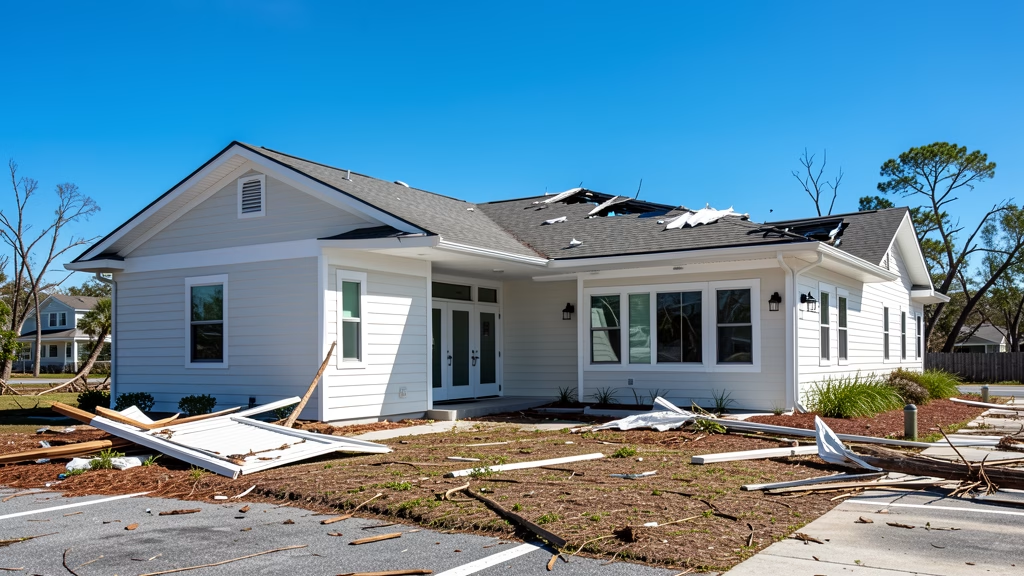
Hurricane Michael in 2018 was a wake-up call for Bay County. A Category 5 storm made landfall at Tyndall Air Force Base, causing catastrophic damage across Panama City, Panama City Beach, and Mexico Beach. More than 2,700 major structures were damaged. For community associations, the aftermath exposed how unprepared most boards were for the operational, financial, and legal realities of post-storm recovery.
Fast forward to 2026, and many Panama City Beach associations are still operating with the same recovery blind spots: no documented damage assessment protocol, no pre-negotiated vendor network, and no digital system for tracking insurance claims. When the next storm hits—and it will—boards without a structured recovery plan will lose weeks of response time, spend more on emergency repairs, and face higher exposure to fiduciary liability claims from unit owners.
This checklist is designed for board members, not property managers. It gives you the framework to demand from your management company—or to build yourself if your current provider cannot deliver. The difference between a board that recovers in 30 days and one that takes six months comes down to preparation, documentation, and technology.
Phase 1: Safety Assessment and Damage Documentation (First 72 Hours)

Immediate Safety Actions
- Confirm safe re-entry: Wait for official clearance from Bay County Emergency Management before allowing residents or staff to return. Do not rely on social media reports.
- Document common area damage: Photograph and video every common area—roofs, pools, clubhouses, fencing, landscaping, parking lots, storm drains. Use timestamped digital records, not paper notes. A mobile damage assessment app captures GPS-tagged photos that hold up in insurance claims.
- Secure the perimeter: Chain-link fencing, caution tape, or barriers around damaged areas. Board members have a fiduciary duty to prevent foreseeable injuries. An undocumented hazard becomes a liability claim.
- Activate emergency contact tree: Contact all unit owners to confirm safety. A digital owner portal with mass notification capability does this in minutes, not days.
Damage Documentation Protocol
The biggest mistake boards make is under-documenting storm damage. Insurance adjusters and FEMA representatives need evidence. Without it, claims get denied or underpaid.
A digital documentation system should capture:
- Wide-angle photos of each affected area before any cleanup begins
- Close-up photos of specific damage points (roof penetrations, cracked stucco, displaced screen enclosures)
- Video walkthroughs of common areas with narration noting pre-existing conditions vs. storm damage
- Written notes with date, time, weather conditions, and names of people present
- Duplicate copies stored in cloud-based association management software, not on a single phone or laptop
Phase 2: Insurance Claim Activation (Days 3–14)
Once damage is documented, the insurance claim clock starts. Most association master policies require notice within 30 days, but faster reporting gets faster response. Delays give insurers reason to question whether damage was storm-related or pre-existing.
Insurance Claim Checklist for Board Members
- Notify the master policy carrier immediately. Request a claim number and adjuster assignment in writing.
- Review your policy before the adjuster arrives. Know your deductible (often a named-storm percentage deductible, not a flat dollar amount), coverage limits, and exclusions. Coastal Florida policies frequently have wind-named-storm deductibles of 2–5% of the insured value.
- Prepare a damage summary document. Categorize by common area, estimated repair cost, and urgency. This is where digital damage tracking pays for itself—you hand the adjuster a structured report instead of a stack of photos.
- Track all claim communications. Every email, phone call, and adjuster visit should be logged with dates and outcomes. A claim management dashboard prevents the “he said, she said” problem that delays settlements.
- Understand the difference between association and owner responsibility. Florida condominium law (FS 718) places certain repair responsibilities on the association (common elements) and others on unit owners (interior, limited common elements). Misallocating repairs triggers liability. When in doubt, consult your governing documents and a Florida association attorney.
Phase 3: Vendor Coordination for Emergency Repairs (Weeks 1–4)
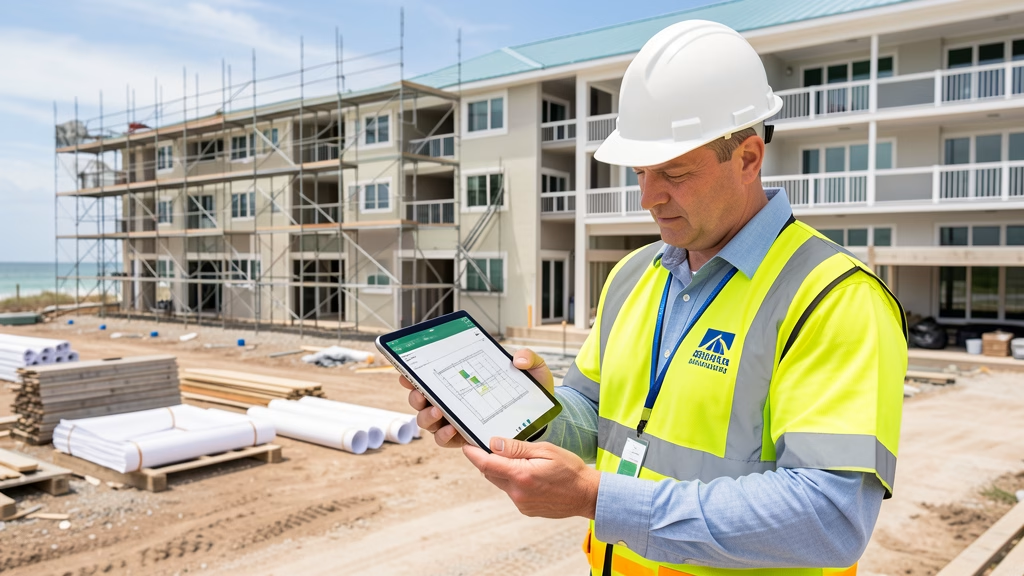
After a hurricane, every contractor in the Florida Panhandle is booked. Boards that wait until the storm hits to find vendors pay premium prices and get bottom-tier service. Boards with a pre-vetted vendor network and digital work order system recover faster and spend less.
Vendor Management Recovery Steps
- Activate pre-negotiated emergency contracts. Roofers, water extraction services, tree removal, and fencing contractors should be contracted before hurricane season, not after. These agreements lock in pricing and guarantee priority response.
- Issue digital work orders with scope and caps. Every repair should have a written scope of work, a not-to-exceed dollar amount, and a completion deadline. Verbal authorizations lead to cost overruns and board liability.
- Track vendor performance. Did the roofer show up when promised? Did the tree service complete the full scope or leave stumps? A vendor performance scoring system—rating on-time completion, quality, and communication—creates accountability and builds a data-driven vendor network for the next storm.
- Require lien waivers before payment. Florida construction lien law (FS 713) allows contractors and subcontractors to file liens against the property if they are not paid. Require partial lien waivers for each payment and a final lien waiver before releasing retainage. This protects the association from double-payment claims.
- Document all change orders in writing. Emergency repairs often expand in scope. Every change order should be approved by the board (or a designated officer under emergency authority) before work proceeds.
Phase 4: Financial Recovery and Reserve Access (Weeks 2–8)
Storm recovery is expensive. Even with insurance, deductibles and uncovered costs can run into tens of thousands of dollars for a mid-sized association. The financial recovery phase determines whether your board emerges stable or spirals into a budget crisis.
Financial Recovery Actions
- Assess reserve fund availability. FS 718.205 (condos) and FS 720.3033 (HOAs) both address reserve usage. Emergency repairs may qualify for reserve fund access, but the board must document the emergency declaration and follow the statutory process for reserve fund withdrawals. Using reserves without proper authorization is a fiduciary breach.
- Track all storm-related expenses separately. Create a dedicated cost center in your accounting system for hurricane recovery. This separates reimbursable insurance costs from association-funded costs and makes the claim reconciliation process manageable.
- Evaluate special assessment needs early. If insurance proceeds and reserves fall short, the board should assess the gap quickly rather than letting it compound. A transparent special assessment process—supported by documented cost estimates and reserve analysis—reduces homeowner pushback and liability exposure.
- Communicate financial status to owners. Post-storm financial transparency builds trust. A digital financial dashboard showing insurance claim status, recovery expenses, and reserve balances keeps owners informed and reduces speculation-driven complaints.
Emergency Powers Under Florida Law: What Boards Can and Cannot Do
Both FS 718.1265 (condominiums) and FS 720.316 (HOAs) grant boards emergency powers after a hurricane. These powers allow boards to act without a formal meeting, spend funds, and take protective actions—but they are not unlimited.
What Emergency Powers Allow
- Board members or committee members to meet via electronic communication (telephone, video conference) without notice requirements
- Expenditure of funds for emergency repairs without prior owner approval
- Entry into units to assess damage or prevent further damage to common elements or other units
- Temporary suspension of certain covenant enforcement (e.g., debris in yards, storm shutters remaining up)
What Emergency Powers Do NOT Allow
- Waiving assessments—owners still owe dues regardless of storm impact
- Permanent changes to governing documents without owner vote
- Spending beyond what is reasonably necessary for the emergency—boards must document the basis for each expenditure
- Skipping financial reporting—emergency powers do not eliminate fiduciary accountability
Emergency powers expire when the emergency ends. Boards should document when the emergency is declared and when it is lifted, with board ratification of all emergency actions at the next regular meeting.
Traditional Post-Storm Recovery vs. Technology-Driven Recovery
| Aspect | Traditional Recovery | Tech-Driven Recovery |
|---|---|---|
| Damage Assessment | Paper checklists, phone photos on personal devices | GPS-tagged digital photos, cloud-stored, structured by area |
| Insurance Claims | Email chains, lost documents, manual status tracking | Claim management dashboard, document versioning, adjuster access portal |
| Vendor Coordination | Phone calls, sticky notes, no performance tracking | Digital work orders, vendor scoring, automated completion tracking |
| Owner Communication | Mailers, bulletin board posts, word of mouth | Mass notification system, real-time status portal, mobile alerts |
| Financial Tracking | Spreadsheet, manual reconciliation, delayed reporting | Dedicated cost center, real-time expense tracking, reserve impact modeling |
| Recovery Timeline | 4–6 months typical | 4–6 weeks with structured execution |
FS 718 vs FS 720: Hurricane Recovery Comparison
| Provision | FS 718 (Condominiums) | FS 720 (HOAs) |
|---|---|---|
| Emergency Powers | FS 718.1265 — broad emergency authority after hurricane | FS 720.316 — similar emergency powers for property damage |
| Reserve Access | FS 718.205 — reserve funds for deferred maintenance, emergency repairs with board approval | FS 720.3033 — reserve accounts, board must follow statutory withdrawal process |
| Insurance Requirements | FS 718.111(11) — mandatory property insurance, adequate coverage | FS 720.3033(3) — may require insurance per governing documents |
| Board Liability | FS 718.111(1)(d) — directors must discharge duties in good faith | FS 720.303 — directors owe fiduciary duty to members |
| Owner Notification | Must notify unit owners of board actions; emergency powers have limits | Must notify members; emergency actions ratified at next meeting |
Frequently Asked Questions
Can an HOA board waive assessments after a hurricane?
No. Florida law does not give boards authority to waive assessments, even after a hurricane. Owners remain responsible for dues regardless of storm damage. Boards may consider payment plans for owners experiencing hardship, but the financial obligation does not disappear. Waiving assessments without a lawful basis is a fiduciary breach that exposes individual board members to personal liability.
How soon after a hurricane should the board file an insurance claim?
Immediately. Most master policies require notice within 30 days, but waiting risks denial or reduced payment. Contact your carrier the day safe access is restored. Document all damage before cleanup begins, and request a claim number in writing. The faster you file, the faster an adjuster is assigned and the claim process begins.
Can a board enter a unit owner’s property after a storm without permission?
Under emergency powers (FS 718.1265 for condos, FS 720.316 for HOAs), boards may enter units to assess damage or prevent further damage to common elements or other units. However, this authority is limited to the emergency period and should be exercised with documented justification. Boards should attempt to contact the owner first, document the reason for entry, and restore the unit to its pre-entry condition. If the owner refuses entry and there is no immediate threat, consult a Florida association attorney before forcing access.
What should a board do if the management company cannot respond after a hurricane?
This is a critical failure point. If your management company cannot mobilize within 48 hours of safe access being restored, the board should activate its own recovery plan independently. This is exactly why a documented checklist, pre-negotiated vendor network, and digital recovery tools are essential. A board that depends entirely on its management company for post-storm response is one phone call away from a recovery crisis. If this happens, document the failure—it may be grounds for contract termination and transition to a management company with demonstrated disaster recovery capability.
The Maxet Approach: Technology-Driven Hurricane Recovery
Hurricane recovery is where technology-driven management proves its value. While traditional management companies rely on phone trees, paper damage reports, and handwritten work orders, Maxet’s approach uses digital systems at every phase of the recovery process.
Our digital damage assessment tools capture GPS-tagged photos and structured damage reports that feed directly into insurance claim packages. Our vendor management platform tracks work orders, completion status, and performance scoring—so you know which contractors delivered and which to drop before the next storm. Our financial tracking systems separate storm-related costs from operating expenses, making claim reconciliation and reserve reporting transparent and defensible.
The technology handles the data synthesis and documentation, while the management team provides the professional judgment, vendor relationships, and fiduciary oversight that boards need during a crisis. This human-in-the-loop approach ensures that statutory requirements are met, board decisions are documented, and homeowners receive clear communication throughout the recovery process.
If your Panama City Beach association is heading into peak hurricane season without a documented recovery plan, now is the time to fix that. Contact Maxet to discuss a hurricane recovery assessment for your association—before the next storm names itself.
Key Takeaways for Bay County Board Members
- Document everything before cleanup begins—digital, GPS-tagged, cloud-stored photos and videos are your insurance claim foundation
- File insurance claims within 48 hours of safe access; request claim numbers in writing
- Pre-negotiate vendor contracts before hurricane season; emergency pricing is 2-3x normal rates
- Follow statutory reserve withdrawal processes—using reserves without board authorization is a fiduciary breach
- Use emergency powers lawfully: document the emergency declaration, act within scope, ratify at the next meeting
- Invest in technology-driven recovery tools before the storm, not after
Legal disclaimer: Maxet is a professional community association management firm providing business operational efficiency and administrative support. We are not a law firm, and the information provided in this article does not constitute legal advice or create an attorney-client relationship. For specific legal interpretation of Florida Statutes or governing documents, we strongly recommend consulting with a licensed attorney specializing in Florida community association law.