
Short answer: Automated reserve study tracking uses digital tools to monitor reserve fund balances, compare actual contributions against the funding plan, and flag shortfalls before they become special assessments. For Bay County condominium and HOA boards, this technology transforms a once-a-year paper exercise into a continuous, auditable process that strengthens fiduciary oversight and reduces the risk of compliance violations under Florida Statutes 718 and 720.

Why Bay County Boards Need Automated Reserve Study Tracking
If your association’s reserve study lives in a three-ring binder that gets opened once a year at budget time, you’re operating the way most Northwest Florida boards did a decade ago. The problem isn’t laziness — it’s that manual tracking makes it nearly impossible to catch drift early. A reserve contribution that falls short by $2,000 in March doesn’t look urgent. By October, that gap has compounded across multiple line items, and suddenly the board is staring at a six-figure shortfall and reaching for a special assessment to cover it.
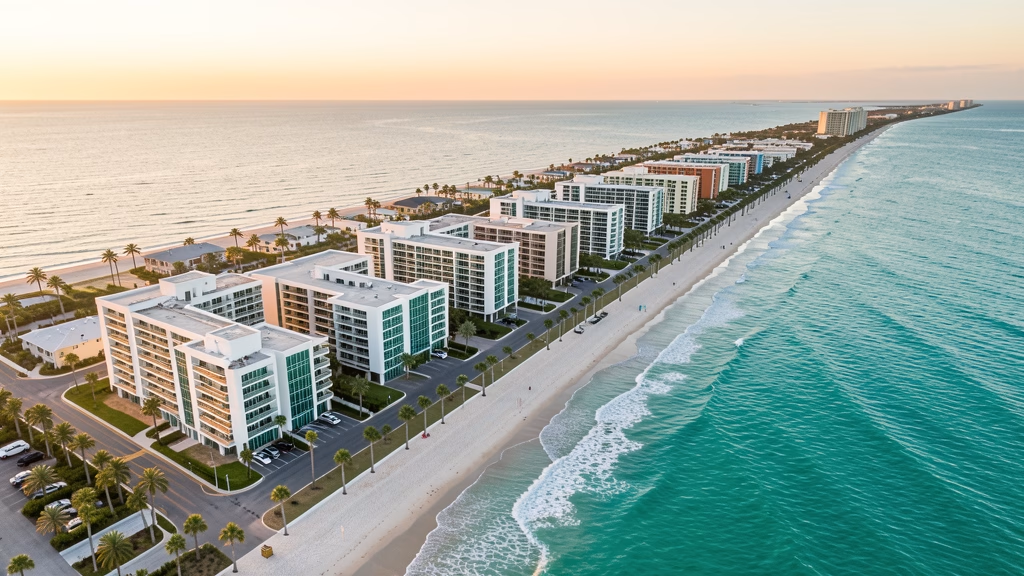
Bay County associations face a particularly steep curve. Coastal properties along Panama City Beach and the surrounding area deal with accelerated wear from salt air, hurricane exposure, and rising insurance premiums — all of which inflate replacement costs faster than a static reserve study predicts. SB 154 and the structural integrity requirements it introduced have made accurate reserve tracking not just a best practice but a statutory obligation for condominium associations. Boards that can demonstrate continuous monitoring are in a far stronger position than those scrambling to reconstruct their numbers retroactively.
What Manual Reserve Tracking Gets Wrong
Here’s what the traditional process looks like in most Bay County associations: the management company or a reserve specialist produces a study every three to five years. The board reviews it, adopts a funding plan, and then… nothing happens until the next study. In between, nobody is comparing the reserve account balance against the planned trajectory. Nobody is adjusting for inflation on replacement costs. Nobody is tracking whether the monthly contributions are actually landing in the reserve account or getting diverted to cover operating shortfalls.
The gaps that emerge from this approach are predictable:
- Contribution drift: Monthly reserve transfers get reduced or skipped during tight months, and the shortfall is never made up.
- Cost escalation blindness: The reserve study assumed a roof replacement at $80,000 in 2026 dollars; by the time the roof actually needs replacing, the cost is $115,000.
- No early-warning system: The board doesn’t see the funding gap until a major component fails and there isn’t enough money to cover it.
- Audit vulnerability: When a unit owner or the DBPR asks for reserve records, the board can’t produce a clean, month-over-month trail.
How Automated Reserve Study Tracking Works
Automated tracking replaces the binder with a living system. At its core, the technology does four things that a manual process simply cannot:
1. Continuous Balance Monitoring
Instead of checking the reserve account once a year, the system syncs with the association’s bank records and displays the current reserve balance alongside the planned balance from the study. If the actual balance drops below the projected trajectory, the board sees it immediately — not at the next annual meeting.
2. Component-Level Tracking
A reserve study breaks the association’s assets into components — roofs, elevators, pool equipment, paving, etc. Automated tracking keeps each component’s funding status visible individually, so the board can see that the roof reserve is on track while the elevator reserve is falling behind, rather than looking at a single aggregate number that hides the problem.
3. Inflation and Cost Adjustment
The system applies inflation indices to projected replacement costs on an ongoing basis, so the funding targets adjust upward as material and labor costs rise. This is particularly critical for Bay County, where post-hurricane construction costs can spike dramatically and a reserve study prepared in a normal year quickly becomes outdated.
4. Compliance Documentation
Every transaction, adjustment, and projection is logged with a timestamp and an audit trail. When the association needs to demonstrate reserve compliance to the DBPR, a lender, or a unit owner, the records are already compiled and exportable — no reconstruction required.

Traditional Management vs. Maxet’s Tech-Driven Reserve Tracking
| Aspect | Traditional Management | Maxet’s Tech-Driven Approach |
|---|---|---|
| Reserve study review frequency | Annual or once every 3–5 years | Continuous, with monthly variance reporting |
| Funding gap detection | Reactive — discovered at budget time or when a component fails | Proactive — flagged within 30 days of drift |
| Cost adjustment for inflation | Static until next study is commissioned | Dynamic, with quarterly inflation indexing |
| Component-level visibility | Aggregate balance only | Individual component tracking with drill-down |
| Compliance audit trail | Manual reconstruction from bank statements | Automated, timestamped, exportable on demand |
| Board reporting | Spreadsheet or PDF at annual meeting | Live dashboard accessible to board members 24/7 |
FS 718 vs FS 720: Reserve Requirements at a Glance
Bay County associations operate under different statutory frameworks depending on whether they are condominium associations (FS 718) or homeowners’ associations (FS 720). The reserve obligations differ meaningfully, and boards need to understand which requirements apply.
| Requirement | FS 718 (Condominiums) | FS 720 (HOAs) |
|---|---|---|
| Reserve study mandate | Required; SIRS for buildings 3+ stories | Not statutorily mandated, but strongly recommended |
| Reserve funding | Required per the funding plan; waivable only by majority vote | Reserves are optional unless governing documents require them |
| Milestone inspection link | Direct — SIRS tied to milestone inspection results | Not applicable |
| Reporting to unit owners | Annual reserve report required in budget package | Disclosure varies by governing documents |
| DBPR oversight | Direct regulatory authority | Limited; primarily contractual/civil |
For condominium associations in Panama City Beach and across Bay County, the SIRS (Structural Integrity Reserve Study) requirements under SB 154 make automated tracking less of a convenience and more of a compliance necessity. The board’s ability to demonstrate ongoing reserve monitoring directly affects its legal posture in the event of a structural issue or owner challenge.
What Bay County Boards Should Demand from a Reserve Tracking System
If you’re evaluating management firms or technology platforms for your association, here’s what a credible automated reserve tracking capability should include:
- Real-time bank integration: The system should sync with the association’s reserve accounts automatically, not rely on someone manually entering the balance each month.
- Component-level dashboards: You should be able to see the funding status of every reserve component individually, not just a single aggregate number.
- Variance alerts: The board should receive automated notifications when actual contributions deviate from the planned schedule by more than a defined threshold.
- Inflation-adjusted projections: The system should update replacement cost estimates quarterly based on current construction cost indices, not rely on the original study’s assumptions indefinitely.
- Audit-ready exports: A one-click export should produce a complete reserve transaction history with timestamps, suitable for DBPR review or lender submission.
- Board-level access: Directors should have direct, read-only access to the dashboard at any time — not just when the manager emails a spreadsheet.
Frequently Asked Questions
Is automated reserve study tracking required by Florida law?
Florida Statutes do not explicitly require automated tracking, but FS 718 condominium associations must maintain and report reserve adequacy annually, and SIRS requirements under SB 154 create a strong practical need for continuous monitoring. Boards that rely on manual tracking are more likely to miss funding drift and face compliance gaps that automated systems would have caught early.
How often should a Bay County association update its reserve study?
For condominium associations subject to SIRS, the study must be updated after each milestone inspection and at least every 10 years. However, best practice for coastal Bay County properties — which face accelerated component degradation — is to review and adjust the study every 3 to 5 years, with automated tracking filling the gaps between formal updates.
Can automated tracking prevent special assessments?
It can’t guarantee prevention, but it significantly reduces the likelihood. By identifying funding shortfalls early — sometimes months or years before a component fails — the board has time to adjust contributions gradually rather than being forced into a lump-sum special assessment. The goal is converting surprise crises into planned, manageable adjustments.
What does it cost to implement automated reserve tracking?
Costs vary by platform and association size, but the expense is typically modest compared to the cost of a single special assessment or the legal exposure of a reserve-related compliance failure. Many modern management platforms include reserve tracking as part of their core service, so the question is often whether your management firm has invested in the right technology rather than whether you need to purchase a separate tool.
Talk to Maxet About Your Reserve Tracking
If your Bay County association is still managing reserves with a spreadsheet and an annual review, you’re carrying more fiduciary risk than necessary. Maxet provides tech-driven reserve tracking as part of our community association management services, giving boards continuous visibility into funding status, automated variance alerts, and audit-ready documentation. Contact us to see how the system works and what your current reserve position looks like through that lens.
Legal disclaimer: Maxet is a professional community association management firm providing business operational efficiency and administrative support. We are not a law firm, and the information provided in this article does not constitute legal advice or create an attorney-client relationship. For specific legal interpretation of Florida Statutes or governing documents, we strongly recommend consulting with a licensed attorney specializing in Florida community association law.