Short answer: Bay County condominium boards must maintain accurate, compliant meeting minutes under Florida Statute 718 and their governing documents. A digital board meeting minutes compliance audit identifies gaps in motion documentation, fiduciary record-keeping, and open-meeting requirements before they become legal liability. Maxet’s tech-driven approach digitizes the entire audit trail, giving boards verifiable compliance records they can defend in any challenge.

Why Meeting Minutes Compliance Matters for Bay County Condo Boards
Board meeting minutes are the official record of every decision your association makes. In Bay County, where coastal condominium associations face heightened regulatory scrutiny under Florida Statute 718.111(12) and the post-SB 154 compliance environment, sloppy or incomplete minutes are more than an administrative annoyance. They are evidence. When a board cannot produce minutes showing proper notice, quorum, motion language, and roll-call votes, opposing counsel treats that absence as proof the action never properly occurred.
For condo board members in Panama City Beach and unincorporated Bay County, the risk is concrete. Unit owners can challenge assessments, election results, or contract approvals by pointing to minutes that fail to document the legal prerequisites. Insurance carriers and lenders increasingly request minutes as part of due diligence for building safety and financial health. A gap in your minute records can stall a refinance, trigger a coverage dispute, or surface during a fiduciary-breach claim against individual directors.
The traditional approach — handwritten notes passed to a volunteer secretary, typed into a Word document weeks later, filed in a binder nobody opens — does not survive that level of scrutiny. A digital compliance audit replaces that fragile paper chain with a verifiable, timestamped record that aligns each board action with the statutory requirement it satisfies.
What a Digital Meeting Minutes Compliance Audit Covers
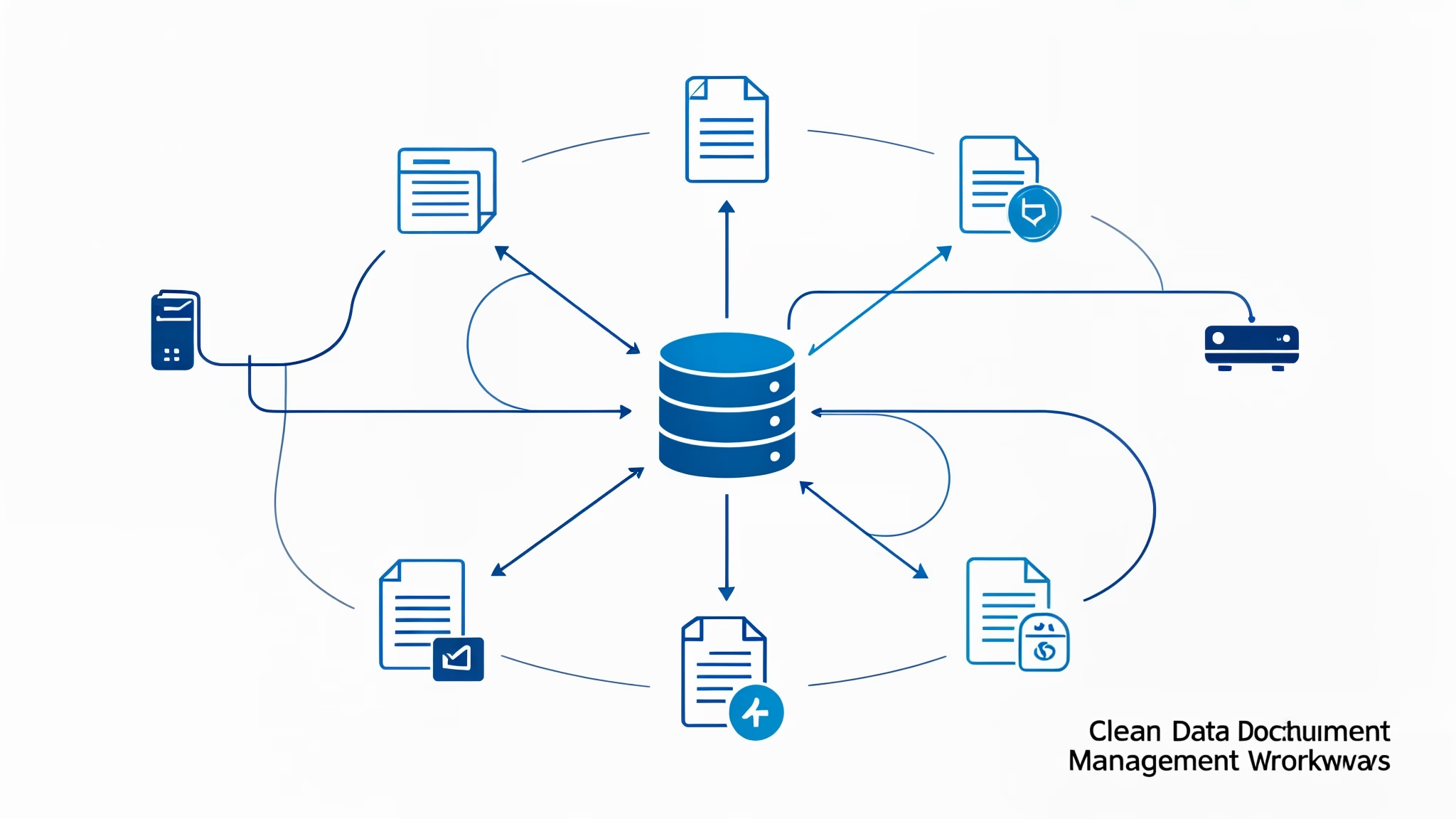
A thorough compliance audit examines three layers: statutory requirements, governing-document requirements, and operational best practices. The digital process accelerates all three by cross-referencing your minute records against a structured compliance framework rather than relying on manual review.
Statutory Requirements Under Florida Law
Florida Statute 718.111(12) requires associations to maintain minutes of all meetings of the board of administration and member meetings for at least 7 years. Florida Statute 718.112(2)(c) governs open-meeting requirements, including posting notice and the limited circumstances for executive sessions. For HOA boards operating under Florida Statute 720, parallel requirements exist under FS 720.303 for meeting notice and record-keeping.
The audit checks each set of minutes for:
- Proper notice documentation (date posted, location, agenda)
- Quorum confirmation
- Motion language and second recorded
- Roll-call or recorded vote results
- Executive session justification and documentation (if applicable)
- Financial decisions tied to reserve study and budget references
- Contract approvals with vendor identification
- Compliance with special assessment procedural requirements
Governing Document Alignment
Your declaration, articles of incorporation, and bylaws may impose stricter notice, voting, or documentation requirements than state statute. A compliance audit cross-references your minutes against these governing documents to identify where the board’s record falls short of its own rules. This is where most associations find gaps — boards often follow statutory minimums without realizing their bylaws require additional steps.
Operational Best Practices for Fiduciary Protection
Beyond legal minimums, the audit evaluates whether minutes document the fiduciary reasoning behind decisions. Did the board record that it reviewed competing bids before awarding a contract? Did minutes reflect that directors asked about reserve fund adequacy before approving the budget? This level of documentation protects individual directors from personal liability claims by showing they exercised informed business judgment.
Traditional Minutes Management vs. Maxet’s Tech-Driven Compliance Audit
| Aspect | Traditional Management | Maxet’s Tech-Driven Audit |
|---|---|---|
| Minute Creation | Handwritten notes, typed days later | Digital capture with structured templates at meeting time |
| Compliance Cross-Check | Manual review by manager, inconsistent | Automated cross-reference against FS 718, FS 720, and governing docs |
| Vote Documentation | “Motion passed” without roll call | Individual director votes recorded and timestamped |
| Record Retention | Physical binder, single copy | Cloud-based, 7-year minimum, version-controlled |
| Audit Readiness | Days of manual retrieval | Instant compliance report on demand |
| Fiduciary Documentation | Rarely documented | Decision rationale captured alongside each vote |
How Maxet Runs a Digital Minutes Compliance Audit for Bay County Boards
The audit follows a structured five-phase process designed to surface every compliance gap and close it with a permanent digital record.
Phase 1: Records Ingestion and Digitization
Maxet collects all existing meeting minutes — paper, PDF, Word files, email forwards — and ingests them into a centralized digital repository. Optical character recognition converts scanned documents into searchable text. The system indexes each record by date, meeting type, and governing-document reference.
Phase 2: Statutory Cross-Reference
Each minute entry is cross-referenced against the relevant Florida statute. For Bay County condominium associations, that means FS 718.111(12) for record-keeping, FS 718.112(2)(c) for open meetings, and any applicable Bay County ordinances or Panama City Beach municipal requirements. For HOAs, the framework maps to FS 720.303. The system flags any meeting where required documentation elements are missing.
Phase 3: Gap Analysis and Risk Scoring
The audit produces a risk-scored report. High-risk findings include missing minutes for meetings where financial decisions were made, missing vote records for special assessments, or executive sessions without documented justification. Medium-risk findings cover incomplete motion language or missing notice documentation. The board receives a prioritized remediation list.
Phase 4: Digital Remediation
Where minutes can be reconstructed from supplementary records (agendas, notices, email correspondence, financial statements), the system compiles a reconstructed record with a clear audit trail. Where reconstruction is impossible, the report flags the gap as a compliance risk requiring board acknowledgment and a corrective-action resolution.
Phase 5: Ongoing Compliance Framework
The audit is not a one-time event. Maxet implements a digital minute-taking framework with structured templates that enforce compliance at the point of creation. Every future meeting automatically generates minutes that include all statutory elements — notice confirmation, quorum, motions, votes, executive-session documentation — and files them to the cloud repository with version control.
The technology handles the data synthesis and compliance cross-referencing, while the board and manager provide the professional judgment and operational execution. This human-in-the-loop model ensures that statutory verification and fiduciary decisions remain with the people accountable for them.
The Bay County Compliance Context
Bay County condominium associations operate under a specific regulatory stack. Federal requirements (Fair Housing Act, ADA accessibility records) sit above Florida Statutes 718 and 720. Bay County ordinances and Panama City Beach municipal codes add local layers — particularly around short-term rental compliance and coastal construction documentation. Your governing documents sit below all of these and may impose stricter requirements.
Meeting minutes are where all these layers intersect. A decision to approve a roofing contract touches fiduciary duty (FS 718.111(1)), reserve fund adequacy (FS 718.112(2)(f)), milestone inspection obligations under SB 154, and your bylaws’ contract-approval threshold. If your minutes only say “roofing contract approved,” you have documented the outcome but not the compliance chain. A digital audit surfaces that gap before an attorney does.
Frequently Asked Questions
How long must Bay County condo associations keep board meeting minutes?
Florida Statute 718.111(12) requires condominium associations to maintain minutes of all board and member meetings for at least 7 years. The records must be available for inspection by unit owners. A digital compliance audit verifies that your minute archive meets this retention threshold and flags any gaps in the 7-year window.
Can a condo board hold a meeting without recording minutes?
No. Under Florida Statute 718.112(2)(c), board meetings must be open to unit owners (with limited exceptions for executive sessions), and minutes must be recorded and maintained. Failure to produce minutes for a meeting where board action was taken creates a rebuttable presumption that the action was not properly taken. A compliance audit identifies any meetings in your records where minutes are missing.
What happens if our meeting minutes do not show individual director votes?
Minutes that record only “motion passed” without naming how each director voted weaken the board’s position if a unit owner challenges the decision. While Florida law does not require roll-call votes for every motion, documenting them creates a clear fiduciary record and protects individual directors from claims that they supported an action they actually opposed. The digital audit framework enforces vote-by-vote recording by default.
Does a digital minutes audit replace our community association manager’s role?
No. The audit is a compliance verification tool, not a substitute for professional management. The technology handles the data synthesis — cross-referencing minutes against statutes, flagging gaps, generating reports. Your CAM and board provide the professional judgment: approving corrective actions, making fiduciary decisions, and ensuring the operational execution of board directives. Maxet’s model keeps a human in the loop for every consequential decision.
Take Action: Audit Your Minutes Before Someone Else Does
Bay County condo boards that wait for a unit-owner challenge, an insurance audit, or a lender due-diligence request to discover gaps in their meeting minutes are operating without a safety net. A digital compliance audit gives you the same verifiable record your opponents would demand in litigation — but on your terms, before a dispute forces the issue.
Maxet’s tech-driven approach turns your minute records from a dusty binder into a searchable, timestamped, statute-aligned compliance asset. The audit takes weeks, not months, and the ongoing framework ensures every future meeting automatically meets the standard.
Ready to audit your Bay County association’s meeting minutes compliance? Contact Maxet for a preliminary compliance assessment and see how digital record-keeping transforms your board’s fiduciary posture.
Boards evaluating their current provider can use Maxet’s Bay County condo association management standard as a benchmark for financial reporting, maintenance oversight, and owner communication.
Legal disclaimer: Maxet is a professional community association management firm providing business operational efficiency and administrative support. We are not a law firm, and the information provided in this article does not constitute legal advice or create an attorney-client relationship. For specific legal interpretation of Florida Statutes or governing documents, we strongly recommend consulting with a licensed attorney specializing in Florida community association law.