
Short answer: Bay County HOA boards must maintain at least 3 feet of clear access around every fire hydrant in common areas, coordinate hydrant placement with the local fire marshal and utility provider, and document annual compliance inspections. Failure to maintain hydrant access can result in municipal fines, delayed emergency response, and potential board liability for fiduciary negligence. A technology-driven inspection and documentation system eliminates the blind spots that plague traditional management.
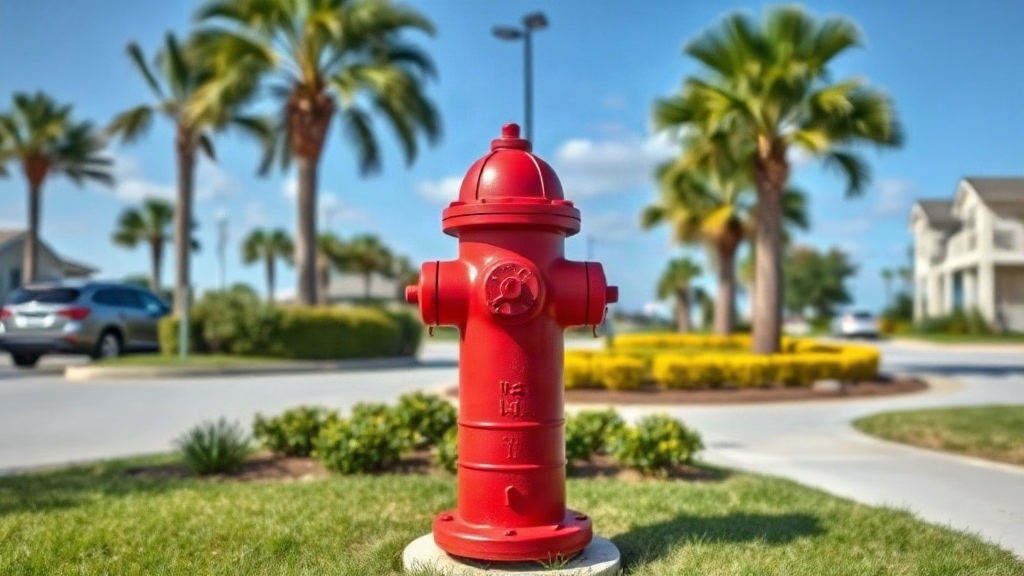
Why Fire Hydrant Access Is a Board-Level Responsibility in Bay County
Fire hydrant access compliance is not a landscaping issue — it is a fiduciary duty. When a Bay County HOA board allows vegetation, parked vehicles, fences, or debris to obstruct a fire hydrant, the community faces three simultaneous risks: municipal code enforcement penalties, elevated insurance exposure, and potential personal liability for board members who failed to act on a known safety hazard.
In Panama City Beach and unincorporated Bay County, fire marshals conduct periodic hydrant access inspections. A community found non-compliant may receive a correction notice with a 30-day remediation window, followed by escalating fines. More importantly, if a fire emergency occurs and the nearest hydrant is obstructed, the resulting property damage claim can name the association and its board directly.
Boards shopping for management firms should ask a direct question: How does your management company track, document, and enforce fire hydrant access compliance across all common areas? If the answer involves manual drive-by inspections with no digital record, the firm is operating at a standard of care that leaves the board exposed.
The Regulatory Framework: What Bay County Boards Must Know
Fire hydrant access in Bay County HOA communities sits at the intersection of four regulatory layers. Understanding this hierarchy helps boards distinguish between what is a municipal requirement, what is an association obligation, and where the two overlap.
1. Florida Fire Prevention Code (FFPC)
The Florida Fire Prevention Code adopts the NFPA 1 Uniform Fire Code, which requires a minimum 3-foot clear radius around all fire hydrants. This applies statewide, including all Bay County jurisdictions. The code prohibits vegetation, structures, parking, storage, or any obstruction within this zone.
2. Bay County Municipal Ordinances
Both Panama City Beach and the City of Panama City maintain municipal fire codes that adopt and sometimes exceed the FFPC minimum. Panama City Beach enforces hydrant access through its fire marshal’s office, which can issue correction notices and assess fines against property owners — including HOAs — for non-compliance. Unincorporated Bay County relies on the Bay County Fire Marshal for enforcement.
3. Florida Statutes 718 and 720
Under FS 718.111(12) (condominiums) and FS 720.303 (HOAs), associations have a fiduciary obligation to maintain common areas in a safe and compliant condition. Fire hydrant access falls squarely within this duty. A board that knows — or should know — that hydrants are obstructed and fails to act may be found in breach of fiduciary duty. FS 720.3033 imposes officer certification requirements, and a documented failure to address known safety hazards creates direct exposure.
4. Association Governing Documents
Most Bay County HOA declarations assign common area maintenance responsibility to the association, including fire protection infrastructure. CC&Rs typically require the board to maintain all common elements in compliance with applicable codes. If your governing documents delegate hydrant maintenance to the association but the board has never conducted a formal access audit, that gap is a fiduciary risk.

The Common Failure Points in Bay County HOA Communities
After reviewing hydrant access issues across Northwest Florida communities, five failure patterns emerge consistently. Boards evaluating their current management should check for each of these.
Vegetation Encroachment
Landscaping crews maintain shrubs, hedges, and ground cover near hydrants as part of their regular route. Without explicit instructions to trim back the 3-foot radius, vegetation grows back within weeks. Traditional management companies rarely include hydrant clearance in their landscaping scope of work, leaving the responsibility unowned.
Parked Vehicle Obstruction
In communities with tight parking — common in Bay County’s older townhome developments — residents and guests routinely park adjacent to hydrants. Without enforcement of parking restrictions near hydrants (typically 15 feet on either side per Florida law), the hydrant becomes inaccessible during an emergency.
Signage and Visibility
Blue reflective road markers (called “fire hydrant locators”) are required by many Bay County jurisdictions to help firefighters locate hydrants at night or in smoke. If markers are missing, faded, or displaced, the fire department loses critical seconds locating the water source.
No Inspection Documentation
The most systemic failure is the absence of a documented inspection trail. Many management companies perform visual checks during drive-bys but create no dated, photographic record. When a fire marshal requests proof of compliance, the board has nothing to produce. A board’s fiduciary defense in a liability claim depends on documentation — not just on having done the work.
Utility Coordination Gaps
Fire hydrants in Bay County are typically owned and maintained by the local water utility (Florida Governmental Utility Authority or a municipal provider). However, the association is responsible for maintaining clear access to the hydrant, even though the utility owns the device itself. This split responsibility creates confusion about who handles what — and the gap falls on the board.
Traditional Management vs. Maxet’s Tech-Driven Management
The difference between a legacy management approach and a technology-driven standard is measurable when it comes to fire hydrant compliance.
| Responsibility | Traditional Management | Maxet’s Tech-Driven Management |
|---|---|---|
| Hydrant Access Inspection | Drive-by visual check, no record | GPS-tagged photo inspection with timestamp |
| Vegetation Trimming | Ad hoc, not in landscaping scope | Hydrant radius explicitly scoped in vendor contract |
| Parking Enforcement | Manual complaint-driven | Digital violation tracking with photo evidence |
| Utility Coordination | Phone calls, no audit trail | Shared digital log with utility work orders |
| Fire Marshal Response | Paper file in a binder | Digital compliance dashboard available on request |
| Board Reporting | Verbal at annual meeting | Automated monthly compliance summary |
FS 720 vs. FS 718: Fire Safety Obligations Comparison
| Obligation | FS 720 (HOA) | FS 718 (Condominium) |
|---|---|---|
| Common area safety maintenance | FS 720.303(1) — fiduciary duty | FS 718.111(12) — fiduciary duty |
| Officer certification | FS 720.3033 — certified officers | FS 718.112(2)(a) — director qualifications |
| Recordkeeping | FS 720.303(4) — 7-year retention | FS 718.111(12) — accounting records |
| Insurance requirements | FS 720.303(3) — D&O coverage | FS 718.111(11) — fidelity bond + D&O |
| Fire code compliance | Both: Association must comply with applicable municipal and state fire codes for common areas | Both: Association must comply with applicable municipal and state fire codes for common elements |
The Technology Layer: How Digital Systems Close the Compliance Gap
Fire hydrant access compliance is fundamentally a data problem disguised as a maintenance issue. The technology handles the data synthesis — scheduling inspections, tagging GPS coordinates, flagging violations, generating work orders — while the manager provides the professional judgment and operational execution to resolve the flagged issues and coordinate with the utility and fire marshal.
GPS-Tagged Inspection Routes
A digital inspection app creates a route covering every hydrant in the community. Each inspection captures a timestamped, GPS-tagged photo of the hydrant and its 3-foot radius. If vegetation, a parked car, or a structural obstruction is detected, the system generates a work order automatically — routed to landscaping, towing, or maintenance depending on the violation type.
Automated Vendor Scoping
Landscaping contracts should explicitly include hydrant radius maintenance as a scoped line item, not a general “mowing and trimming” catch-all. A technology-driven management system embeds this scope in the vendor contract and tracks compliance against it — generating alerts when the vendor misses a scheduled hydrant clearance pass.
Municipal Coordination Log
When the fire marshal issues a correction notice, the association needs a response within the remediation window. A digital coordination log tracks every interaction with the Bay County Fire Marshal’s office — the notice date, the required corrections, the work performed, and the re-inspection confirmation. This log serves as the board’s defense in any liability claim.
Board-Level Compliance Dashboard
Board members should not have to request a report to know whether their community’s hydrants are compliant. A real-time dashboard shows the status of every hydrant: cleared, flagged, or overdue. This shifts the board from reactive crisis management to proactive oversight — the standard of care that fiduciary duty demands.
Bay County Jurisdictional Nuances
Fire hydrant access enforcement varies by jurisdiction within Bay County. Boards should understand which authority governs their community.
Panama City Beach
The Panama City Beach Fire Department enforces fire code compliance through its fire marshal’s office. Hydrants in PCB communities are typically maintained by the PCB water utility. The fire marshal has authority to issue correction notices and assess fines for obstructed hydrants. Beachfront condominium associations should verify that hydrant access extends to all beach-access pathways where hydrants are located.
City of Panama City
The Panama City Fire Department provides fire marshal services within city limits. Hydrant maintenance is handled by the city’s water utility. Boards of associations within Panama City limits should coordinate directly with the city fire marshal for annual compliance verification.
Unincorporated Bay County
Unincorporated Bay County communities fall under the Bay County Fire Marshal. Hydrant ownership and maintenance typically belong to FGUA or a private utility provider. Boards in unincorporated areas should confirm which utility owns their hydrants and establish a direct coordination contact for maintenance and access issues.
Walton County Service Area
For Maxet’s Walton County service area, hydrant access enforcement follows similar principles through the Walton County Fire Marshal’s office. Boards should verify utility ownership and establish the same documentation trail recommended for Bay County communities.
A Board Action Plan: 5 Steps to Hydrant Compliance
Boards evaluating their current management’s handling of fire hydrant compliance can use this checklist as a benchmark.
- Conduct a baseline audit. Walk or drive every common area and photograph each hydrant from four angles. Note any obstruction within 3 feet. This establishes the current compliance state.
- Verify utility ownership. Contact your water provider and confirm which hydrants they own and maintain versus any that are association-owned. Request their maintenance schedule.
- Scope hydrant clearance in vendor contracts. Add explicit language requiring the landscaping vendor to maintain a 3-foot clear radius around every hydrant on every service visit. Require photo documentation.
- Enforce parking restrictions. Verify that “no parking — fire hydrant” signage is present and visible. Coordinate with your towing partner for enforcement. Document all violations with photos.
- Schedule annual fire marshal coordination. Invite the local fire marshal or their designee for an annual walk-through. Document the visit and any corrective actions. This creates the inspection trail that defends the board in a liability claim.
Frequently Asked Questions
Who is responsible for maintaining fire hydrant access in a Bay County HOA?
The association is responsible for maintaining clear access to all hydrants in common areas, even though the hydrant itself is typically owned by the water utility. The board’s fiduciary duty under FS 720.303 requires the association to keep common areas safe and code-compliant, which includes hydrant access.
Can a board member be held personally liable for obstructed fire hydrants?
Yes. If the board knew or should have known about an obstructed hydrant and failed to act, a resulting property damage or injury claim can name individual directors. D&O insurance provides defense coverage, but a documented failure to address a known safety hazard can breach the standard of care that fiduciary duty demands. This is why documented inspections and corrective action trails are essential.
How often should a Bay County HOA inspect fire hydrant access?
At minimum, quarterly visual inspections with photo documentation. Monthly is preferable for communities with heavy landscaping growth or tight parking. The fire marshal typically conducts annual inspections, but the association should not rely solely on the marshal’s schedule — the board’s obligation is independent.
What is the penalty for obstructing a fire hydrant in Bay County?
Penalties vary by jurisdiction. Panama City Beach and the City of Panama City can issue correction notices with 30-day remediation deadlines, followed by escalating fines. In unincorporated Bay County, the fire marshal has similar enforcement authority. The greater financial risk is not the fine — it is the liability exposure if a fire occurs and the hydrant is inaccessible.
What Bay County Boards Should Demand From Their Management Company
If your current management company cannot produce a GPS-tagged, photo-documented inspection trail for every hydrant in your community, cannot show you the specific language in your landscaping vendor contract that scopes hydrant clearance, and cannot produce a coordination log with your local fire marshal — those gaps represent a standard of care below what Bay County boards should accept. Fire hydrant compliance is not a landscaping detail. It is a fiduciary obligation that technology-driven management can systematize and traditional management routinely overlooks.
Legal disclaimer: Maxet is a professional community association management firm providing business operational efficiency and administrative support. We are not a law firm, and the information provided in this article does not constitute legal advice or create an attorney-client relationship. For specific legal interpretation of Florida Statutes or governing documents, we strongly recommend consulting with a licensed attorney specializing in Florida community association law.