
Short answer: Digital vendor performance scoring lets Bay County HOA boards replace gut-feel vendor reviews with objective, trackable metrics — response time, work quality, contract compliance, and cost variance — all updated automatically through management software. Instead of waiting for a crisis to discover a landscaping contractor hasn’t met standards in months, boards see real-time dashboards that flag underperformance before it drains reserves or damages property values. This is fiduciary oversight modernized.

If your board is still evaluating vendors based on whether residents complained at the last meeting, you’re operating with the same oversight model associations used thirty years ago. Meanwhile, the vendors serving your community have gotten more sophisticated, your contracts have gotten more complex, and Florida’s statutory expectations for board fiduciary duty have only tightened. The gap between what boards should know about vendor performance and what they actually know is where money leaks out of your operating budget.
Digital vendor performance scoring closes that gap. It’s not about installing fancy software for its own sake. It’s about building a system where every vendor interaction — every work order, every inspection, every invoice — feeds into a score that tells your board, at a glance, whether you’re getting what you’re paying for.
What Vendor Performance Scoring Actually Means for HOA Boards
Vendor performance scoring is a structured system for rating how well your contracted service providers meet the standards defined in their contracts. Think of it as a report card, but instead of grades in English and Math, it tracks the metrics that matter to your association’s bottom line.
A typical scoring framework evaluates vendors across four or five weighted categories:
- Response Time: How quickly does the vendor acknowledge and address work orders? A landscaping company that takes five days to respond to a downed-tree issue after a Panama City Beach storm isn’t meeting the standard.
- Quality of Work: Does the completed work pass inspection? Are there repeat callbacks for the same issue? A pool maintenance vendor who leaves debris in the skimmer baskets week after week is failing quality.
- Contract Compliance: Is the vendor delivering the scope, frequency, and materials specified in the contract? A security patrol contracted for 12 hours per night that averages 9 is non-compliant.
- Cost Management: Are change orders and upcharges within reason? Does the vendor stay within agreed pricing, or does every invoice come with surprises?
- Communication & Documentation: Does the vendor submit reports, photos, and logs as required? Can your board produce documentation of vendor activity if an audit or litigation arises?
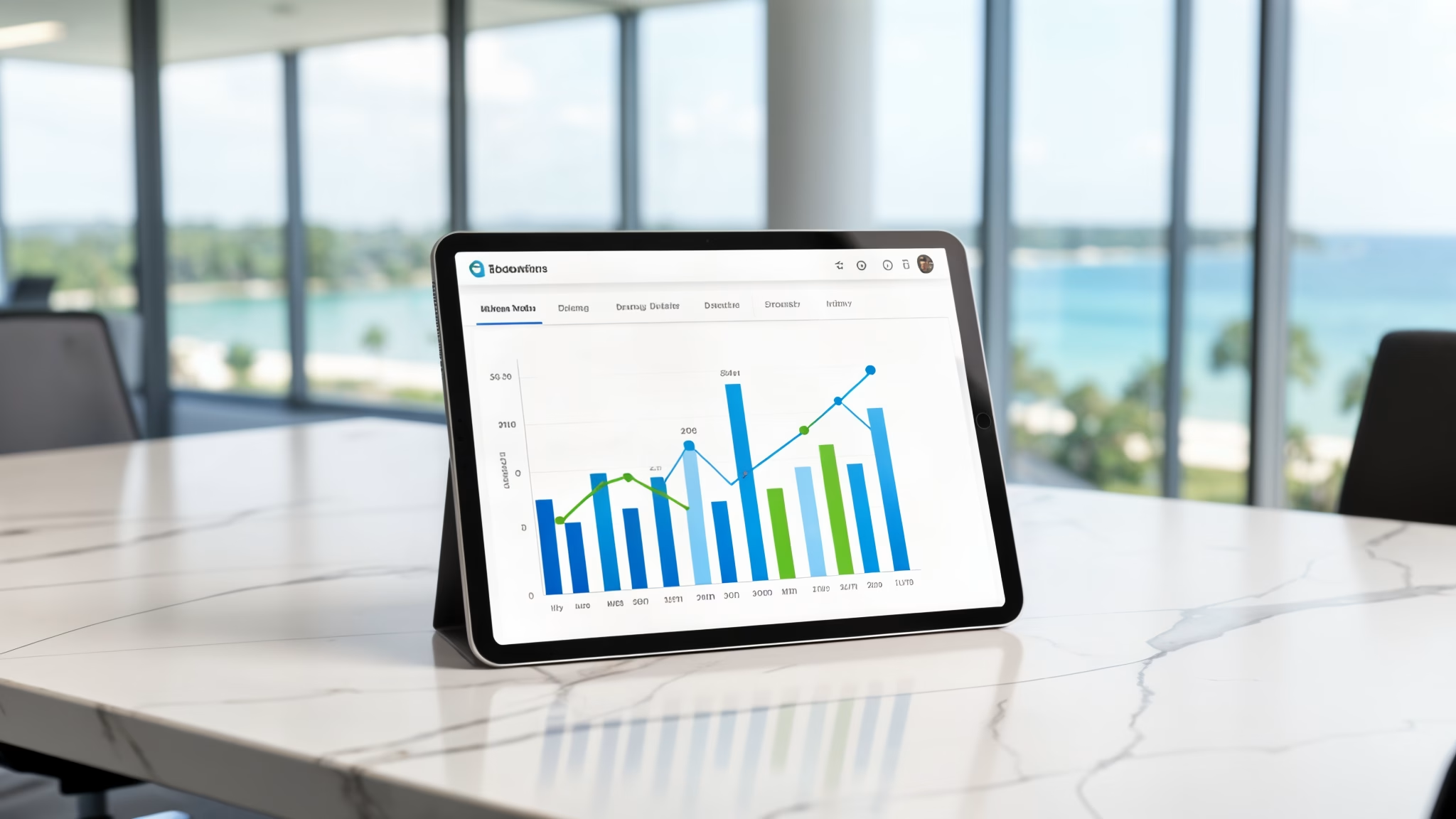
Each category gets a score — typically on a 1-5 or 1-10 scale — and the weighted average produces a composite score that rolls up to a dashboard your board reviews monthly or quarterly. The technology handles the data collection and synthesis, while the board provides the professional judgment on what the scores mean and what action to take.
Why Bay County Boards Need This Now
Bay County associations face a combination of pressures that make manual vendor oversight untenable:
Coastal Weather Cycles Drive Vendor Dependency
Panama City Beach and surrounding Bay County communities rely heavily on vendors for storm preparation, post-storm recovery, and ongoing maintenance of infrastructure exposed to salt air and hurricane risk. When a vendor underperforms in this environment, the consequences aren’t just aesthetic — they’re structural and financial. Deferred vendor response after a weather event accelerates asset deterioration and drives up future repair costs.
Fiduciary Duty Under Florida Statute 720 and 718
Both Chapter 720 (HOAs) and Chapter 718 (condominiums) impose fiduciary obligations on board members. Under Florida law, board members owe a duty of care that includes reasonable oversight of association funds — including vendor payments. A board that continues paying a vendor month after month without any documented performance evaluation is creating fiduciary exposure. If that vendor’s negligence leads to property damage or a special assessment, residents and their attorneys will ask what oversight the board exercised. “We didn’t have a system” is not a defensible answer.
Vendor Sprout After Hurricane Recovery
Post-hurricane Panama City Beach saw an influx of new vendors — some excellent, some opportunistic. Boards that had pre-existing vendor scoring systems could quickly separate reliable contractors from fly-by-night operators. Boards that didn’t found themselves locked into multi-year contracts with underperformers, paying premium rates for substandard work because they had no data to justify termination.
Traditional Vendor Oversight vs. Tech-Driven Performance Scoring
| Dimension | Traditional Oversight | Tech-Driven Performance Scoring |
|---|---|---|
| Evaluation Trigger | Resident complaint or annual renewal | Continuous, data-fed scoring with monthly board review |
| Data Source | Anecdotes, memory, emails | Work orders, inspections, invoices, GPS logs, photo documentation |
| Termination Justification | “We’ve had issues” — difficult to defend legally | Documented score history with objective metrics — legally defensible |
| Cost Variance Tracking | Manual invoice comparison, often skipped | Automated flagging when invoices exceed contract pricing |
| Board Visibility | Manager’s verbal report at meetings | Real-time dashboard accessible to all board members |
| Fiduciary Protection | Minimal documentation trail | Complete audit trail of vendor performance decisions |
The difference isn’t just operational efficiency. It’s fiduciary protection. When a board can produce a twelve-month performance history showing a vendor’s scores declining from 4.2 to 2.1 across response time, quality, and compliance categories, that’s documentation. That’s a board exercising its duty of care. When a board says “we just weren’t happy with them,” that’s a target for litigation.
How to Implement Vendor Performance Scoring: A Board Roadmap

Step 1: Audit Existing Contracts and Extract Measurable Standards
Before you can score performance, you need to know what “good” looks like. Pull every active vendor contract and extract the specific, measurable obligations: service frequency, response time windows, material specifications, reporting requirements, and pricing terms. If your contracts are vague — “vendor will maintain landscaping in a professional manner” — that’s your first problem. A scoring system requires measurable standards. Work with your management company to amend contracts with specific performance criteria if needed.
Step 2: Define Scoring Categories and Weights
Not every category matters equally for every vendor. A landscaping vendor’s quality score might carry 40% weight, while a security patrol’s response time might carry 50%. Work with your CAM to establish category weights that reflect the risk profile of each vendor type. A sample framework for a Bay County landscaping vendor might look like: Response Time 20%, Quality 35%, Contract Compliance 25%, Cost Management 10%, Communication 10%.
Step 3: Select Technology That Automates Data Collection
The scoring system only works if data flows in without manual effort from board members. Modern community association management platforms — including the tools Maxet deploys for Bay County associations — can capture work order data, inspection results, and invoice variance automatically. The technology handles the data synthesis, while the manager provides the professional judgment and operational execution. Board members shouldn’t be manually entering scores into spreadsheets. If they are, the system will degrade into another task nobody has time for.
Step 4: Establish a Monthly Review Cadence
Scores that nobody reviews are worthless. Build vendor performance review into your monthly board agenda — not as a deep-dive on every vendor, but as a dashboard scan. Any vendor scoring below a defined threshold (say, 3.0 on a 5-point scale) triggers a formal review at the next meeting. This cadence creates accountability for the management company too: if scores aren’t being tracked, the board sees that immediately.
Step 5: Build a Corrective Action and Termination Protocol
Scoring without consequences is just noise. Define what happens when a vendor’s composite score drops below threshold for one month, two consecutive months, or three consecutive months. A typical escalation: first drop triggers a formal written notice; second triggers a board review with the vendor present; third triggers contract termination proceedings per the contract’s termination clause. Document each step. This protocol protects the board legally and gives the vendor a fair opportunity to correct.
The Fiduciary Case: Why This Protects Board Members Personally
Board members in Florida community associations serve as volunteers, but their fiduciary obligations are not voluntary. Under both FS 720 and FS 718, board members owe the association a duty of care and loyalty. That duty extends to how association funds are spent — including payments to vendors.
Consider a scenario that plays out regularly in Bay County: A community’s roofing vendor fails to properly maintain the clubhouse roof over two years. The roof leaks, causing interior damage. The association faces a $75,000 repair bill and a special assessment. Residents demand to know why the board didn’t catch the problem.
Without a vendor scoring system, the board’s answer is: “We relied on the manager to handle it.” With a scoring system, the board’s answer is: “Our monthly vendor performance dashboard showed the roofing vendor’s quality scores declining over six months. We issued a corrective action notice in month three. The vendor failed to improve. We initiated contract termination in month five and brought in a replacement. The damage occurred during the transition period, and we have documentation of every step we took.”
Which board would you rather be on? The first is exposed. The second is protected.
What Bay County Boards Should Demand From Their Management Company
If your current management company can’t provide vendor performance dashboards, can’t produce documented vendor score histories, and evaluates vendors the same way associations did in 1995, that’s a signal. The technology to do this exists today. The question isn’t whether your management company can implement it — it’s whether they will, or whether they’re comfortable with the old model where vendor oversight lives in the manager’s head and disappears when the manager changes companies.
Bay County boards should demand:
- Monthly vendor performance dashboards with composite scores per vendor, accessible to all board members through a secure portal.
- Automated work order tracking that captures response times, completion dates, and quality inspection results without manual data entry.
- Invoice variance flagging that alerts the board when a vendor charges above contract pricing.
- Documented corrective action protocols that the management company follows consistently, not ad hoc.
- An annual vendor review package that compiles each vendor’s full-year performance history for board decision-making at contract renewal time.
If your management company pushes back on any of these — “that’s not how we do things” or “the software is too expensive” — that tells you what you need to know about their commitment to fiduciary transparency.
Frequently Asked Questions
How much does digital vendor performance scoring cost to implement?
The scoring system is typically part of a modern community association management platform. If your management company already uses contemporary software, the vendor scoring module may be included or available as an add-on. The real question is the cost of not having it: continued overpayment for underperforming vendors, fiduciary exposure, and the financial impact of vendor failures discovered too late. For Bay County associations, the ROI typically materializes within the first budget cycle as underperforming vendors are identified and replaced.
Can a board terminate a vendor based on performance scores?
Yes, provided the termination follows the contract’s termination provisions and the scores are documented. Performance scores serve as objective evidence of vendor underperformance, which strengthens the board’s legal position. However, boards should review the specific termination clauses in each vendor contract and follow the notice and cure periods specified. A documented scoring history makes any termination more defensible than subjective dissatisfaction.
What if our management company says they already “monitor” vendors?
Ask to see the documentation. If “monitoring” means the manager mentally tracks vendor performance and reports verbally at board meetings, that’s not a system — it’s an opinion. Request a sample vendor performance report with objective metrics, trend data, and scoring history. If they can’t produce one, the monitoring isn’t happening at a level that protects the board’s fiduciary duty.
Does vendor performance scoring apply to both HOAs (FS 720) and condominiums (FS 718)?
Yes. Both statutes impose fiduciary duties on board members, and both types of associations contract with vendors for maintenance, repairs, and services. The scoring framework is the same regardless of association type. The difference lies in the specific vendor categories — condominiums typically have more vertical infrastructure vendors (elevators, fire systems, building envelope), while HOAs may have more horizontal infrastructure (landscaping, irrigation, amenities, gates). The scoring system adapts to whichever vendor categories your association uses.
Ready to Modernize Your Vendor Oversight?
If your Bay County association is ready to move beyond gut-feel vendor management, Maxet can help. We deploy digital vendor performance scoring as part of our standard management toolkit — not as an upsell, but as a baseline fiduciary safeguard. Every board we work with gets monthly vendor dashboards, automated performance tracking, and a documented corrective action protocol.
Contact Maxet today to schedule a vendor oversight assessment for your association. We’ll review your current contracts, evaluate your management company’s vendor tracking capabilities, and show you what data-driven vendor accountability looks like in practice.
Boards evaluating their current provider can use Maxet’s Bay County HOA management standard as a benchmark for financial reporting, vendor oversight, and owner communication.
Legal disclaimer: Maxet is a professional community association management firm providing business operational efficiency and administrative support. We are not a law firm, and the information provided in this article does not constitute legal advice or create an attorney-client relationship. For specific legal interpretation of Florida Statutes or governing documents, we strongly recommend consulting with a licensed attorney specializing in Florida community association law.