
Short answer: Amending your Bay County HOA’s declarations or bylaws requires a two-thirds vote of all voting interests under Florida Statute 720.306, followed by recording with the Bay County Clerk of the Circuit Court. The technology handles the vote tracking, member notification, and document management — while the board provides the professional judgment and statutory compliance oversight that makes the amendment legally enforceable.

Most Bay County association governing documents were drafted by developers a decade or more ago. Between HB 1203, new electronic voting statutes, mandatory website requirements, and the post-Surfside reform wave, those documents are almost certainly out of compliance with current Florida law. Boards that delay amendment updates risk enforceability challenges, fiduciary exposure, and operational friction that compounds every year.
For Bay County boards — whether in Panama City Beach, Panama City, Callaway, or unincorporated Bay County — the amendment process is not just a legal exercise. It is a governance modernization opportunity. The right technology platform can reduce a months-long, error-prone paper process into a streamlined, auditable workflow that gets amendments passed, recorded, and communicated with confidence.
Why Bay County Associations Need to Amend Their Governing Documents Now
If your community’s declarations and bylaws haven’t been updated since before 2024, they likely conflict with current Florida law in several areas. The Florida Legislature has passed significant reforms affecting HOA operations — from HB 1203’s new transparency and fining restrictions to updated electronic voting procedures under Chapter 718 and Chapter 720.
Here is what Bay County boards are facing when they operate under outdated documents:
- Unenforceable provisions: Bylaw clauses that conflict with current statutes are void — even if every owner voted to adopt them originally. Courts will not enforce provisions that violate Florida law, regardless of the community’s intent.
- Fiduciary exposure: Board members who continue operating under documents they know are noncompliant may face personal liability claims for breach of fiduciary duty. The standard of care requires boards to act on known compliance gaps.
- Operational friction: Outdated quorum thresholds, obsolete notice requirements, and pre-electronic-voting procedures slow every decision. Boards spend more time fighting process disputes than governing.
- Buyer and lender friction: Title companies and prospective buyers increasingly scrutinize governing documents during transactions. Inconsistent or outdated provisions can delay closings and reduce property marketability in Bay County communities.
The cost of inaction is not hypothetical. Bay County associations that delay amendment cycles face compounding compliance debt — each new statutory change that goes unaddressed makes the next amendment cycle larger, more expensive, and more disruptive.
The Florida Legal Framework: What Bay County Boards Must Know
Amending governing documents in Florida follows a specific legal hierarchy. Understanding where your bylaws and declarations sit in that hierarchy determines what you can change, how you must change it, and what vote threshold applies.
The Document Hierarchy
Florida community associations operate under a five-level document hierarchy. When documents conflict, the higher-level document prevails:
- Level 1 — Florida Statutes: The controlling legal authority. Any governing document provision that conflicts with Florida Statutes is unenforceable, regardless of member approval.
- Level 2 — Declaration / CC&Rs: The foundational document that creates the association and defines property use restrictions, assessment authority, and common area rights. Typically requires the highest vote threshold to amend.
- Level 3 — Articles of Incorporation: Filed with the Florida Division of Corporations. Defines the association’s corporate existence and purpose.
- Level 4 — Bylaws: Governs how the association operates — board composition, meetings, elections, officer roles, committees. The default amendment threshold is two-thirds of total voting interests.
- Level 5 — Rules & Regulations: Day-to-day operational rules (pool hours, parking, noise). Can be adopted by board vote alone — no member approval required.
The critical distinction for Bay County boards: bylaws govern how the association operates (procedures, officer roles, meeting rules). The declaration governs what owners can do with their property (architectural standards, use restrictions, assessment authority). Many boards confuse the two — and that confusion leads to wasted time and money amending the wrong document.
FS 720.306: The HOA Amendment Statute
For homeowner associations in Bay County, Florida Statute 720.306 controls the amendment process. Key requirements:
- Vote threshold: Unless the governing documents specify otherwise, any governing document may be amended by the affirmative vote of two-thirds of the total voting interests of the association. This is two-thirds of all voting interests — not just those present at a meeting.
- Quorum: Unless a lower number is provided in the bylaws, 30 percent of the total voting interests must be present (in person or by proxy) to constitute a quorum at a membership meeting.
- Recording: The amendment is not effective until recorded in the official public records of the county where the community is located. For Bay County associations, this means filing with the Bay County Clerk of the Circuit Court.
- Member notice: Within 30 days after recording, the association must provide copies of the amendment to all members. If the proposed amendment was provided to members before the vote and was not changed, the association may instead provide notice identifying the book and page number of the recorded amendment.
- Formatting: Amendments must use underline/strikethrough formatting — new language underlined, deleted language struck through. If the rewrite is extensive, a notation reading “Substantial rewording. See governing documents for current text” must precede the amendment.
FS 718.110 and 718.112: The Condominium Amendment Statutes
For Bay County condominium associations, the amendment process follows Florida Statute 718.110 (declaration amendments) and 718.112 (bylaws amendments). Key differences from HOA law:
- Declaration amendments: Unless the declaration provides otherwise, not less than two-thirds of the unit owners must approve an amendment to the declaration of condominium.
- Bylaws amendments: Under Section 718.112(h), bylaws may be amended by an affirmative vote of not less than two-thirds of the voting interests, unless the bylaws provide another approval threshold.
- Material alterations: Under Florida law, 75 percent of owners must approve material alterations to common elements unless the declaration specifies a different threshold.
FS 720 vs FS 718: Amendment Process Comparison
| Requirement | FS 720 (HOA) | FS 718 (Condominium) |
|---|---|---|
| Default amendment vote | 2/3 of total voting interests (720.306(1)(b)) | 2/3 of unit owners (718.110) / 2/3 of voting interests for bylaws (718.112(h)) |
| Default quorum | 30% of total voting interests (720.306(1)(a)) | Unless bylaws provide otherwise, a majority of voting interests |
| Recording requirement | Must be recorded with county clerk to be effective | Must be recorded with county clerk; certified per 718.110 |
| Member notice after recording | Within 30 days (720.306(1)(b)) | Within 30 days (718.110) |
| Electronic notice permitted | Yes, for owners who consented to electronic notice | Yes, under electronic voting statutes (718.128) |
| Material alteration threshold | Governing documents control (typically 2/3) | 75% unless declaration specifies otherwise |
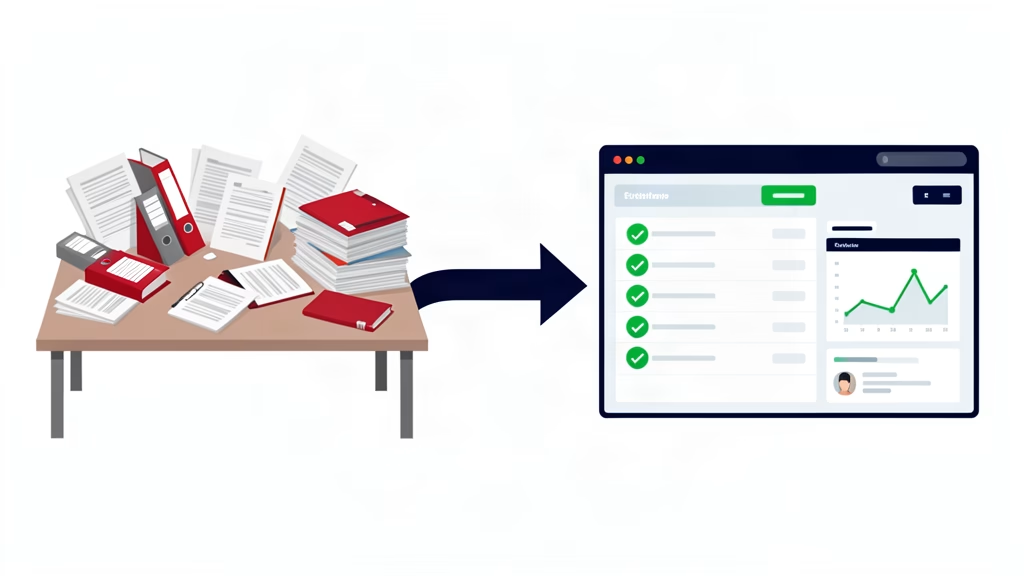
The Traditional Amendment Process vs. Maxet’s Tech-Driven Approach
Most Bay County associations approach bylaw amendments the same way they did twenty years ago: print copies, mail them, track responses in a spreadsheet, and hope the quorum holds. This manual process is slow, error-prone, and frequently produces amendments that fail on procedural challenges — not because the membership opposed the change, but because the process was not properly documented.
| Aspect | Traditional Management | Maxet’s Tech-Driven Management |
|---|---|---|
| Member notification | Printed letters mailed individually; tracking done manually in a spreadsheet | Automated digital notice delivery with read receipts and electronic consent tracking per FS 720.306(1)(b) |
| Vote tracking | Paper ballots counted by hand; proxy forms collected by email with no verification | Secure electronic voting with identity verification, audit trail, and real-time quorum monitoring |
| Quorum management | Discovered at the meeting that quorum was not met — wasting months of preparation | Live quorum dashboard showing participation rates; automated reminders to non-responsive owners |
| Document formatting | Underline/strikethrough done manually in Word; version control errors common | Version-controlled amendment drafting with automated formatting compliance and attorney review tracking |
| Recording and notice | Manual filing with Bay County Clerk; member notice sent weeks later | Recording coordination with Bay County Clerk of the Circuit Court; automated member notice within 30-day statutory window |
| Audit trail | Paper records in binders; affidavit of mailing filed but easily lost | Digital audit trail with timestamps, delivery confirmations, and vote verification stored in a secure member portal |
The technology handles the data synthesis — vote tracking, notification delivery, quorum monitoring, document versioning — while the board provides the professional judgment and operational execution that makes the amendment legally sound and aligned with the community’s interests.
The Bay County Amendment Roadmap: A Step-by-Step Guide
For Bay County boards preparing to amend their declarations or bylaws, here is the operational roadmap — grounded in Florida Statutes 720.306 and 718.110 — with technology integration at each step.
Step 1: Audit Your Current Governing Documents
Before drafting any amendment, conduct a thorough review of your existing declarations, bylaws, articles of incorporation, and rules against current Florida law. Flag every provision that conflicts with current statutes, is obsolete, or creates operational problems. Prioritize fixing illegal or unenforceable provisions first.
For Bay County associations, this audit should specifically check for: pre-2024 provisions that conflict with HB 1203, obsolete quorum thresholds above the 30 percent statutory default, missing electronic voting authorization, and any provisions that conflict with the post-Surfside safety reform requirements under SB 154.
Step 2: Engage Legal Counsel
Only a licensed Florida attorney should draft amendments to governing documents. The attorney ensures compliance with Chapter 720 or 718, checks for conflicts with the declaration, and formats the amendment correctly with the required underline/strikethrough formatting. For Bay County associations, this is not optional — a procedurally defective amendment has no legal effect regardless of the vote outcome.
Step 3: Build Member Buy-In Through a Committee
Create an ad hoc amendment committee to review the current bylaws, gather member input, and work with the attorney. Set a timeline. This builds community buy-in and makes the member vote easier to win — particularly important when you need two-thirds of all voting interests, not just those who attend a meeting.
Technology enables this step: a secure member portal lets the committee share proposed amendments, collect feedback, and track community sentiment before the formal vote. The technology handles the information distribution; the committee provides the judgment about what the community will support.
Step 4: Draft the Amendment with Proper Formatting
The attorney drafts the amendment with the specific formatting required by Section 720.306: new language underlined, deleted language struck through. If the rewrite is extensive, the notation “Substantial rewording. See governing documents for current text” must precede the amendment. Version-controlled drafting platforms prevent the formatting errors that have invalidated amendments in Florida courts.
Step 5: Board Vote to Present to Membership
The board reviews the attorney’s draft and votes to present it to the membership. This is not the member vote — it is the board’s decision to put the amendment on the ballot. Document the board vote in meeting minutes.
Step 6: Send Statutory Member Notice
Mail, deliver, or electronically transmit written notice to all members at least 14 days before the meeting. The notice must include the full text of proposed changes (with underline/strikethrough formatting), date/time/location of the meeting, voting procedures, and proxy forms. An affidavit of mailing must be filed in the official records.
This is where most amendments fail. A generic notice like “bylaw changes will be discussed” is legally insufficient. The full amendment text must be included. And 14 days means 14 days of receipt — not 14 days from mailing. Technology platforms automate this: digital notice delivery with read receipts, electronic consent tracking per FS 720.306(1)(b), and automated affidavit generation.
Step 7: Hold the Meeting and Conduct the Vote
Verify quorum (30 percent of total voting interests for HOAs under FS 720.306(1)(a), unless bylaws specify a lower number). Conduct the vote. Both general and limited proxies are valid for HOA votes. Document attendance, quorum verification, and vote tallies in the meeting minutes.
For Bay County condominium associations, the quorum and vote requirements follow FS 718.112 — check your specific declaration and bylaws for the applicable threshold, as condominium law provides more flexibility for governing documents to set different standards.
Step 8: Record with the Bay County Clerk
For Bay County associations, the amendment must be recorded with the Bay County Clerk of the Circuit Court. Recording fees are approximately $10 for the first page and $8.50 for each additional page. The amendment is not effective until recorded — an unrecorded amendment has no legal effect regardless of the vote outcome.
The Bay County Clerk’s office accepts recordings at the courthouse in Panama City. Electronic recording may be available through approved e-recording vendors, which technology platforms can coordinate.
Step 9: Notify Members Within 30 Days
Within 30 days after recording, provide copies of the amendment to all members. If the proposed amendment was provided before the vote and was not changed, the association may instead provide notice identifying the book and page number of the recorded amendment. Electronic notice is permitted for owners who previously consented to receive notice electronically.
Step 10: Update All Operational Systems
Once the amendment is recorded and noticed, update all operational systems to reflect the new provisions. This includes the association’s website or member portal (required for HOAs with 100+ parcels under FS 720.303(4) and condos with 25+ units under FS 718.111(12)(g)), governing document repositories, and board reference materials.

How Technology Resolves the Biggest Amendment Challenges for Bay County Boards
The amendment process fails most often not on substance but on process. Bay County boards that have struggled with amendments typically cite three recurring problems — each of which technology directly addresses.
Challenge 1: Quorum Failure
The most common reason amendments fail is that the membership meeting cannot achieve quorum. For an HOA with 200 homes, 30 percent quorum means 60 owners must participate — in person or by proxy. For a two-thirds vote threshold, 134 owners must vote yes. Getting 134 yes votes when only 60 show up is mathematically impossible.
Technology solves this through electronic voting under FS 718.128 (condos) and the electronic voting provisions available to HOAs under Chapter 720. Secure online voting platforms let owners vote from their phones, with identity verification and real-time quorum tracking. Automated reminders go to non-responsive owners. The technology handles the vote collection; the board provides the judgment about what to put before the membership.
Challenge 2: Notice Defects
Amendments have been invalidated in Florida courts because the member notice was deficient — even when the vote was overwhelmingly in favor. The notice must include the full text of the proposed amendment, not a summary. It must be delivered 14 days before the meeting. And an affidavit of mailing must be filed and preserved.
Digital notice platforms automate compliance: full-text delivery with read receipts, automated 14-day countdown tracking, and electronic affidavit generation that satisfies the official records requirement. Every step is timestamped and auditable.
Challenge 3: Version Control Errors
When multiple revisions circulate among board members, the attorney, and the amendment committee, version errors creep in. Owners vote on a draft that differs from what was recorded. The amendment fails because the voted text does not match the recorded text.
Version-controlled drafting platforms maintain a single source of truth. Every revision is tracked, dated, and attributable. The version that goes to the membership vote is the version that gets recorded — with an automated audit trail confirming the match.
The Sovereign AI Framework: Technology and Human Judgment in the Amendment Process
Maxet’s approach to governance modernization follows a clear principle: the technology handles the data synthesis, while the manager provides the professional judgment and operational execution. In the amendment context, that means:
- Technology handles: Member notification delivery and tracking, electronic vote collection and verification, quorum monitoring, document versioning, recording coordination, and audit trail generation.
- Human judgment handles: Legal interpretation of statute requirements, assessment of community sentiment, strategic decisions about amendment priorities, attorney selection and oversight, and fiduciary decisions about what changes serve the community’s long-term interests.
This is not artificial intelligence replacing professional judgment. It is a reasoning engine handling high-volume administrative synthesis — the kind of repetitive, error-prone work that consumes board meeting time and produces compliance risk when done manually. The board remains the fiduciary decision-maker. The technology is a tool that makes the board’s decisions faster, more transparent, and more defensible.
Frequently Asked Questions
How many votes does a Bay County HOA need to amend its bylaws?
Under Florida Statute 720.306(1)(b), the default threshold is two-thirds of the total voting interests of the association — not just two-thirds of those present at a meeting. Your governing documents may specify a different threshold, so always check your declaration and bylaws before starting the amendment process.
Does a bylaw amendment need to be recorded with the Bay County Clerk?
Yes. Under FS 720.306(1)(e), an amendment to a governing document is effective only when recorded in the public records of the county where the community is located. For Bay County associations, this means filing with the Bay County Clerk of the Circuit Court. An unrecorded amendment has no legal effect regardless of the vote outcome.
Can Bay County HOAs use electronic voting for bylaw amendments?
Yes. Florida law permits electronic voting for both HOAs and condominium associations. HOAs can adopt electronic voting procedures under Chapter 720, and condominium associations follow FS 718.128. The association must adopt procedures governing consent, authentication, and deadlines — and the electronic voting system must provide each owner with a method to verify their vote was counted.
What happens if an amendment passes the vote but is never recorded?
The amendment has no legal effect. Recording is a condition of enforceability under Florida law, not a formality. If your board passed an amendment vote but never recorded it with the Bay County Clerk, the amendment cannot be enforced — and the board may face fiduciary exposure for failing to complete the process.
Talk to Maxet About Your Amendment Project
If your Bay County association is operating under governing documents that have not been updated in years, the compliance risk grows every legislative session. Maxet’s tech-driven approach to governance modernization brings the amendment process into a single, auditable workflow — from document audit through member vote to recording and notice.
The technology handles the vote tracking, notification delivery, and document management. Your board provides the strategic direction and fiduciary judgment. The result is an amendment process that is faster, more transparent, and legally defensible — without the months-long disruption that manual processes impose on Bay County communities.
Ready to modernize your association’s governance documents? Contact Maxet to discuss how our tech-driven approach can help your Bay County board navigate the amendment process with confidence.
Legal disclaimer: Maxet is a professional community association management firm providing business operational efficiency and administrative support. We are not a law firm, and the information provided in this article does not constitute legal advice or create an attorney-client relationship. For specific legal interpretation of Florida Statutes or governing documents, we strongly recommend consulting with a licensed attorney specializing in Florida community association law.