
Short answer: Bay County HOA boards facing deteriorating streets and parking lots need a structured repaving project management approach that combines pavement condition assessment, competitive contractor bidding, and reserve fund alignment. Technology-driven project tracking replaces guesswork with documented cost comparisons, timeline accountability, and defensible fiduciary records — the standard of care boards should demand from any management company.

Why Street and Parking Lot Repaving Is a Board Fiduciary Issue in Bay County
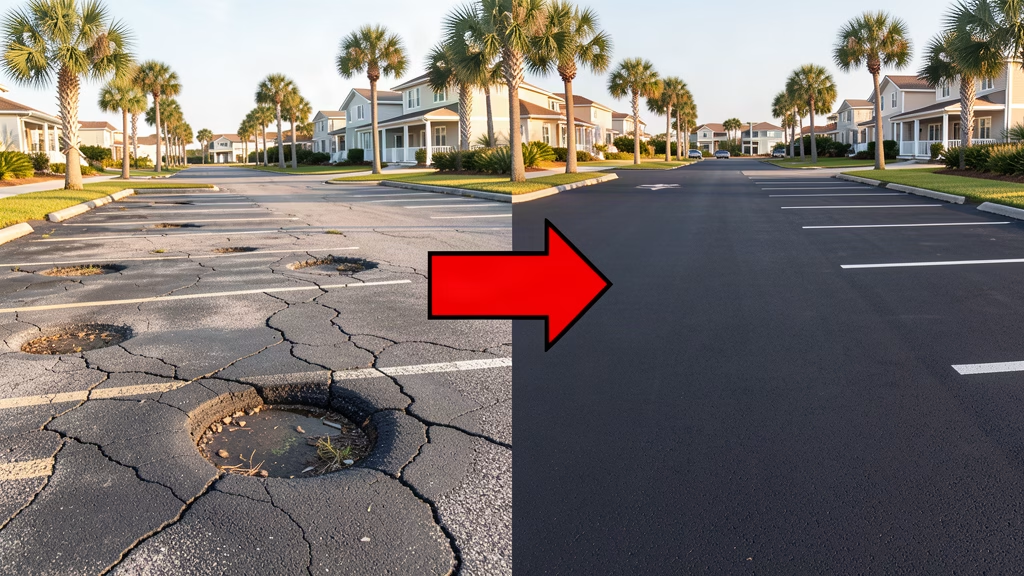
Bay County’s coastal climate is brutal on asphalt. Salt air, seasonal storms, and the freeze-thaw cycle of sudden temperature drops accelerate pavement deterioration across community roads, guest parking areas, and private drives. For HOA boards, ignoring cracked and fading pavement is not just a cosmetic problem — it is a fiduciary liability. Under Florida Statute 720.303, board members owe a fiduciary duty to the association, which includes maintaining common areas in a condition that protects property values and resident safety.
Deferred pavement maintenance compounds costs rapidly. A parking lot that could be crack-sealed for a few thousand dollars today becomes a full mill-and-overlay project at ten times the price within three to five years. Boards that lack a documented repaving plan — with condition assessments, cost projections, and reserve allocations — expose themselves to resident lawsuits, insurance claims from trip-and-fall incidents, and the political fallout of sudden special assessments.
What Bay County Boards Should Demand in a Repaving Project Plan
A repaving project is not a single phone call to a paving contractor. It is a multi-phase capital project that requires the same governance discipline as a roof replacement or a pool renovation. Boards should expect their management company to deliver:
- Pavement Condition Assessment: A documented inspection of all community streets and parking areas, noting crack patterns, rutting, drainage failures, and ADA compliance gaps. This assessment should be photographically recorded and dated.
- Scope-of-Work Definition: Clear specifications for each area — whether it needs crack sealing, patching, mill-and-overlay, or full reconstruction. Mixed conditions mean mixed treatments, not a blanket contract.
- Competitive Bid Process: At least three qualified contractors should submit written bids against the same scope of work. Bids should be compared on a unit-cost basis (per square yard, per linear foot of crack seal), not lump-sum totals.
- Reserve Fund Alignment: The repaving project must be funded from the association’s reserve account, not operating cash flow. If reserves are insufficient, the board needs a documented funding plan before committing to a contract.
- Contractor Performance Tracking: Milestone-based payment schedules tied to verified completion — not upfront deposits. Daily progress logs, material delivery tickets, and compaction test results should be collected and archived.
- Post-Project Documentation: Warranty information, as-built specifications, and a maintenance schedule (sweeping, crack sealing, seal coating) to protect the investment and extend pavement life.

How Technology Changes the Repaving Equation for Bay County Boards
Most HOA management companies handle repaving the same way they did in 2005: a contractor relationship, a phone call, and a lump-sum invoice. The result is predictable — boards approve projects they cannot independently verify, pay invoices they cannot cross-reference, and discover scope discrepancies months after the contractor has left the site.
Technology-driven project management replaces that opacity with a documented audit trail. The technology handles the data synthesis — consolidating contractor bids into side-by-side unit-cost comparisons, tracking milestone completion against the project timeline, and flagging budget variances in real time. The manager provides the professional judgment and operational execution — interpreting the data, negotiating scope adjustments, and ensuring the contractor meets the agreed specifications on the ground.
Digital Bid Comparison
Instead of three PDF bids sitting in an email folder, a tech-driven approach structures each bid into a standardized cost matrix. Boards see unit prices for asphalt tonnage, tack coat application, crack sealing, striping, and site cleanup — side by side. A contractor offering a lower lump sum but charging 40% more per ton for asphalt is exposed immediately. This is the kind of transparency that protects the board’s fiduciary position and builds resident trust.
Milestone-Based Payment Tracking
Pavement contractors should never receive full payment before the project is complete. A digital project tracker enforces milestone-based disbursement: 25% on mobilization, 25% on milling completion, 25% on paving completion, and 25% after final striping, cleanup, and a joint board-contractor walkthrough. Each milestone requires uploaded documentation — progress photos, material tickets, compaction test results — before the payment is authorized. This creates a defensible record that the board acted with diligence if any dispute arises.
Reserve Fund Integration
Repaving is a reserve-funded capital expense, not an operating budget line item. A tech-driven approach links the project cost directly to the reserve study schedule, showing the board exactly how the expenditure affects the reserve balance and whether the current funding level will support the next repaving cycle. If reserves are short, the system surfaces the gap before the contract is signed — not after the invoice arrives.
Traditional Management vs. Maxet’s Tech-Driven Repaving Management
| Aspect | Traditional Management | Maxet Tech-Driven Management |
|---|---|---|
| Bid Comparison | Lump-sum totals in separate PDFs; manual review | Standardized unit-cost matrix; side-by-side digital comparison |
| Payment Authorization | Upfront or progress payments based on contractor claims | Milestone-based disbursement with uploaded documentation required |
| Reserve Alignment | Reserve impact assessed manually, often after contract signing | Reserve fund integration surfaces funding gaps before commitment |
| Project Documentation | Paper invoices and phone logs stored in a filing cabinet | Digital archive with progress photos, material tickets, and compaction tests |
| Maintenance Planning | Next repaving cycle addressed when pavement visibly fails | Scheduled maintenance calendar (sweeping, crack sealing, seal coating) tied to reserve study |
| Fiduciary Defense | Difficult to prove board diligence if disputes arise | Complete audit trail demonstrates process and accountability |
FS 720 vs. FS 718: Which Statute Governs Your Repaving Project?
Bay County has both HOA-governed communities (FS 720) and condominium associations (FS 718). The statute that applies to your community determines the governance framework for capital projects, reserve requirements, and board authority. Understanding the distinction matters when planning a repaving project because the reserve and disclosure obligations differ.
| Aspect | FS 720 (HOA) | FS 718 (Condominium) |
|---|---|---|
| Reserve Study | Not mandatory; recommended by governing documents | Mandatory for condominiums; SIRS required for buildings 3+ stories |
| Common Area Maintenance | Board duty under governing documents and FS 720.303 | Board duty under FS 718.111 and 718.112 |
| Fiduciary Duty | FS 720.303(1): officers and directors owe fiduciary duty to members | FS 718.111(1): same fiduciary standard applies |
| Special Assessment | Governed by articles of incorporation; member notice required | FS 718.116: 14-day notice; specific disclosure requirements |
| Bid Transparency | Recommended but not statutorily mandated; check governing docs | Competitive bidding expected; document for fiduciary defense |
For Bay County HOA boards operating under FS 720, the reserve study is not statutorily mandated, but the fiduciary duty to maintain common areas and plan for major repairs absolutely is. A board that skips a documented repaving plan — relying instead on a contractor’s verbal estimate — has a weak defense if a resident challenges the expenditure or the process. For condominium boards under FS 718, the reserve obligations are stricter and the documentation expectations are higher.
The Bay County Repaving Recovery Roadmap
For boards that have deferred pavement maintenance and are now facing deteriorating streets and parking areas, the path forward should be structured as a recovery project, not a routine vendor call:
- Commission a pavement condition assessment. Hire an independent assessor (not the paving contractor) to document the current state of all community asphalt. This creates a baseline and prevents a contractor from overselling scope.
- Map the condition data to a priority matrix. Not every street needs repaving at once. Prioritize by safety risk, traffic volume, and cost escalation risk. A tech-driven approach surfaces this ranking automatically from the assessment data.
- Issue a standardized RFP to at least three contractors. Require unit-cost bids against a fixed scope. Reject lump-sum-only bids — they prevent meaningful comparison and protect the contractor, not the association.
- Align the selected project to the reserve fund. Confirm the reserve balance covers the contract before signing. If reserves are short, present the funding gap to the board with options (reserve adjustment, phased approach, or special assessment) before committing.
- Execute with milestone-based payments. Tie every payment to verified, documented completion. Collect material tickets, compaction tests, and progress photos. The technology handles the data synthesis, while the manager provides the professional judgment and operational execution.
- Close out with a maintenance plan. Schedule the next crack sealing, seal coating, and re-assessment cycle. File the warranty and as-built specifications in the digital project archive.
Frequently Asked Questions
How often should a Bay County HOA repave its streets and parking lots?
In the Florida coastal climate, asphalt typically lasts 15 to 20 years with proper maintenance. However, Bay County’s salt air and storm exposure can shorten that to 12 to 15 years. The key is intervening before full failure — crack sealing every 2 to 3 years, seal coating every 4 to 5 years, and a mill-and-overlay or full repaving when the pavement condition assessment indicates structural degradation. A tech-driven maintenance calendar tied to the reserve study ensures these interventions happen on schedule, not after visible failure.
Can a Bay County HOA board approve a repaving project without a competitive bid?
Under FS 720, competitive bidding is not statutorily mandated for HOAs, but the board’s fiduciary duty under FS 720.303 effectively requires a documented, defensible process. Approving a single-bid repaving contract exposes board members to personal liability if the cost is later challenged as unreasonable. Even when the governing documents do not require bidding, the standard of care does. A tech-driven bid comparison system provides the documentation that demonstrates the board acted with diligence.
What happens if the reserve fund cannot cover the repaving project?
If reserves are insufficient, the board must choose between deferring the project (which accelerates deterioration and increases future cost), phasing the work across multiple budget cycles, or levying a special assessment. Each option carries fiduciary and political implications. A tech-driven approach surfaces the funding gap before the contract is signed, giving the board time to evaluate options and communicate with residents — rather than discovering the shortfall when the invoice arrives.
How does technology improve contractor accountability during a repaving project?
Milestone-based payment tracking is the core mechanism. Instead of paying the contractor based on verbal progress reports, the board authorizes each payment only when documented evidence is uploaded and verified — progress photos, material delivery tickets, compaction test results. If a contractor disputes a payment hold, the documented audit trail shows exactly what was delivered and what was not. This shifts the leverage from the contractor to the board, where it belongs.
What Bay County Boards Should Do Next
If your community’s streets and parking lots are showing cracks, fading stripes, or drainage failures, the cost of waiting compounds every month. Commission a pavement condition assessment, demand a competitive bid process with unit-cost comparison, and ensure the project is reserve-aligned before signing a contract. The management company you hire should deliver digital project tracking, milestone-based payments, and a documented audit trail — not a phone call and a lump-sum invoice.
Maxet provides tech-driven community association management for Bay County boards that demand documented fiduciary standards. Contact Maxet to discuss your repaving project and learn how technology-driven project management protects your board and your community’s investment.
Related Maxet resources
For broader capital-project oversight, review Maxet’s Bay County HOA management approach and its association management services for vendor coordination, documentation, and board reporting.
Legal disclaimer: Maxet is a professional community association management firm providing business operational efficiency and administrative support. We are not a law firm, and the information provided in this article does not constitute legal advice or create an attorney-client relationship. For specific legal interpretation of Florida Statutes or governing documents, we strongly recommend consulting with a licensed attorney specializing in Florida community association law.