
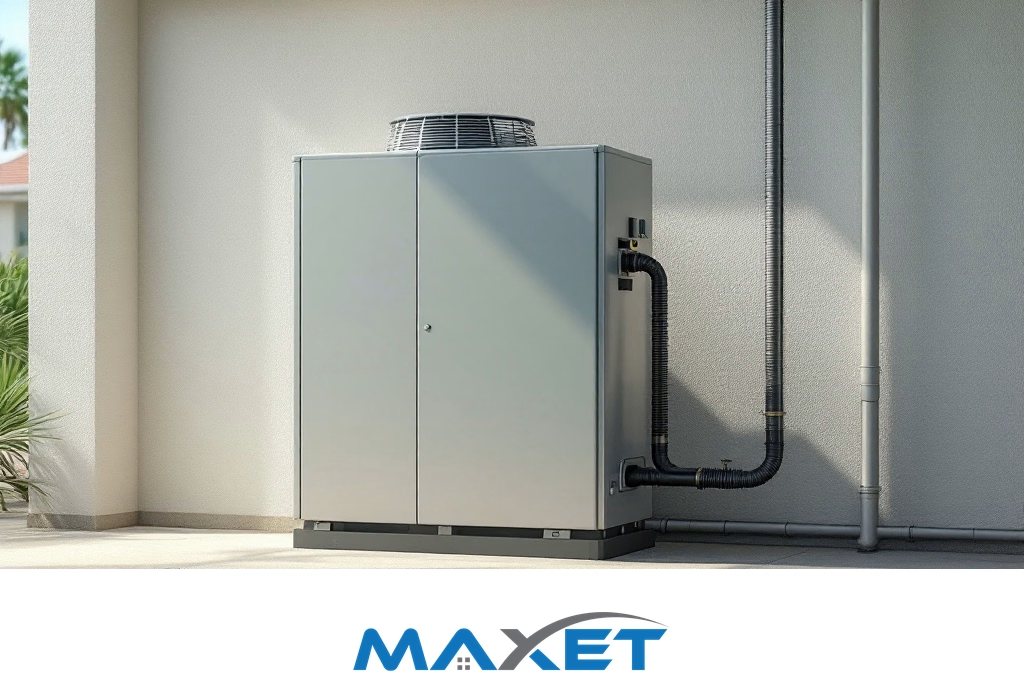
Short answer: Pool heater replacement is one of the largest energy-consuming capital decisions a Bay County HOA board will face. A modern high-efficiency heat pump or condensing gas heater can cut operating costs by 30 to 50 percent compared to a unit past its service life, and the savings can be structured to recover the installation cost within 3 to 5 years. Boards should treat heater replacement as a reserve-funded capital project with an energy payback analysis, not a reactive emergency repair.
Why Pool Heater Replacement Is a Board-Level Decision in Bay County
Community pools in Panama City Beach, Lynn Haven, and unincorporated Bay County operate seasonally from roughly April through October. Heating costs for a typical community pool can run $8,000 to $25,000 per season depending on heater type, pool volume, and target temperature. When a heater reaches the end of its service life — typically 7 to 10 years for gas-fired units and 10 to 15 years for heat pumps — the board faces a decision that affects reserve balances, monthly operating budgets, owner satisfaction, and energy exposure.
Too many Bay County associations replace failing heaters reactively: the heater breaks mid-season, the board approves an emergency replacement at a premium, and no one evaluates whether a different technology or size would lower long-term operating costs. A disciplined board treats heater replacement as a planned capital project with a documented energy efficiency and cost recovery analysis.
What Drives Pool Heating Costs for Bay County Associations
Three factors dominate community pool heating expenses in Northwest Florida:
- Heater type and efficiency. Conventional atmospheric gas heaters run 78 to 82 percent thermal efficiency. Condensing gas heaters reach 95 to 96 percent. Heat pumps deliver a coefficient of performance of 4.0 to 6.0, meaning each unit of electricity produces 4 to 6 units of heat. The efficiency gap between an aging conventional heater and a modern heat pump can translate to thousands of dollars per season.
- Pool volume and temperature target. A 100,000-gallon community pool heated to 84 degrees consumes substantially more energy than the same pool at 80 degrees. Boards should document the target temperature in the pool operating policy and verify it against actual usage patterns.
- Climate and wind exposure. Bay County coastal pools face wind-driven evaporation losses that increase heating demand. Pool covers, windbreaks, and proper equipment sizing mitigate this, but only if the board includes them in the replacement project scope.

Energy Efficiency Upgrade Options for Bay County Community Pools
When evaluating a heater replacement, Bay County boards should compare three primary technologies:
High-Efficiency Condensing Gas Heaters
Condensing gas heaters capture heat from exhaust gases that conventional units vent outside. At 95 to 96 percent thermal efficiency, they waste roughly 4 percent of fuel input compared to 18 to 22 percent for older units. For a pool spending $15,000 per season on natural gas or propane, the efficiency gain alone can save $2,500 to $3,500 annually. Condensing heaters cost 20 to 40 percent more upfront than conventional units, but the payback typically falls within 2 to 3 heating seasons.
Air-Source Heat Pumps
Heat pumps extract ambient heat from the air and transfer it to the pool water. In Bay County mild climate, heat pumps operate efficiently through most of the swimming season. A properly sized heat pump can reduce heating costs by 50 to 70 percent compared to a conventional gas heater. The tradeoff is slower heating rates — heat pumps are best for maintaining a consistent temperature rather than rapid warm-up. For seasonal community pools that maintain a set temperature throughout the season, heat pumps are often the lowest-cost option over a 10-year horizon.
Hybrid Gas-Plus-Heat-Pump Systems
Some Bay County associations benefit from a hybrid approach: a heat pump handles baseline temperature maintenance, and a gas heater provides rapid warm-up for events or early-season startup. This configuration optimizes for both efficiency and responsiveness. The higher upfront cost is justified when the pool hosts scheduled events or when early-season swimming is a priority for residents.
The Cost Recovery Model: How Bay County Boards Should Evaluate Payback
A cost recovery analysis converts the efficiency savings into a payback timeline that the board can evaluate against reserve availability and competing capital needs. The model has four inputs:
- Current annual heating cost. Pull the last 24 months of gas or electric utility bills attributable to the pool heater. If the heater shares a meter with other amenities, use a submeter reading or estimate based on heater BTU rating and run hours.
- Projected annual cost with the new heater. Calculate based on the new unit efficiency rating, pool volume, target temperature, and Bay County climate data. A qualified pool mechanical contractor should provide this projection in the replacement bid.
- Installed cost. Include the heater unit, labor, gas or electrical connection upgrades, permits, and any required modifications to the equipment pad or ventilation.
- Remaining useful life of the current heater. If the current unit has 1 to 2 years left, the board can plan and budget. If it has already failed, the analysis shifts to comparing replacement options rather than deciding whether to replace.
The payback period is the installed cost divided by the annual savings. A payback under 3 years is strong. A payback of 3 to 5 years is reasonable for a capital project with a 10 to 15 year asset life. Beyond 5 years, the board should question whether the efficiency upgrade justifies the premium over a like-for-like replacement.

Traditional Management vs Maxet’s Tech-Driven Management
- Traditional approach: Heater fails mid-season. Management calls the first available contractor. Board approves an emergency replacement at a premium. No efficiency analysis. No payback calculation. The new heater is often the same model as the old one. The association misses the opportunity to cut energy costs for the next decade.
- Maxet’s tech-driven approach: Heater replacement is tracked in the asset registry with a projected replacement year. When the unit enters its final service window, Maxet prepares a structured bid package with efficiency comparisons, cost recovery projections, and contractor qualifications. The board reviews options months before failure, approves a planned replacement, and the project is funded from reserves rather than an emergency special assessment.
The technology handles the data synthesis — utility bill trends, equipment service-life tracking, bid comparison matrices — while the manager provides the professional judgment and operational execution. This is the standard of care Bay County boards should demand.
FS 720 vs FS 718: Pool Asset Replacement Differences for Bay County Boards
- FS 720 (HOAs): Reserve study requirements apply to assets with a replacement cost over $10,000 and a useful life of 3 or more years. A pool heater replacement typically qualifies and should appear in the reserve schedule. The board has discretion on funding levels but must disclose reserve adequacy annually.
- FS 718 (Condominiums): Condominium associations must fund reserves at full replacement cost unless the membership votes to reduce or waive funding. A pool heater in a condominium common element must be included in the reserve schedule at full replacement cost. SB 154 inspection requirements for condominiums do not directly apply to pool equipment, but the reserve adequacy implications affect overall building safety funding.
How Bay County Boards Should Demand Better Pool Heater Planning
- Require an asset registry entry for every piece of pool mechanical equipment. The entry should include install date, manufacturer, model, BTU or kW rating, warranty expiration, and projected replacement year.
- Demand a cost recovery analysis before approving any heater replacement. The analysis should compare at least two technology options and project annual savings, payback period, and 10-year total cost of ownership.
- Verify reserve funding for the replacement. If the reserve balance is insufficient, the board should plan a funding catch-up rather than waiting for failure.
- Include a pool cover or wind mitigation in the replacement scope. These low-cost additions can reduce heating demand by 30 to 50 percent and should be evaluated alongside the heater upgrade.
- Require post-installation utility tracking. Compare actual energy costs for the 12 months following installation against the projection. This validates the payback analysis and creates a record for future capital decisions.
Frequently Asked Questions
How long does a community pool heater last in Bay County?
Gas-fired pool heaters typically last 7 to 10 years in a coastal Bay County environment. Salt air and humidity accelerate corrosion of heat exchangers and burners. Heat pumps generally last 10 to 15 years because they have fewer combustion components. Boards should plan for replacement at year 7 for gas heaters and year 12 for heat pumps to avoid mid-season failures.
Should a Bay County HOA use a gas heater or a heat pump for the community pool?
For seasonal pools maintained at a consistent temperature from April through October, a heat pump is usually the lowest-cost option in Bay County. Heat pumps reduce energy costs by 50 to 70 percent compared to conventional gas heaters. Gas heaters are better suited for pools that need rapid warm-up or for early-season startup. A hybrid system using both can optimize for efficiency and responsiveness.
Can a Bay County HOA use reserve funds to replace a pool heater?
Yes, if the pool heater is listed in the reserve study. For HOAs under FS 720, the board has discretion on reserve funding levels but should disclose the adequacy of reserves annually. For condominiums under FS 718, reserves must be funded at full replacement cost unless the membership votes to reduce or waive. If the heater is not in the reserve schedule, the board should add it and plan a funding catch-up.
How much can a Bay County HOA save by upgrading to a high-efficiency pool heater?
Annual savings depend on current fuel costs, pool volume, and temperature target. A typical Bay County community pool spending $15,000 per season on heating can save $2,500 to $7,500 annually by switching from a conventional gas heater to a condensing gas heater or heat pump. The payback period for the efficiency upgrade typically ranges from 2 to 4 years.
The Bottom Line for Bay County Boards
Pool heater replacement is a capital decision that affects operating budgets for the next decade. Boards that treat it as a planned project — with an efficiency comparison, a cost recovery analysis, and reserve funding — protect owners from both higher energy costs and emergency assessments. Boards that react to failure pay a premium and miss the savings opportunity. The standard of care is clear: plan the replacement, compare the options, and document the payback.
Legal disclaimer: Maxet is a professional community association management firm providing business operational efficiency and administrative support. We are not a law firm, and the information provided in this article does not constitute legal advice or create an attorney-client relationship. For specific legal interpretation of Florida Statutes or governing documents, we strongly recommend consulting with a licensed attorney specializing in Florida community association law.