
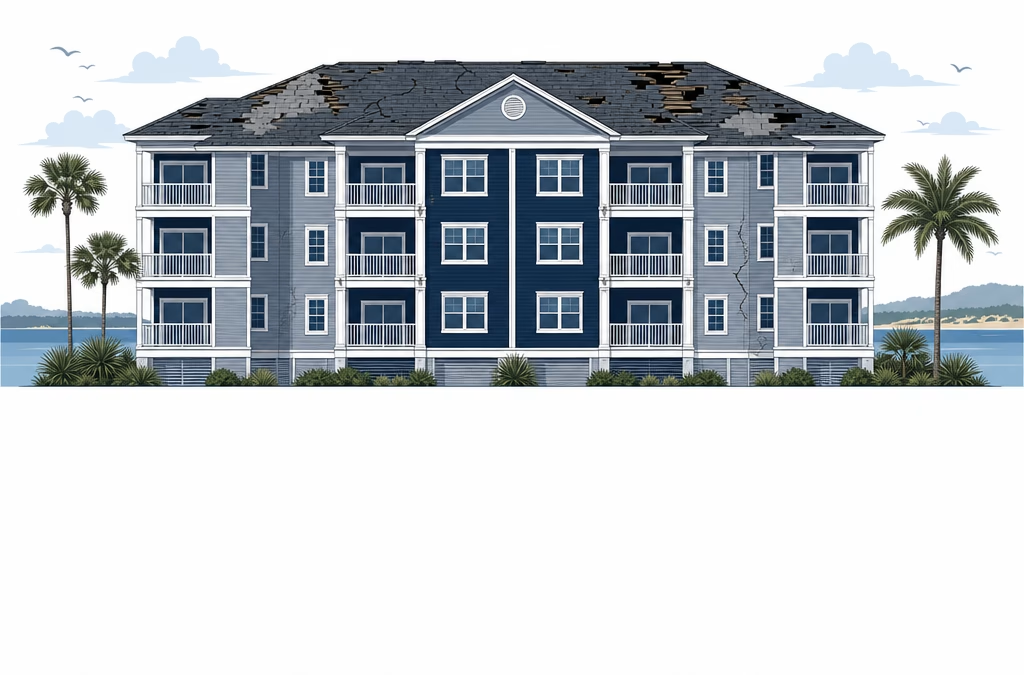
Short answer: A roof replacement is one of the largest single expenditures a Bay County association will face, and without a properly funded reserve allocation, boards are forced into special assessments or emergency loans that erode owner trust. The solution is a documented reserve study that isolates the roof as a discrete component, a competitive contractor selection process that verifies Florida licensing and insurance, and a tech-driven tracking system that monitors reserve contributions against the replacement timeline so the board always knows whether it is on schedule or falling behind.
Why Roof Replacement Catches Bay County Boards Off Guard
Coastal Northwest Florida communities face aggressive UV exposure, salt-laden air, and hurricane-season wind events that accelerate roof degradation faster than inland properties. A roof that a reserve study estimated at 20 years of remaining life may need replacement at 14 or 15 years when coastal exposure is factored in. Boards that rely on outdated reserve studies — or on studies prepared for a different climate zone — routinely discover the shortfall only after a post-storm inspection reveals widespread shingle loss or deck damage.
The fiduciary exposure is real. Under Florida Statute 720.303(5), HOA boards must maintain adequate reserves for replacement components, and under FS 718.112(2)(f) for condominium associations, reserve funding is tied to the annual budget. A board that knowingly defers a roof replacement because the reserves are underfunded is making a conscious financial decision that could expose directors to claims of breach of fiduciary duty — particularly if the deficiency was documented and the board failed to act.
The Reserve Study: Your Roof as a Discrete Component
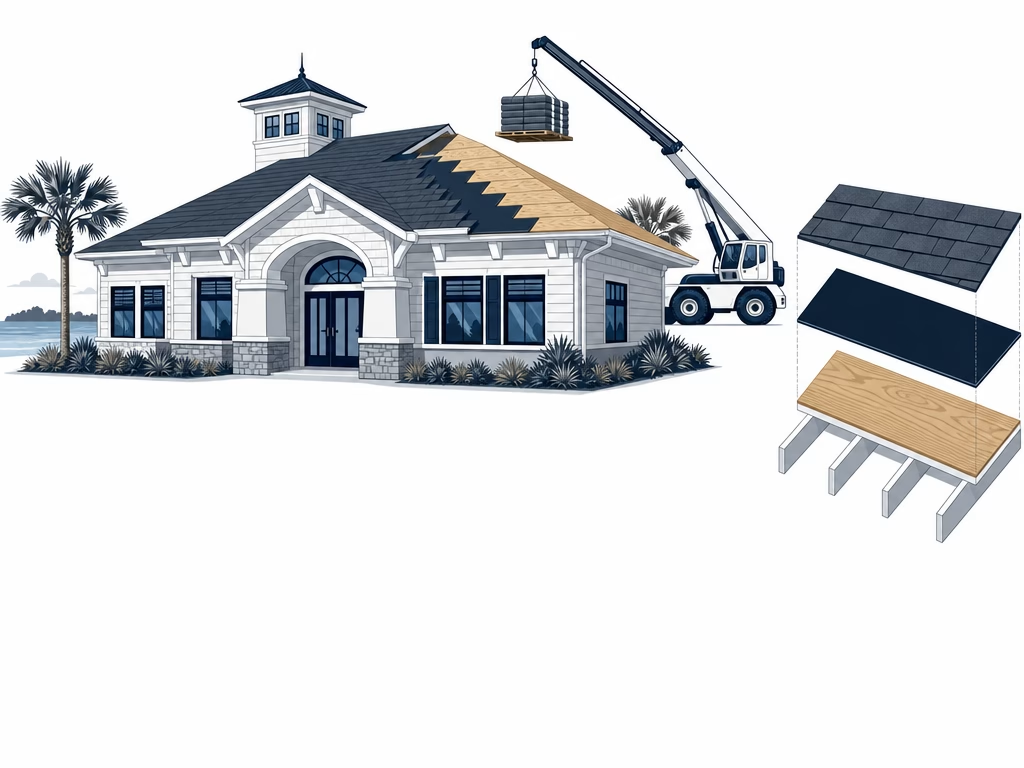
Too many associations treat the roof as a line item buried inside a general “building” reserve category. This obscures the funding gap. A proper reserve study breaks the roof out as its own component with three critical data points:
- Remaining useful life: How many years before replacement is required, adjusted for coastal exposure.
- Replacement cost estimate: Current construction cost per square foot, including tear-off, disposal, underlayment, and finish material.
- Annual contribution requirement: The calculated annual reserve allocation that fully funds the replacement by the projected end of useful life.
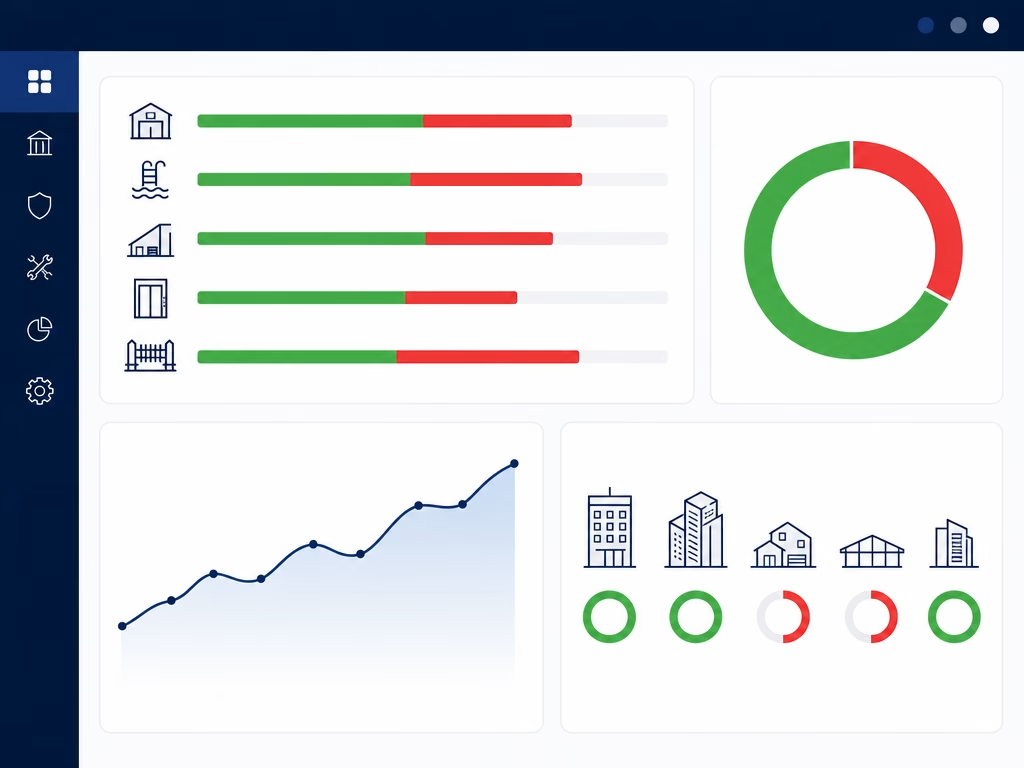
When the roof is isolated as a discrete component, the board can see exactly whether contributions are keeping pace with the depreciation curve. A dashboard view that tracks actual contributions against the required annual funding amount turns an abstract reserve number into an actionable gap analysis. If the reserve is underfunded by $80,000 with three years of remaining life, the board knows it needs approximately $26,700 per year in additional contributions — not a vague sense that something is behind.
Contractor Selection: What Bay County Boards Must Demand
Selecting a roofing contractor for an association-scale project is not the same as hiring a roofer for a single-family home. The scope, cost, and liability are exponentially larger, and the board is spending other people’s money — which means the standard of care for vendor selection is higher, not lower.
Florida Licensing and Insurance Verification
Every contractor considered for a Bay County association roof replacement must hold an active Florida roofing contractor license (CGC or CCC). Boards should verify the license through the Florida Department of Business and Professional Regulation online portal, not rely on a photocopy in a proposal packet. Equally critical is proof of general liability insurance and workers’ compensation coverage at limits appropriate to the project value — at minimum $2 million in aggregate for a full roof replacement on a multi-building community.
Coastal Wind Uplift and Building Code Compliance
Bay County roofing projects must comply with the Florida Building Code wind uplift requirements for the local wind zone. Panama City Beach and coastal Bay County sit in a higher wind zone than inland areas, and the underlayment, fastening pattern, and edge metal details must be engineered for that exposure. A contractor who cannot articulate the wind zone requirements for your specific location is not qualified for the job.
References from Comparable Coastal Associations
Ask for at least three references from other coastal community associations of similar size — not single-family residential customers. Visit those properties if possible, or request photos of completed work. A contractor’s ability to manage logistics around occupied units, coordinate with residents on access, and clean up debris in a community setting is a different skill set from residential roofing.
FS 720 vs FS 718: Reserve and Contract Requirements
The reserve and contracting obligations differ between HOAs (FS 720) and condominiums (FS 718). The following table summarizes the distinctions Bay County boards need to understand:
| Requirement | FS 720 (HOA) | FS 718 (Condominium) |
|---|---|---|
| Reserve study mandate | Not statutorily required, but strongly recommended as a fiduciary best practice | Required for buildings 3+ stories (SIRS); reserve component analysis expected |
| Reserve funding obligation | Board must maintain reserves per governing documents; waiver requires owner vote | Mandatory funding unless waived by majority vote; SIRS components cannot be waived |
| Competitive bidding | Not mandated by statute; board should follow governing document requirements | Required for contracts exceeding statutory thresholds (FS 718.3026) |
| Contractor insurance verification | Fiduciary duty requires due diligence; no statutory insurance minimum | Same fiduciary standard; governing documents may specify minimums |
| Owner disclosure of reserves | Annual budget notice includes reserve components (FS 720.303(5)) | Annual financial report must include reserve fund status (FS 718.111(12)) |
Traditional Management vs. Maxet’s Tech-Driven Management
| Aspect | Traditional Management | Maxet’s Tech-Driven Management |
|---|---|---|
| Reserve tracking | Annual reserve study filed in a binder; reviewed rarely | Digital dashboard updated monthly; gap alerts sent to the board automatically |
| Contractor vetting | Three bids collected; license check often skipped or done once | License and insurance verified at proposal and again at contract execution; stored digitally |
| Project oversight | Manager visits site occasionally; relies on contractor self-reporting | Milestone-based progress tracking with photo documentation at each phase |
| Board reporting | Post-project summary at the next board meeting | Executive brief with reserve impact, project status, and financial reconciliation |
The technology handles the data synthesis — tracking reserve contributions, monitoring contractor compliance deadlines, and cross-referencing the reserve study timeline against actual funding — while the manager provides the professional judgment and operational execution that no software can replace. The board receives a decision-ready executive brief instead of a binder full of raw invoices.
The Roof Replacement Roadmap for Bay County Boards
Step 1: Commission or Update the Reserve Study
If the most recent reserve study is more than three years old, or if it was not prepared with coastal exposure adjustments, commission a new one. Specify that the roof must be broken out as a discrete component with a remaining-life estimate calibrated for Bay County coastal conditions. The cost of the study is an association expense — not a line item to defer.
Step 2: Calculate the Funding Gap
Compare the current roof reserve balance against the projected replacement cost divided by remaining years of useful life. If the annual contribution is short, the board must decide whether to increase regular assessments, levy a special assessment, or pursue a reserve line of credit. Each option has different owner-communication and governing-document requirements.
Step 3: Issue a Competitive Request for Proposals
Prepare a scope-of-work document that includes building addresses, roof areas (in square feet), existing roof type, access constraints, and the required Florida Building Code wind zone. Distribute to at least three licensed Florida roofing contractors with documented coastal community experience. Require proof of license, insurance certificates, and three association references in the proposal package.
Step 4: Verify and Select
Confirm each proposer’s license through the DBPR portal. Contact all references. Compare proposals on cost, timeline, warranty terms, and project management approach — not on price alone. The lowest bid is frequently the most expensive choice when warranty exclusions and change-order patterns are factored in.
Step 5: Track the Project and the Reserve Impact
Once the contract is signed, track the project against milestones and the reserve drawdown against the study projections. If the project comes in over budget, the board needs to know immediately — not at the next quarterly financial review. A digital tracking system that flags reserve shortfalls in real time is the difference between proactive governance and reactive crisis management.
Frequently Asked Questions
How often should a Bay County association update its reserve study for roof replacement?
Reserve studies should be updated every three to five years at minimum, but coastal Bay County associations should consider a roof-specific review every two to three years. Salt air and hurricane exposure accelerate degradation faster than inland climate models predict, and a stale study can leave a board believing it has more time and more funding than it actually does.
Can an HOA board waive roof reserve funding in Florida?
Under FS 720.303(5), an HOA board can waive or reduce reserve funding only by a majority vote of the members present at a properly noticed meeting. For condominiums under FS 718.112(2)(f), a majority vote of the unit owners is required, and SIRS-mandated structural components cannot be waived at all after SB 154. Waiving roof reserves does not eliminate the roof replacement need — it merely shifts the cost to a future special assessment that will be larger and more disruptive.
What insurance should a roofing contractor carry for an association project?
At minimum, a roofing contractor should carry general liability coverage of $2 million aggregate and workers’ compensation coverage for all employees. For large multi-building projects, the board should also require the contractor to name the association as an additional insured on the policy. Verify coverage directly with the insurance carrier — not by accepting a certificate of insurance that could be outdated or fabricated.
What happens if the roof reserve is significantly underfunded and replacement is urgent?
The board has three primary options: increase regular assessments to close the gap, levy a special assessment to cover the shortfall, or negotiate a reserve line of credit to spread the cost over time. Each option requires different owner-notice procedures and governing-document compliance. The worst option is deferring the replacement entirely — a failing roof can lead to interior damage, mold, and insurance claim denials that dwarf the cost of the replacement itself.
What This Means for Bay County Boards Right Now
If your association’s roof reserve is not broken out as a discrete component in a current reserve study, that is the first problem to fix. If the study exists but the reserve balance is tracking below the required contribution curve, the board needs to close the gap now — not after the next storm. And if the contractor selection process relies on three bids and a handshake without verified licensing and insurance, the board is accepting fiduciary risk that a documented, tech-driven process would eliminate.
The boards that manage roof replacements successfully are the ones that treat the project as a multi-year financial and operational plan — not a last-minute emergency. The technology handles the tracking and the data synthesis. The board provides the judgment. Maxet provides the operational execution that turns a well-funded plan into a completed project on budget and on time.
For a broader standard of care around projects, vendors, and board oversight, see how Maxet approaches Bay County HOA management.
Legal disclaimer: Maxet is a professional community association management firm providing business operational efficiency and administrative support. We are not a law firm, and the information provided in this article does not constitute legal advice or create an attorney-client relationship. For specific legal interpretation of Florida Statutes or governing documents, we strongly recommend consulting with a licensed attorney specializing in Florida community association law.