
Short answer: Asphalt crack sealing and pavement preservation scheduling can extend Bay County HOA road life by 5-7 years and reduce total repair costs by 40-60% compared to reactive patching. Boards should demand a written pavement management plan with condition assessments every 2 years, crack sealing every 1-2 years, and sealcoating every 3-5 years, tracked through digital infrastructure software rather than vendor-driven emergency calls.
Why Bay County HOA Roads Deteriorate Faster Than Boards Expect
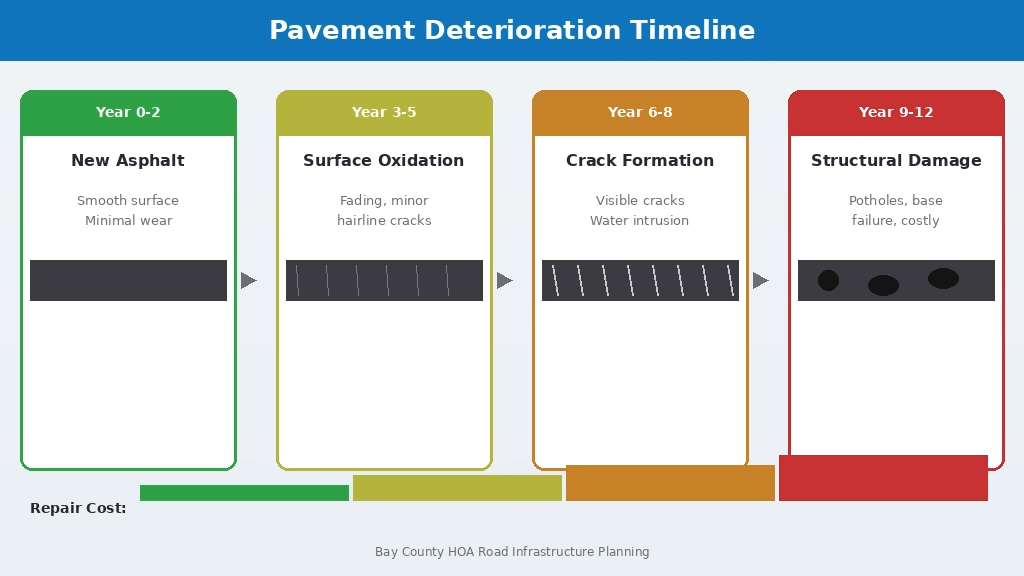
Bay County’s coastal climate presents a uniquely aggressive environment for asphalt. Salt-laden humidity, intense UV exposure, and seasonal stormwater runoff accelerate pavement oxidation and cracking. Many HOA boards in Panama City Beach and unincorporated Bay County discover too late that their roads have passed the critical threshold where crack sealing alone can no longer prevent structural failure.
The problem is not that boards are negligent. It is that deferred maintenance accumulates silently until the cost of inaction exceeds the cost of action. It is that traditional management companies treat road maintenance as a vendor-initiated process: a contractor calls when potholes appear, and the board approves a reactive repair. This approach guarantees higher costs, shorter pavement life, and more resident complaints. A tech-driven pavement management approach flips the model: the board sets a preventive maintenance schedule based on condition data, not vendor phone calls.
What Pavement Preservation Actually Includes
Pavement preservation is a system of scheduled treatments applied before visible deterioration reaches structural layers. For Bay County HOAs, the core components include:
- Crack sealing: Routing and sealing asphalt cracks with rubberized sealant every 1-2 years to prevent water intrusion into the base layer. This is the single highest-ROI maintenance activity for coastal community roads.
- Sealcoating: Applying a protective coal tar or asphalt emulsion overlay every 3-5 years to shield the surface from UV oxidation and fuel spill damage.
- Patch repair: Targeted removal and replacement of deteriorated sections before they expand into potholes. Infrared patching can bond seamlessly to surrounding pavement in Bay County temperatures above 50 degrees.
- Condition assessment: A formal pavement condition index (PCI) survey every 2-3 years that scores road sections on a 0-100 scale, producing a data-driven maintenance prioritization rather than guesswork.
The Cost Gap: Reactive Repairs vs Proactive Scheduling
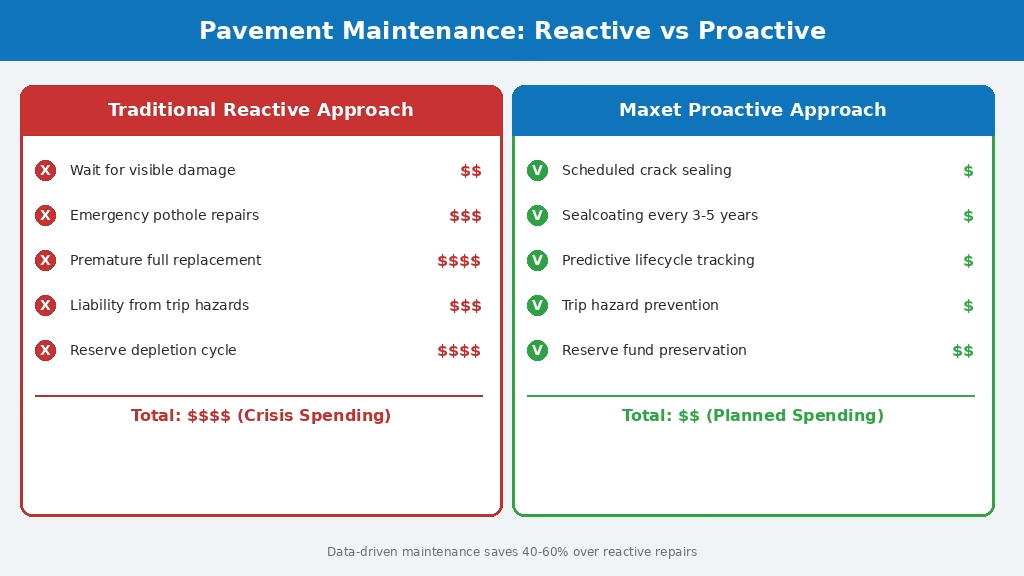
A typical Bay County HOA with 3-5 miles of internal roads will spend roughly $12,000-$18,000 per year on a proactive crack-sealing and sealcoating program. The same community that defers maintenance until potholes appear typically faces $45,000-$80,000 in emergency milling, patching, and partial resurfacing costs over the same period. The math is unambiguous: proactive preservation costs roughly one-third to one-half of reactive repair.
The deeper cost is reserve depletion. Under Florida Statute 718.112(2)(f) for condominium associations and FS 720.303(5) for HOAs, boards must maintain adequate reserves for deferred maintenance. Misaligned reserve contributions are a leading cause of reserve deficiencies that force special assessments. When road repairs are emergency-driven rather than scheduled, the reserve study’s paving component becomes unreliable, and boards face the prospect of special assessments to cover shortfalls that were predictable years earlier.
Traditional Management vs Maxet’s Tech-Driven Management
| Aspect | Traditional Reactive Management | Maxet Tech-Driven Management |
|---|---|---|
| Scheduling | Vendor calls when damage appears | Condition data triggers scheduled work |
| Cost tracking | Emergency invoices, unpredictable | Annual maintenance budget, planned |
| Reserve alignment | Reserve study misses road deterioration | PCI scores feed reserve schedule updates |
| Board reporting | Surprise repair requests | Quarterly infrastructure health dashboard |
| Pavement life | 10-12 years before full resurfacing | 15-20 years with scheduled preservation |
FS 720 vs FS 718: Reserve Implications for Pavement
Bay County associations operate under different statutory frameworks depending on their type. The reserve and maintenance obligations differ in ways that directly affect pavement planning:
| Requirement | FS 718 (Condominiums) | FS 720 (HOAs) |
|---|---|---|
| Reserve study | Required; SIRS includes structural components | Recommended; must be completed if board adopts reserves |
| Reserve funding | Mandatory for structural components (post-SB 154) | Board may waive funding by majority vote annually |
| Pavement as reserve line item | Common element; must be in reserve schedule | Common area; included if reserves are adopted |
| Deferred maintenance reporting | Annual report to unit owners | Annual financial report includes maintenance |
How Technology Transforms Pavement Management
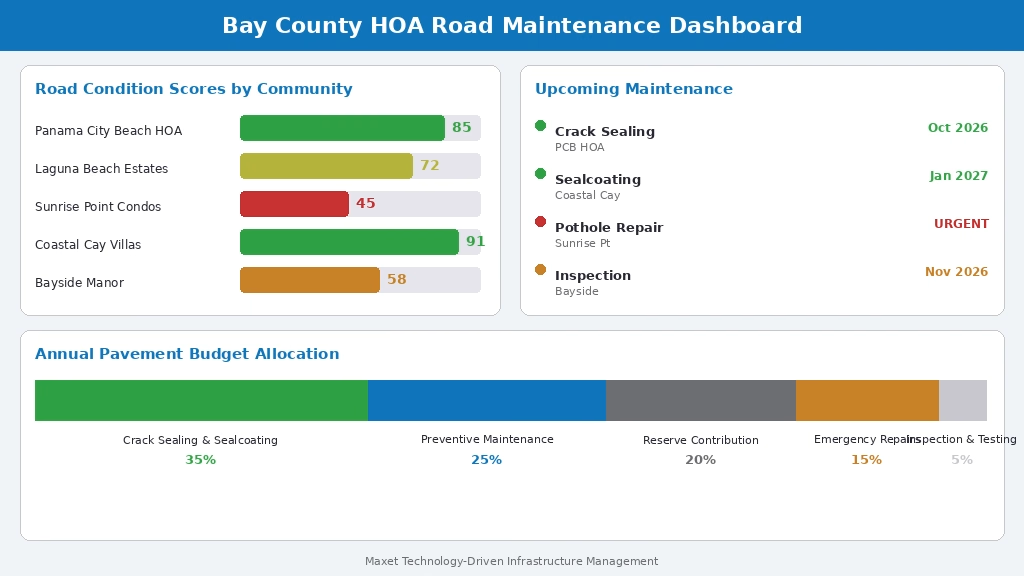
The difference between a board that controls its road costs and one that doesn’t comes down to data. Traditional management companies rely on vendor assessments and resident complaints to trigger maintenance. A tech-driven approach uses infrastructure tracking software to maintain a living condition map of every road segment in the community.
The technology handles the data synthesis: tracking PCI scores, monitoring crack density trends, projecting deterioration curves, and generating maintenance schedules that align with the reserve study. The manager provides the professional judgment: validating vendor scopes, negotiating contract terms, coordinating lane closures, and ensuring work meets Bay County construction standards. This is the Sovereign AI pattern in practice: the technology synthesizes the condition data, while the manager provides the professional judgment and operational execution.
What Bay County Boards Should Demand from Their Management Company
If your current management company cannot answer these questions, your pavement maintenance is reactive by default:
- Do you maintain a current pavement condition index for every road segment? If the answer is no, the board has no basis for scheduling or budgeting.
- What is the projected resurfacing date for each road segment based on current condition? This should come from a deterioration model, not a vendor estimate.
- How does the pavement maintenance schedule align with the reserve study funding plan? Misalignment here is the leading cause of special assessments for road work.
- Can you produce a 5-year pavement maintenance budget that stays within current reserve contributions? If not, the reserve study needs updating or the maintenance plan needs restructuring.
- What crack sealing and sealcoating intervals do you recommend for coastal Bay County conditions? Generic Florida recommendations understate Bay County’s salt and UV exposure.
Building a 5-Year Pavement Management Plan
A defensible pavement management plan for a Bay County HOA follows a predictable cycle:
- Year 1: Commission a PCI assessment. Score every road segment. Identify segments scoring below 55 for immediate intervention. Begin crack sealing on all segments scoring above 55.
- Year 2: Continue crack sealing cycle. Apply sealcoating to segments last sealed 3+ years ago. Begin engineering design for any segments projected to fail within 36 months.
- Year 3: Reassess PCI on a sample basis. Execute targeted patch repair on degraded areas identified in Year 1-2 tracking. Continue sealcoating rotation.
- Year 4: Full PCI reassessment. Adjust the 5-year reserve contribution based on updated deterioration rates. Begin resurfacing design for segments entering final service life.
- Year 5: Execute planned resurfacing on the worst segments using reserve funds accumulated specifically for this purpose. Reset the cycle with a new full PCI assessment.
Frequently Asked Questions
How often should Bay County HOAs seal cracks in asphalt roads?
Bay County’s coastal climate accelerates crack formation through salt air, UV exposure, and stormwater intrusion. Crack sealing should be performed every 1-2 years on all visible cracks wider than 1/4 inch. Communities that wait 3+ years between crack sealing cycles typically face 40% higher repair costs when the base layer begins to fail.
What is a pavement condition index and why does my HOA need one?
A pavement condition index (PCI) is a standardized 0-100 score that rates the surface distress, structural capacity, and ride quality of a road segment. It provides a data-driven basis for maintenance prioritization and reserve budgeting. Without a PCI assessment, HOA boards are guessing at road conditions and relying on vendor assessments that may overstate repair urgency.
Can deferred road maintenance trigger a special assessment in a Bay County HOA?
Yes. Under both FS 718 and FS 720, if reserve contributions are inadequate to cover pavement replacement when needed, the board must either defer the work (creating liability from deteriorating road conditions) or levy a special assessment. Proactive pavement preservation keeps road costs within the reserve schedule, eliminating the need for surprise assessments.
How does pavement preservation relate to fiduciary duty for board members?
Florida courts have consistently held that board members owe a fiduciary duty to act in the association’s best financial interest. Deferring maintenance that could have been performed at one-third the cost through proactive scheduling is a direct breach of that duty. A documented pavement management plan with condition assessments and scheduled treatments is evidence that the board exercised its fiduciary obligation to preserve association assets efficiently.
Take Control of Your Community’s Road Costs
Bay County HOA boards that manage pavement proactively spend less, avoid special assessments, and maintain higher property values. The shift from reactive vendor calls to data-driven maintenance scheduling is exactly the kind of operational modernization Maxet delivers. If your current management company cannot produce a current pavement condition assessment or a 5-year road maintenance plan aligned with your reserve study, contact Maxet for a technology-driven infrastructure review.
Pavement planning is one part of the disciplined reserve and vendor oversight Maxet provides through HOA management in Bay County.
Legal disclaimer: Maxet is a professional community association management firm providing business operational efficiency and administrative support. We are not a law firm, and the information provided in this article does not constitute legal advice or create an attorney-client relationship. For specific legal interpretation of Florida Statutes or governing documents, we strongly recommend consulting with a licensed attorney specializing in Florida community association law.