
Short answer: A management transition becomes a stabilization project when the community inherits incomplete records, active vendor obligations, unresolved building conditions, and more work than a conventional handoff can responsibly absorb. In that situation, the right first objective is not to promise a rapid return to routine. It is to establish reliable information, preserve continuity, prioritize risk, and give the board an evidence-based path to the next decision.
This anonymized case study follows the second phase of a transition at a Gulf Coast resort condominium community. The first phase focused on creating operational order: reliable owner access, organized records, traceable workflows, and a clearer view of active work. The next phase revealed a more difficult reality. The scale and technical nature of inherited conditions meant that the original plan to shift daily responsibility quickly into a conventional onsite model was no longer the responsible course.
That was not a failed transition plan. It was a disciplined change in plan based on what the property and its records actually showed.

When a transition plan has to change
Management transitions often start with a reasonable operating assumption: establish control of the day to day work, identify open items, and then move into a steady onsite management rhythm. That model can work when the inherited environment is reasonably organized and active projects have clear ownership, records, scopes, and next steps.
It becomes inadequate when the transition uncovers a more complicated mix of conditions. In this case, management was simultaneously rebuilding the administrative foundation, tracing financial and vendor obligations, closing out a major building project, investigating moisture conditions, restoring property systems, evaluating security and access infrastructure, and communicating status to owners.
The appropriate response was to continue senior management involvement while the board and management developed a more realistic view of priorities, resources, dependencies, and timing. A professional manager should not preserve an original timetable merely because it was the original timetable. The plan must follow the evidence.
Information rehabilitation comes before property rehabilitation
One of the least visible parts of a difficult transition is often the most important: turning inherited records into a usable operating resource.
During this phase, prior-management files were moved from staging locations into an organized taxonomy while original names and source structures were preserved. Duplicate materials were separated, and other files were held for review. The point was not to announce that every historical document had been substantively verified. It was to create a defensible retrieval structure so the board and management could locate the source material needed for contracts, warranties, financial history, project status, maintenance records, and professional review.
That distinction matters. Filing is not the same as validating. A well-run transition makes the record easier to find while preserving the boundary between an organized archive and a concluded answer.
For a board, this work creates practical capacity. It becomes easier to ask which obligation is still open, which vendor has the relevant history, which record supports a decision, and what remains unknown. Without that foundation, management can spend enormous time responding to individual requests without ever improving the system that produces reliable answers.
Inherited projects and obligations do not reset at the management-change date
A new management agreement does not erase invoices, vendor relationships, project dependencies, or prior decisions already in motion. The association still owns the work, and the new manager must understand enough of the history to protect continuity while bringing the process under clear oversight.
One major modernization project remained in closeout during the period reviewed. Management had to reconcile active work, turnover expectations, access needs, maintenance coordination, and invoice routing that had previously been directed elsewhere. The visible project was only one part of the work. The less visible work included identifying outstanding obligations, clarifying where future invoices belonged, and establishing a current point of accountability.
The transferable lesson is simple: a project is not complete because a manager inherits it, because a vendor reports progress, or because an invoice is received. Boards need a status record that separates scope, authorization, work reported, unresolved items, closeout evidence, and the next decision.
Diagnosis before repair is a management discipline
Some of the most consequential work in a stabilization phase is not construction. It is deciding when not to authorize a repair until the cause is understood.
In this case, management coordinated investigation of separate moisture conditions affecting building areas. Available observations suggested that one reported location might no longer have active water intrusion, while humidity control and remediation questions still required professional input. Another location presented a different set of observations, including moisture readings and a possible condensation or condensate-line theory. Multiple possible causes were being considered.
Management did not treat a preliminary theory or a proposed cleaning measure as proof that the problem had been solved. Additional investigation and proposal work remained necessary before a defined remediation scope could be responsibly recommended.
That is a stronger operating standard than a quick announcement that a leak was fixed. A disciplined sequence is:
- document the observed condition;
- coordinate appropriate access and professional input;
- separate competing theories from verified causation;
- define a scope that matches the evidence;
- authorize work with a clear completion and closeout standard.
This approach can feel slower at the beginning. In practice, it reduces the risk of paying for work that does not address the actual condition.
Rehabilitation work and routine operations happen at the same time
A troubled property does not pause ordinary operations while larger questions are investigated. Management still has to keep common areas functioning, coordinate vendors, respond to owner needs, and report visible conditions honestly.
During the period reviewed, property systems showed both progress and open work. Irrigation recovery advanced through repairs and system troubleshooting, while some component-level deficiencies still required attention. Pool-related work was moving through scope development and proposal planning rather than being represented as complete rehabilitation. Roof work had sequencing dependencies tied to other active building activity. Smaller visible items, including amenity equipment and lighting, required their own diagnosis and follow through.
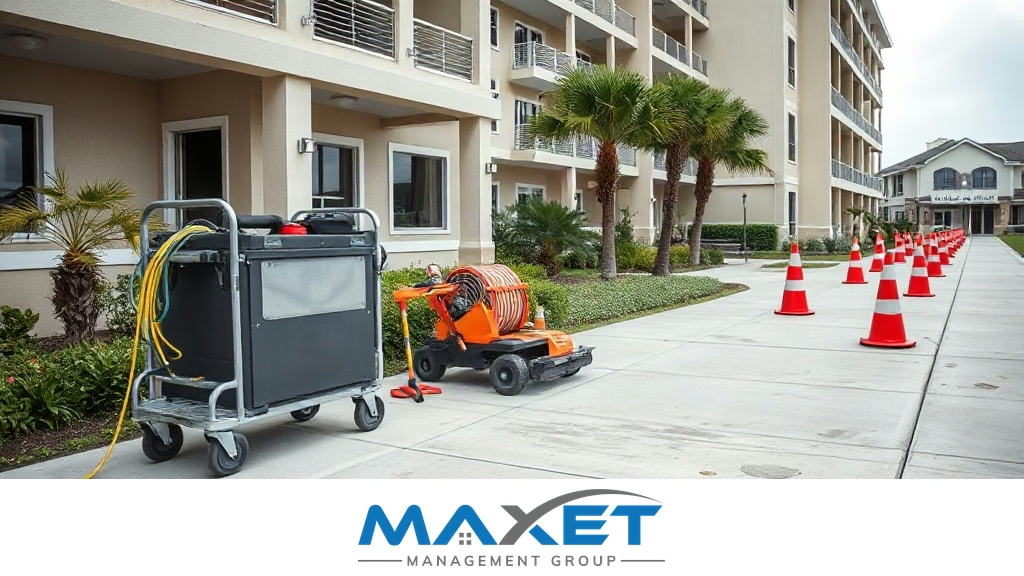
For boards, this is an important expectation to set. A stabilization project is not one master work order. It is a portfolio of workstreams with different evidence, urgency, cost, dependencies, and owners. Good management makes those distinctions visible instead of allowing every item to become a vague statement that it is being handled.
Technology issues can reveal a larger infrastructure decision
Transition work also uncovered access-control, camera, network, and equipment-location questions that could not be solved responsibly as isolated service calls. Existing equipment limitations affected the ability to use the current system as intended. Multiple solution paths were being evaluated, including options with different levels of integration and future flexibility.
The right question was not simply which vendor could replace a single failed component fastest. The board needed to understand how access, security, network reliability, common-area equipment, and future operating responsibility fit together.
This is a recurring association-management challenge. A broken lock, disconnected controller, or unsupported device may look like a small maintenance ticket. It can actually be evidence of a system-level decision that needs a scope, options, lifecycle view, and owner of the final operating standard.
Communication is operating infrastructure
Owners do not gain confidence merely because management is busy. They need a reliable way to understand what is known, what is under review, what affects them now, and when another update will be available.
In this transition, management established a recurring owner communication channel and used it alongside the owner portal to share project status, operational updates, and resources. The communication did not claim that every issue was resolved. It gave the community a more predictable place to receive updates while the work continued.

That is the point of transition communication. It is not a substitute for construction, financial reporting, or professional investigation. It is the system that lets the board and owners see the difference between a confirmed action, an open question, a scheduled next step, and a finished result.
What boards should take from a stabilization phase
A board does not need a manager to tell it that every inherited issue is fixed. It needs a manager who can create order without overstating certainty.
- Revisit the transition plan when facts change. A timeline is useful until it conflicts with the condition actually discovered.
- Organize the record before relying on it. Preserve source files, make them retrievable, and distinguish filing from substantive review.
- Track active obligations separately from completed work. Projects, invoices, warranties, and vendor scope can survive a management change.
- Investigate cause before committing to remediation. The most defensible repair starts with evidence, not pressure to announce closure.
- Sequence work around real dependencies. Access, active modernization, safety, procurement, and owner communication can determine what should happen first.
- Communicate status with precision. Owners and boards should be able to see what is verified, what remains open, and what decision is next.
Frequently asked questions
When should a board extend the transition period for a new management company?
A board should reconsider the initial timeline when the manager’s due diligence identifies material record gaps, active projects without clear closeout, unresolved building conditions, financial-transition issues, or operating risks that cannot be responsibly handed off on the original schedule.
Does organizing inherited records mean they have been fully reviewed?
No. Organizing records makes them retrievable and helps identify what may require review. It does not independently validate every historical document, contract, invoice, warranty, or prior decision.
How should a board report an unresolved maintenance condition?
Report the observed condition, what has been investigated, what remains uncertain, the next planned step, and the decision still needed. Do not describe a condition as repaired until the relevant work and closeout evidence support that statement.
Why should access control and camera issues be evaluated together?
They may share network, equipment, credential, access, maintenance, and future-support dependencies. Evaluating the overall system can help a board avoid repeatedly funding disconnected one-off fixes.
For boards considering a management transition, the practical lesson is that responsible stabilization is not a delay tactic. It is the work that creates a defensible path from inherited uncertainty to informed action. Learn more about Maxet’s approach to condominium association management and management transitions.
Case-study note: This article is an anonymized educational account of operational management practices. It does not identify the community, personnel, vendors, unit/building details, financial figures, or nonpublic project information. It does not provide legal, engineering, financial, insurance, or construction advice.
Legal disclaimer: Maxet is a professional community association management firm providing business operational efficiency and administrative support. We are not a law firm, and the information provided in this article does not constitute legal advice or create an attorney-client relationship. For specific legal interpretation of Florida Statutes or governing documents, consult a licensed Florida community association attorney.