
Short answer: Florida law requires HOA and condo directors to disclose conflicts of interest before voting on matters that benefit them personally. For Bay County boards, tracking these disclosures manually with paper forms and spreadsheets creates fiduciary risk, missed deadlines, and audit failures. A tech-driven disclosure tracking system automates the workflow, maintains a permanent audit trail, and ensures every board decision is documented for compliance under FS 720.3033 and FS 718.111(1)(d). The technology handles the data synthesis and deadline tracking, while the manager provides the professional judgment and operational execution.
What Is a Director Conflict of Interest in a Florida HOA?
A conflict of interest arises when a board member’s personal, professional, or financial interests intersect with a decision the board must make. In Bay County associations, this happens more often than most boards realize. A director who owns a landscaping company bidding on the community’s contract. A board member whose property borders a drainage easement slated for repair. A treasurer whose spouse is the association’s insurance broker.
Florida law does not prohibit conflicts of interest outright. Directors are volunteers, and many bring professional expertise that overlaps with association business. What the law requires is disclosure and recusal. When a director fails to disclose a known conflict and votes on the matter anyway, the board has exposed itself to fiduciary breach claims, homeowner lawsuits, and potential removal proceedings.
Statutory Requirements Under Florida Law
Two primary statutes govern director conflict-of-interest disclosures in Bay County:
FS 720.3033 applies to homeowners’ associations under Chapter 720. It requires directors to disclose any financial interest in a matter being voted on and to abstain from the vote. The disclosure must be recorded in the meeting minutes.
FS 718.111(1)(d) applies to condominium associations under Chapter 718. It imposes similar disclosure and recusal obligations on condo directors, with additional requirements for documenting the conflict in the official records.
Both statutes flow from the same principle: transparency. But the operational mechanics of tracking disclosures, maintaining records, and proving compliance at audit time are where most Bay County boards fail.
Why Manual Disclosure Tracking Fails Bay County Boards
Most Bay County associations handle conflict-of-interest disclosures the same way they did twenty years ago. A board member verbally states a conflict at a meeting, the secretary notes it in the minutes, and everyone moves on. If anyone remembers. If the minutes are accurate. If the disclosure makes it into the official records at all.

The problems with this approach compound quickly:
- No structured disclosure form: Verbal disclosures at meetings are inconsistent. One director discloses thoroughly; another mentions a conflict in passing. Without a standardized form, the record is only as good as the secretary’s notes.
- No annual disclosure cycle: Many boards collect disclosures only when a conflict surfaces during a vote. They have no annual or transactional disclosure process, meaning ongoing conflicts (like a director’s spouse working for the association’s vendor) go unreported for years.
- No audit trail: When a homeowner challenges a board decision, the association must produce evidence that the conflicted director disclosed and recused. If the disclosure was verbal and the minutes are sparse, the association has no defense.
- No tracking of recusal compliance: Disclosure without recusal is a partial compliance act. A director who declares a conflict but still votes has violated the statute. Manual systems cannot verify recusal because votes are often recorded as roll calls without noting who abstained.
- Record retention gaps: FS 718.111(12) requires associations to maintain official records including disclosure documents. Paper forms get lost. Spreadsheets get overwritten. Email disclosures sit in an individual’s inbox, not the association’s record system.
The Fiduciary Stakes for Bay County Directors
Bay County board members who serve without D&O insurance or who rely on a management company that does not track disclosures are accepting personal risk. Under the Business Judgment Rule, directors are protected when they act in good faith, with reasonable diligence, and in the association’s best interest. But a director who votes on a contract benefiting their own business, without prior disclosure, has breached the duty of loyalty. That breach pierces the Business Judgment Rule shield and opens the door to personal liability.
How Technology Closes the Disclosure Tracking Gap
A tech-driven disclosure tracking system transforms conflict-of-interest management from a manual, error-prone process into an automated, audit-ready compliance workflow. The system does not replace the board’s judgment. It enforces the process around that judgment.

Core Components of a Tech-Driven System
1. Standardized Digital Disclosure Forms
Every director completes an annual disclosure form at the start of their term and updates it transactionally whenever a new conflict arises. The form is digital, standardized, and stored in the association’s records system, not on someone’s personal computer.
2. Automated Meeting Agenda Flagging
Before each board meeting, the system cross-references agenda items against the disclosure database. If a director has a disclosed conflict with an agenda item, the system flags it for the board president and the director. This ensures the disclosure is addressed at the meeting, not forgotten.
3. Recusal Tracking
When a conflicted item comes to a vote, the system records which directors recused, verifies the recusal against the disclosure record, and logs the vote outcome. No conflicted director can accidentally vote because the system blocks their vote entry.
4. Permanent Audit Trail
Every disclosure, every flag, every recusal, and every vote is timestamped and stored in a permanent record. When an auditor, homeowner, or attorney requests documentation, the association produces a complete chain of compliance in minutes, not days.
Traditional Management vs. Maxet’s Tech-Driven Management
| Compliance Dimension | Traditional Management | Maxet’s Tech-Driven Management |
|---|---|---|
| Disclosure Collection | Verbal at meetings; paper forms lost in files | Digital annual + transactional forms stored in centralized records |
| Conflict Detection | Relies on the director to self-report at the meeting | System cross-references agenda items against disclosure database before each meeting |
| Recusal Tracking | Secretary notes recusal in minutes (if they remember) | Automated recusal logging with vote-blocking for conflicted directors |
| Audit Trail | Paper records, scattered emails, incomplete minutes | Permanent timestamped digital chain from disclosure to vote to recusal |
| Response to Challenge | Days of searching through boxes and old emails | Complete compliance record produced in minutes |
| Fiduciary Risk | High — gaps in disclosure documentation expose directors | Low — every action documented, every conflict addressed |
FS 720 vs. FS 718: Conflict Disclosure Requirements Compared
Bay County boards operate under different statutes depending on whether they manage a homeowners’ association (Chapter 720) or a condominium association (Chapter 718). The disclosure obligations overlap but differ in key operational details.
| Requirement | FS 720.3033 (HOA) | FS 718.111(1)(d) (Condo) |
|---|---|---|
| Disclosure Trigger | Financial interest in a matter being voted on | Any financial or fiduciary interest in a matter before the board |
| Disclosure Method | Verbal or written; must be recorded in meeting minutes | Written disclosure into official records; noted in minutes |
| Recusal Required | Yes — director must abstain from discussion and vote | Yes — director must abstain from discussion and vote |
| Record Retention | Maintained in association official records | Maintained in official records under FS 718.111(12) |
| Penalty for Non-Compliance | Potential removal; breach of fiduciary duty claim | Potential removal; breach of fiduciary duty claim; DBPR complaint |
| Annual Disclosure | Not explicitly required by statute (best practice) | Not explicitly required by statute (best practice) |
Both statutes share a critical gap: neither explicitly mandates an annual disclosure cycle. This means boards that only collect disclosures transactionally are technically compliant but operationally vulnerable. A tech-driven system closes this gap by enforcing annual disclosures as a standard of care, regardless of whether the statute demands it.
The Bay County Context: Local Factors That Escalate Risk
Bay County associations face unique pressure points that make conflict-of-interest disclosure tracking especially critical:
Coastal Vendor Concentration
Panama City Beach and the surrounding Bay County coastline have a limited pool of licensed contractors, particularly for specialized work like seawall repair, hurricane damage remediation, and pool service. Board members who work in construction, real estate, or property management often have professional relationships with these vendors. Without a structured disclosure system, these relationships go undocumented and create hidden fiduciary exposure.
Post-Hurricane Recovery Contracts
Bay County associations that survived Hurricane Michael and subsequent storms often entered into emergency contracts with local vendors under time pressure. Some of these relationships persist years later without competitive bidding. A director with an undisclosed connection to one of these vendors votes on contract renewals every year, deepening the conflict.
Small Community Board Pools
Many Bay County HOAs are small communities where the same volunteers serve for years. The pool of willing board candidates is thin. This means directors with professional ties to local businesses are common, not exceptional. A disclosure system that assumes conflicts are rare will miss the reality that in small communities, conflicts are the norm.
Implementing a Disclosure Tracking System: A Board Roadmap
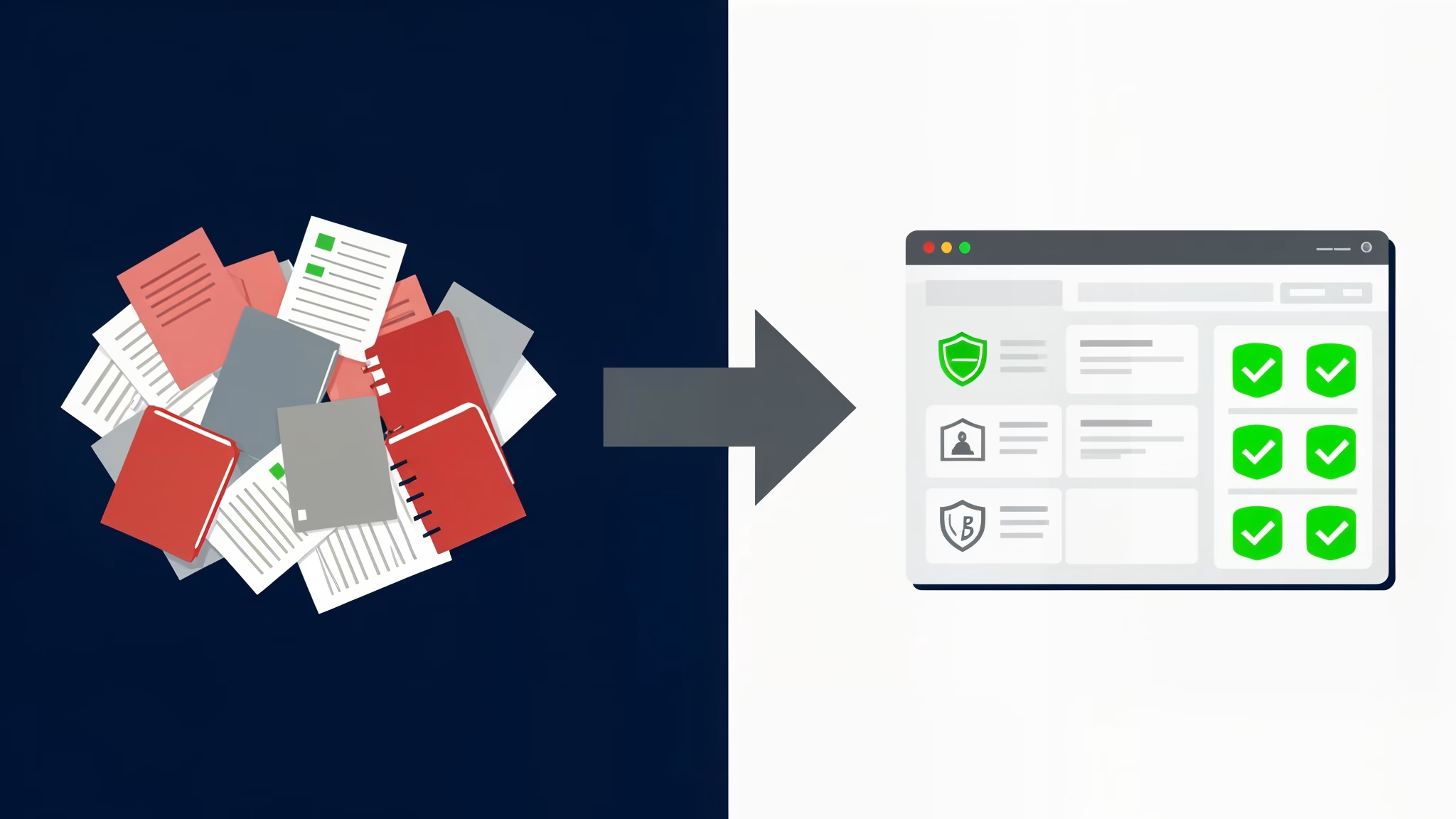
For Bay County boards ready to move beyond paper-based disclosure tracking, the implementation follows a phased approach:
Phase 1: Baseline Audit (Month 1)
Before implementing new technology, the board must understand its current state. Review the last three years of meeting minutes for disclosed conflicts. Identify any votes where a conflicted director participated without recusal. Document the gaps. This baseline establishes the fiduciary risk the board is carrying today.
Phase 2: Standardize the Disclosure Form (Month 1-2)
Adopt a standardized digital disclosure form that every director completes annually and updates transactionally. The form should capture: business relationships with association vendors, ownership interests in companies serving the association, family relationships with staff or contractors, and any property that benefits or is harmed by a pending board decision.
Phase 3: Deploy the Tracking System (Month 2-3)
Implement a digital system that stores disclosures, cross-references agenda items, flags conflicts before meetings, tracks recusals during votes, and maintains a permanent audit trail. The system should be accessible to the board president and the management company, with restricted access for individual directors to view and update their own disclosures.
Phase 4: Board Training and Policy Adoption (Month 3)
Adopt a written conflict-of-interest policy that references FS 720.3033 and FS 718.111(1)(d), defines what constitutes a conflict, mandates annual and transactional disclosures, and specifies the recusal process. Train all directors on the policy and the technology. The policy should be adopted by board resolution and recorded in the official records.
Phase 5: Ongoing Compliance Monitoring (Month 4+)
The system runs continuously. Before every board meeting, the system generates a conflict report. After every vote, the system logs recusals. Quarterly, the management company reviews the compliance log and reports any anomalies to the board. Annually, the disclosure forms are refreshed and the audit trail is reviewed.
The Sovereign AI Approach: Technology With Professional Judgment
Conflict-of-interest disclosure tracking is a domain where AI and automation add significant value, but the technology must operate within a human-governed framework. The system can flag potential conflicts, cross-reference vendor lists against director disclosures, and generate compliance reports. But the determination of whether a relationship constitutes a reportable conflict requires professional judgment.
The technology handles the data synthesis — scanning meeting minutes, matching vendor names, tracking deadlines, and producing audit-ready documentation. The manager provides the professional judgment — interpreting whether a disclosed relationship triggers a recusal obligation, advising the board on precedent, and ensuring the process meets the fiduciary standard of care.
This is the core principle: the technology handles the data synthesis, while the manager provides the professional judgment and operational execution. Boards that deploy automation without professional oversight risk a false sense of compliance. Boards that rely on manual processes without technology risk missed disclosures and audit failures. The Maxet approach combines both layers.
Frequently Asked Questions
What counts as a conflict of interest for an HOA director in Bay County?
A conflict of interest exists when a director has a personal, financial, or family relationship that could influence their vote on a board decision. Common examples in Bay County include a director who owns a company bidding on association work, a director whose spouse is employed by the association’s insurance broker, or a director whose property is directly affected by a maintenance project the board is voting on. Under FS 720.3033 and FS 718.111(1)(d), the director must disclose the conflict and abstain from the vote.
Do Bay County HOA directors need to disclose conflicts annually?
Neither FS 720.3033 nor FS 718.111(1)(d) explicitly requires annual disclosures. However, the statutes require disclosure before any vote where a conflict exists. Annual disclosure forms are a best practice because they capture ongoing relationships that might not be top of mind when a specific vote arises. A tech-driven system enforces annual disclosure as a standard of care, ensuring no ongoing conflict goes unreported.
What happens if a Bay County board member fails to disclose a conflict?
A director who fails to disclose a known conflict and votes on the matter has breached their fiduciary duty of loyalty. This can lead to a homeowner lawsuit seeking to void the board’s decision, a petition for the director’s removal, and in condominium associations, a complaint to the DBPR. The director may also lose D&O insurance coverage for the act if the policy requires good-faith compliance with disclosure obligations.
How does a tech-driven disclosure tracking system protect Bay County board members?
The system creates a permanent, timestamped record of every disclosure, conflict flag, recusal, and vote. If a homeowner challenges a board decision, the association can produce complete documentation showing the conflicted director disclosed and recused. This audit trail is the board’s strongest defense against fiduciary breach claims. Without it, the board relies on meeting minutes that may or may not accurately reflect what happened.
Take the Next Step: Modernize Your Board’s Compliance
If your Bay County association is still tracking conflict-of-interest disclosures on paper, your directors are carrying unnecessary personal risk. Every undocumented conflict, every missed recusal, every gap in the audit trail is a liability waiting to surface. Maxet’s tech-driven approach to community association management transforms disclosure tracking from a manual liability into an automated compliance asset.
Contact Maxet today to schedule a baseline compliance audit and see how a tech-driven disclosure tracking system can protect your board and your community.
Related Maxet resources
Disclosure tracking is one part of durable board governance. Review Maxet’s board-member liability guide and Bay County HOA management support.
Legal disclaimer: Maxet is a professional community association management firm providing business operational efficiency and administrative support. We are not a law firm, and the information provided in this article does not constitute legal advice or create an attorney-client relationship. For specific legal interpretation of Florida Statutes or governing documents, we strongly recommend consulting with a licensed attorney specializing in Florida community association law.