
Short answer: A drainage and stormwater system maintenance audit is a systematic inspection of your community’s retention ponds, drainage channels, culverts, and outflow structures to identify blockages, erosion, structural failures, and compliance gaps before they become costly emergencies. For Bay County HOA boards, this audit is both a fiduciary obligation under Florida Statutes 718 and 720 and a proactive measure to protect property values in a coastal environment where heavy rainfall and storm surge can overwhelm aging infrastructure in hours.

What Is a Drainage and Stormwater System Maintenance Audit?
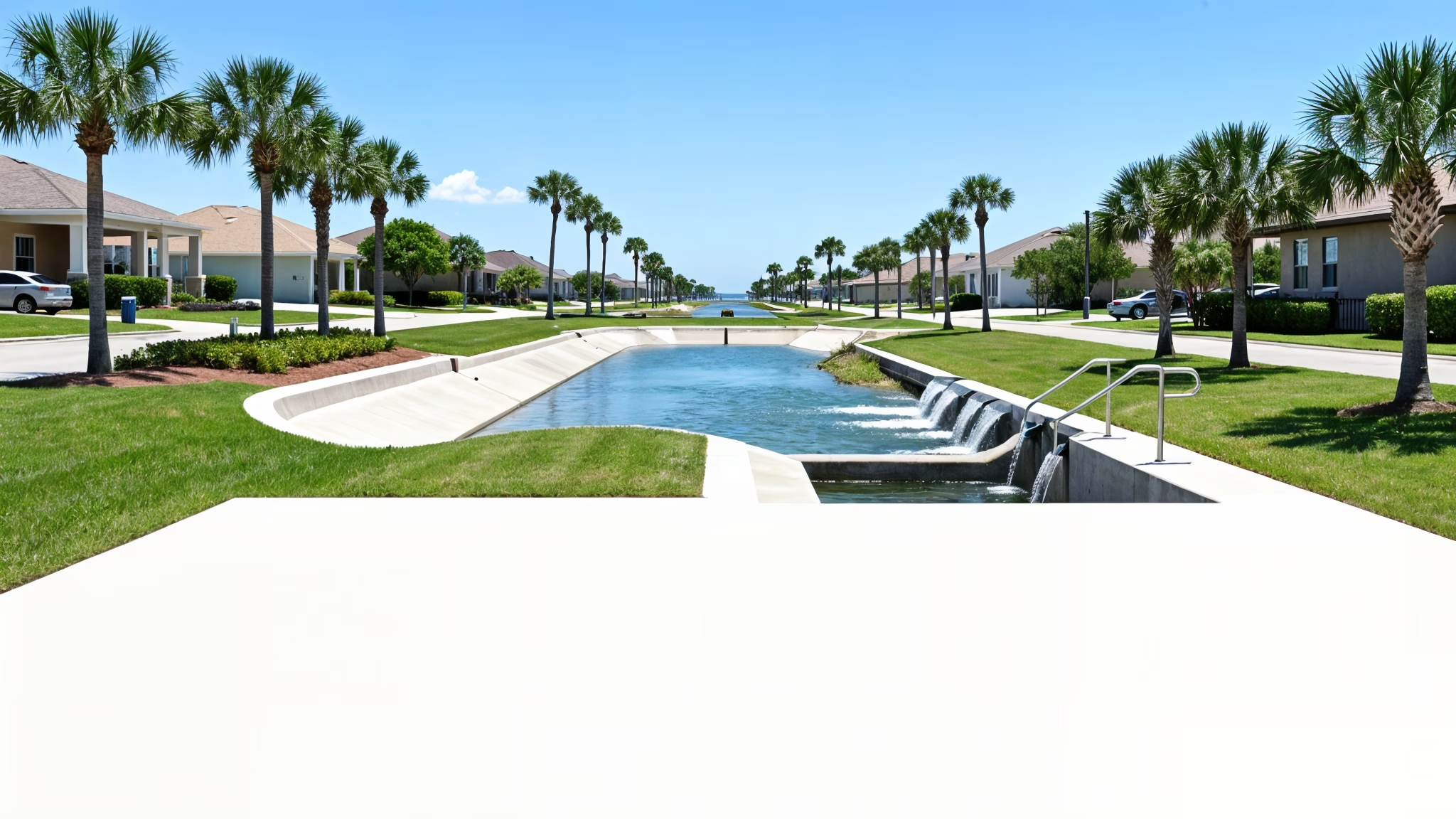
A drainage and stormwater system maintenance audit is a thorough, documented assessment of every component in your community’s stormwater management infrastructure. This includes retention ponds, detention basins, drainage swales, underground culverts, catch basins, outflow control structures, and the vegetative buffers that stabilize them. The audit evaluates physical condition, functional capacity, regulatory compliance, and maintenance history to produce a prioritized action plan.
For Bay County community associations, the audit takes on added urgency. Northwest Florida’s coastal geography means your stormwater system is the last line of defense between your common areas and the Gulf of Mexico. When a retention pond’s outflow structure fails or a drainage channel becomes choked with sediment, the result is not just standing water — it is a cascade of problems: property damage, mosquito infestations, water quality violations, and in some cases, Florida Department of Environmental Protection enforcement actions.
The technology handles the data synthesis — compiling inspection reports, maintenance logs, and regulatory requirements into a single dashboard — while the manager provides the professional judgment and operational execution needed to prioritize repairs and coordinate vendors.
Why Bay County HOAs Face Unique Stormwater Risks
Bay County’s location on the Florida Panhandle exposes community associations to a combination of threats that inland HOAs rarely face. The region receives an average of 60+ inches of rainfall annually, concentrated heavily during hurricane season from June through November. Storm surge from tropical systems can push saltwater into freshwater retention systems, killing vegetation meant to stabilize pond banks and accelerating erosion of concrete outflow structures.
Beyond the climate, Bay County’s development history matters. Many HOA communities in Panama City Beach and surrounding areas were built in phases between the 1990s and 2010s, meaning their stormwater infrastructure is now 15 to 30 years old — squarely in the window when original engineering assumptions about structure lifespan begin to break down. Cast-in-place concrete outflow boxes crack. HDPE pipe joints separate. Sediment accumulation reduces designed storage capacity by 20 to 40 percent. Without a formal audit, these failures are invisible until a storm exposes them.
Bay County also has specific jurisdictional nuances. Unincorporated Bay County follows different stormwater management ordinances than the City of Panama City or Panama City Beach. A community straddling municipal boundaries may be subject to overlapping requirements from the Bay County Stormwater Management Division and the Florida Department of Environmental Protection. Boards that do not know which jurisdiction governs their system cannot verify vendor compliance or respond correctly to enforcement notices.

The Hidden Cost of Deferred Drainage Maintenance
Deferred maintenance is the single most expensive mistake a Bay County HOA board can make with its stormwater system. The cost curve is not linear — it is exponential. A clogged catch basin that costs $300 to clear in year one becomes a $3,000 emergency pump-out in year three when standing water damages adjacent lots. By year five, the same neglected basin can contribute to a $30,000+ retention pond rehabilitation if erosion has undermined the bank.
Here is what the escalation typically looks like in Bay County communities:
- Year 1-2: Minor sediment accumulation, vegetation overgrowth in swales. Repair cost: $500-$2,000 per basin.
- Year 3-4: Partial blockage of outflow structures, early bank erosion visible. Repair cost: $5,000-$15,000 per structure.
- Year 5+: Structural failure of outflow boxes, pond bank collapse, DEP or county enforcement. Repair cost: $25,000-$100,000+ per incident.
The fiduciary dimension is equally critical. Under Florida Statute 720.3034, HOA boards have a affirmative duty to maintain common areas — and stormwater systems are common area infrastructure. A board that cannot produce documentation of regular inspections and maintenance may face personal liability claims from unit owners if property damage results from a foreseeable failure. Directors and officers insurance may not cover claims arising from willful neglect of known maintenance obligations.
How Technology Transforms Stormwater System Audits
Traditional stormwater audits are paper-driven and reactive. A maintenance worker walks the property, fills out a clipboard checklist, files it in a binder, and the board never sees it until a problem surfaces months later. The technology handles the data synthesis — aggregating inspection findings, maintenance logs, weather event data, and regulatory requirements into a single decision-ready dashboard — while the manager provides the professional judgment and operational execution to act on what the data reveals.
A tech-driven audit transforms this process in four ways:
- Digital inspection templates: Standardized checklists on mobile devices ensure every component is inspected the same way every time, with photo documentation geotagged to each asset.
- Condition trending: Instead of a single snapshot, the system tracks the rate of deterioration over time — allowing boards to budget for replacement before failure, not after.
- Regulatory cross-referencing: The system flags components that fall under specific Bay County or DEP requirements, ensuring vendor work scopes include the correct compliance language.
- Automated maintenance scheduling: Based on inspection findings and historical deterioration rates, the system generates a rolling 12-month maintenance calendar with cost projections.
This approach shifts the board’s role from reactive crisis management to proactive capital planning. Instead of debating emergency special assessments after a storm, the board reviews a quarterly infrastructure health report and approves maintenance based on documented need.
Traditional Management vs. Maxet’s Tech-Driven Management
| Aspect | Traditional Management | Maxet’s Tech-Driven Management |
|---|---|---|
| Inspection method | Paper checklist, filed in binder | Digital inspection with geotagged photos |
| Maintenance scheduling | Reactive — after complaints or failures | Predictive — based on condition trending data |
| Board reporting | Annual summary, limited detail | Quarterly infrastructure health dashboard |
| Regulatory compliance | Manual tracking, prone to gaps | Automated cross-reference with Bay County and DEP requirements |
| Cost projection | Emergency special assessments | Rolling 12-month budget with confidence intervals |
| Audit trail | Paper records, retrieval difficult | One-click access to full inspection and maintenance history |
FS 720 vs FS 718: Stormwater Obligations Under Florida Law
Understanding which statute governs your community determines your maintenance obligations, reserve requirements, and director liability exposure. Bay County has both HOA-governed communities (FS 720) and condominium associations (FS 718), and the obligations differ materially.
| Obligation | FS 720 (HOAs) | FS 718 (Condominiums) |
|---|---|---|
| Common area maintenance duty | FS 720.3034 — affirmative duty to maintain common areas including stormwater infrastructure | FS 718.111(1)(f) — association responsible for maintenance of common elements |
| Reserve study requirement | FS 720.3034(2) — reserves for deferred maintenance recommended but not strictly mandated at the same level as condos | FS 718.112(2)(g) — mandatory reserve study, structural integrity reserve study (SIRS) for buildings 3+ stories |
| Director fiduciary duty | FS 720.3033 — officers and directors owe fiduciary duty to members | FS 718.111(1)(d) — officers and directors owe fiduciary duty; liability protections under SB 154 |
| Inspection requirements | No statutory inspection cadence for stormwater, but fiduciary duty implies regular assessment | Milestone inspections for buildings; stormwater systems governed by local and DEP requirements |
| Special assessment authority | FS 720.316 — board may levy special assessments per governing documents | FS 718.115(1)(b) — board may levy special assessments for deferred maintenance and capital improvements |
Step-by-Step Drainage Audit Roadmap for Bay County Boards
Bay County boards that want to move from reactive to proactive stormwater management should follow this six-step roadmap. Each step builds on the previous one, and the technology manages the documentation while the board and manager make the operational decisions.
Step 1: Inventory and Map All Stormwater Assets
Before you can audit, you need a complete inventory. This means identifying every retention pond, detention basin, drainage swale, culvert, catch basin, and outflow control structure on association property. Each asset should be assigned a unique identifier, photographed, and geotagged. This inventory becomes the backbone of your maintenance program — without it, you are maintaining reactively and cannot demonstrate systematic care to regulators or insurers.
Step 2: Conduct a Baseline Condition Assessment
Engage a qualified stormwater engineer or environmental consultant to perform a baseline condition assessment of every inventoried asset. The assessment should document structural integrity, sediment accumulation depth, vegetation condition, bank stability, and outflow function. In Bay County, this assessment should also identify whether each component falls under Bay County Stormwater Management Division jurisdiction, City of Panama City Beach jurisdiction, or DEP oversight.
Step 3: Prioritize Findings by Risk and Cost
Not every finding requires immediate action. Prioritize based on two axes: probability of failure and consequence of failure. A cracked outflow box on a pond adjacent to a building is a higher priority than minor vegetation overgrowth in a swale along a perimeter fence. The technology compiles all findings into a risk matrix, allowing the board to see at a glance which assets need attention this quarter and which can wait until next year’s budget cycle.
Step 4: Develop a Multi-Year Capital Plan
Using the risk matrix and condition trending data, develop a 3 to 5 year capital plan that schedules repairs, replacements, and routine maintenance with cost projections. This plan should align with your reserve study and identify which projects will be funded from reserves, which from operating budget, and which may require a special assessment. A well-documented capital plan also demonstrates fiduciary diligence if a director liability claim is ever raised.
Step 5: Implement a Quarterly Monitoring Cycle
Once the baseline audit is complete, the work is not over — it has just begun. Establish a quarterly monitoring cycle where each asset is inspected on a rotating schedule, findings are logged digitally, and the infrastructure health dashboard is updated. This cycle ensures that deterioration is caught early, maintenance is performed before failure, and the board always has current data for decision-making.
Step 6: Coordinate with Bay County and DEP Compliance
Bay County and the Florida DEP have specific requirements for stormwater system maintenance, particularly for systems that discharge into waters of the state. Ensure your audit findings and maintenance records are organized to demonstrate compliance with applicable environmental resource permit (ERP) conditions. The technology tracks compliance deadlines and flags when permit renewals or inspections are due, preventing the costly scenario of a lapsed permit discovered during an enforcement action.
Frequently Asked Questions
How often should a Bay County HOA audit its stormwater system?
A full stormwater system audit should be conducted at least every three years, with quarterly visual inspections in between. Bay County’s heavy rainfall and hurricane exposure mean that conditions can change rapidly — a system that passed inspection in March may have developed erosion or blockages by September after a named storm. Quarterly monitoring with a full audit every three years is the standard that demonstrates fiduciary diligence.
Who is responsible for stormwater maintenance in a Bay County HOA?
The association is responsible for maintaining stormwater infrastructure located on common area property, as required by FS 720.3034 for HOAs and FS 718.111(1)(f) for condominiums. However, some communities have easements or shared maintenance agreements with Bay County or adjacent property owners. The audit should clarify which components are association responsibility and which are maintained by the county or municipality to prevent gaps in coverage.
Can stormwater maintenance costs be funded from reserves?
Yes — stormwater system components with a predictable useful life and replacement cost are appropriate reserve fund items. However, routine maintenance (sediment removal, vegetation management, minor repairs) should be funded from the operating budget. The distinction matters: if you fund routine maintenance from reserves, you deplete the reserve for major capital replacements. A tech-driven capital plan separates these categories clearly, ensuring reserves are used only for their intended purpose.
What happens if a Bay County HOA ignores stormwater maintenance?
The consequences escalate in three stages. First, property damage from flooding or erosion triggers owner complaints and potential claims against the board. Second, Bay County or DEP enforcement actions can require costly remediation under a compliance order with deadlines. Third, if the board cannot demonstrate it took reasonable steps to maintain the system, directors may face personal liability for breach of fiduciary duty under FS 720.3033 or FS 718.111(1)(d). The cost of proactive maintenance is always lower than the cost of any of these outcomes.
If your Bay County board is ready to move from reactive stormwater management to a documented, tech-driven audit process, learn how Maxet’s Bay County HOA management services support tech-driven infrastructure planning, or contact Maxet directly to schedule a consultation. Our technology platform handles the data synthesis and compliance tracking, while our licensed community association managers provide the professional judgment and operational execution your board needs to protect property values and fulfill fiduciary obligations.
Legal disclaimer: Maxet is a professional community association management firm providing business operational efficiency and administrative support. We are not a law firm, and the information provided in this article does not constitute legal advice or create an attorney-client relationship. For specific legal interpretation of Florida Statutes or governing documents, we strongly recommend consulting with a licensed attorney specializing in Florida community association law.