
Short answer: HVAC preventive maintenance contracts for Bay County HOA clubhouse and amenity buildings should include quarterly inspections, seasonal coil cleaning, refrigerant level checks, and filter replacements with documented service records. Boards should structure contracts with performance benchmarks, penalty clauses for missed visits, and digital tracking to verify vendor compliance — replacing reactive break-fix arrangements that cost 3-5x more over an equipment’s lifecycle.
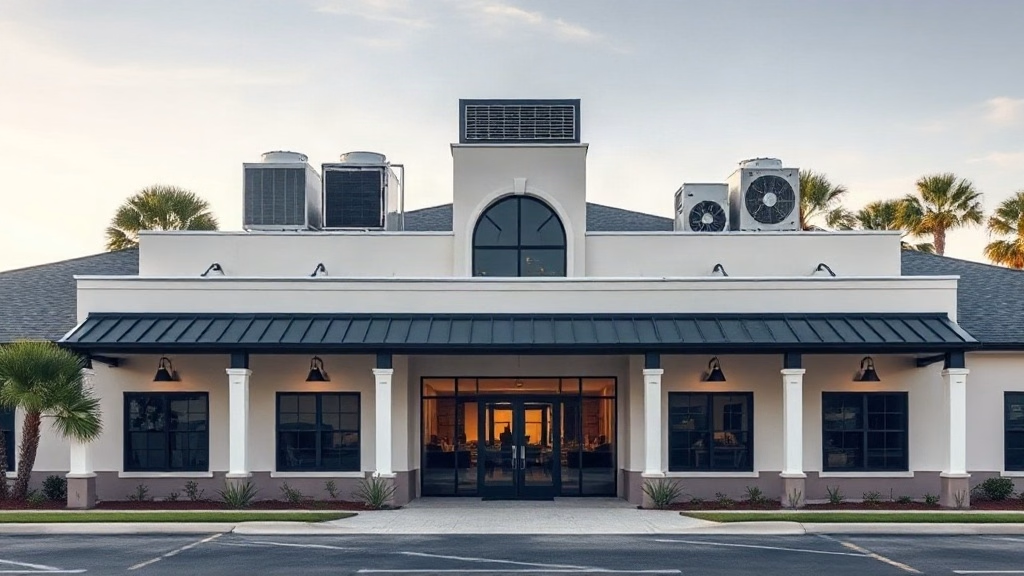
For HOA boards in Panama City Beach and across Bay County, the clubhouse and amenity buildings represent some of the most heavily used — and most expensively maintained — common assets in the community. Fitness centers, meeting rooms, poolside restrooms, and common-area kitchens all depend on climate control systems that run nearly year-round in the Florida heat. When an HVAC unit fails during a July board meeting or a Saturday pool party, the disruption is immediate and the emergency repair bill is steep. Yet many Bay County associations still operate without a structured preventive maintenance contract, relying instead on a call-when-it-breaks approach that drains reserves and shortens equipment life.
What a Preventive HVAC Maintenance Contract Should Cover
A properly structured preventive maintenance contract for HOA common buildings goes far beyond a once-a-year filter change. The contract should specify a minimum of four scheduled visits per year, with each visit tied to specific tasks and deliverables. Boards in Bay County’s coastal environment face humidity, salt air, and tropical storm debris that accelerate wear on condenser coils, compressor contacts, and drain lines — making quarterly attention the floor, not the ceiling.
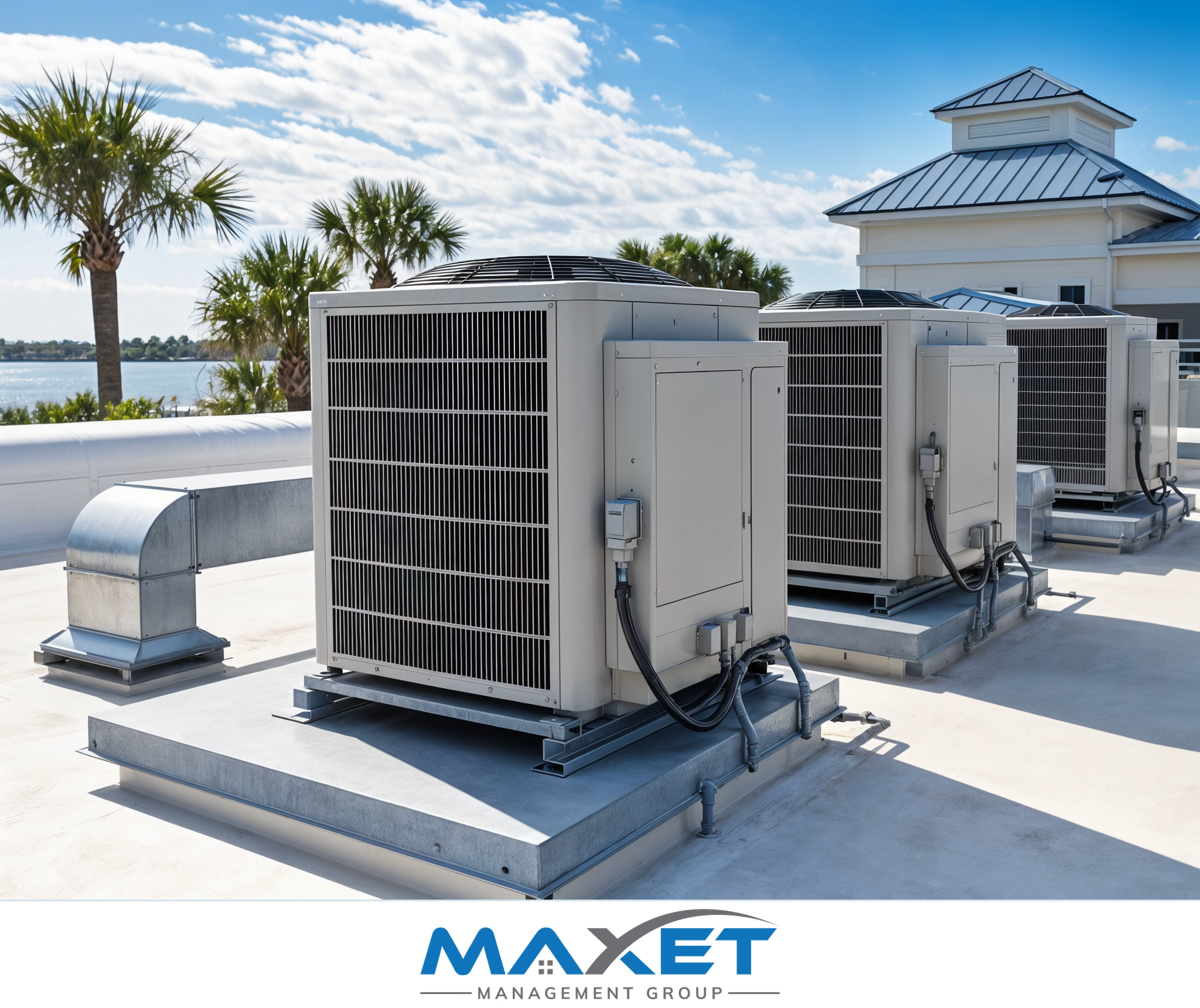
Each visit should include:
- Inspect and replace air filters (MERV 8 or higher for common areas)
- Clean condenser and evaporator coils to restore heat-transfer efficiency
- Clear condensate drain lines and verify float switch operation
- Check refrigerant charge and inspect for leaks
- Test electrical connections, contactors, and capacitor health
- Verify thermostat calibration and programming schedules
- Inspect ductwork for gaps, debris, or biological growth
- Document all findings with photos and a written service report
The deliverable is not just the service — it is the documentation. A vendor who services the equipment but leaves no written record has given the board nothing to verify and nothing to present during a reserve study update or insurance audit.
Why Reactive Maintenance Costs Bay County HOAs More
The math on reactive versus preventive HVAC maintenance is unforgiving. A typical 5-ton rooftop unit for a clubhouse costs $6,000-$8,000 to replace. With quarterly preventive maintenance, that unit should last 12-15 years in a coastal climate. Without it, compressor failure, coil corrosion, or electrical damage can cut that lifespan to 7-9 years — meaning the association replaces the unit nearly twice as often. Over a 15-year horizon for a clubhouse with two units, the difference between preventive and reactive approaches can exceed $15,000 in replacement costs alone, before accounting for emergency labor premiums and member dissatisfaction.
Beyond equipment replacement, reactive maintenance carries hidden costs that rarely appear in a budget line item:
- Emergency labor rates: After-hours and weekend service calls typically carry a 50-100% premium over scheduled maintenance rates.
- Reserve fund depletion: Unplanned HVAC replacements force boards to dip into reserves earmarked for other projects, creating a cascading shortfall.
- Special assessment pressure: When multiple units fail in the same season — common after a harsh summer — the reserve gap can trigger a special assessment that erodes board credibility.
- Member complaints and liability: A clubhouse that hits 90 degrees during a scheduled event generates complaints. A fitness center without ventilation creates humidity and mold risk, which can become a health and safety liability.
How to Structure an HVAC Maintenance Contract: What Bay County Boards Should Demand
The contract structure matters as much as the service scope. Boards should approach HVAC maintenance contracts with the same rigor they apply to any vendor relationship — documented expectations, measurable performance, and accountability for missed commitments.
1. Define the Scope and Frequency in Writing
Every task, every frequency, and every deliverable should be specified in the contract. “Quarterly maintenance” is not a scope — it is a vague promise. The contract should list each task, the number of annual visits, the expected duration of each visit, and the documentation required after each visit. Vendors who resist itemizing the scope are signaling that they intend to deliver the minimum.
2. Require Digital Service Reports with Photo Documentation
Paper logs get lost. Verbal assurances are unverifiable. The contract should require the vendor to submit a digital service report after each visit, including photos of the equipment condition, readings taken (refrigerant pressures, amperage, temperature differentials), and a checklist of completed tasks. The technology handles the data synthesis, while the manager provides the professional judgment and operational execution — reviewing the reports, flagging anomalies, and tracking trends across visits to identify equipment approaching end-of-life before it fails.
3. Set Performance Benchmarks and Penalty Clauses
A contract without consequences for non-performance is a suggestion. Boards should include benchmarks such as:
- Response time for emergency calls: maximum 4 hours during business days, 8 hours after hours
- Missed quarterly visit penalty: 10% reduction in monthly retainer per missed visit
- Equipment uptime target: 98% during cooling season (April through October)
- Documentation deadline: digital service report within 48 hours of each visit
4. Separate Preventive Visits from Repairs in the Pricing Structure
The most common pricing trap is bundling preventive maintenance and repairs into a single monthly fee. This creates a perverse incentive — the vendor earns the same whether the equipment runs flawlessly or breaks down weekly. Instead, boards should pay a fixed monthly retainer for scheduled preventive visits only, with repairs billed separately at a pre-negotiated labor rate. This aligns the vendor’s incentive with the board’s goal: keeping equipment running so repairs are rare.
5. Include a Seasonal Readiness Protocol
Bay County’s cooling season is long and intense. The contract should include a pre-season readiness visit in March or April that specifically prepares the system for peak load: coil deep-clean, refrigerant top-off, capacitor testing, and thermostat programming verification. A corresponding post-season visit in November should assess wear, address any issues discovered during the cooling season, and prepare the system for the shorter but still demanding heating season.
Traditional Management vs. Maxet’s Tech-Driven Management
| Aspect | Traditional HOA Management | Maxet’s Tech-Driven Management |
|---|---|---|
| Service verification | Paper logs, verbal reports | Digital service reports with photo evidence |
| Maintenance tracking | Spreadsheet or binder | Automated tracking with trend analysis and alerts |
| Contract compliance | Manual review, often missed | System-generated compliance dashboard |
| Cost forecasting | Reactive budget adjustments | Predictive lifecycle planning from service data |
| Board reporting | Verbal update at meetings | One-click audit trail with equipment health scores |
| Vendor accountability | Relationship-based trust | Performance-scored with documented evidence |
FS 720 vs FS 718: Maintenance Obligations for Bay County Associations
The maintenance obligations of an association differ depending on whether the community is organized under Florida Statute 720 (HOA) or Florida Statute 718 (Condominium Act). Bay County boards should understand which statute governs their maintenance responsibilities for common-area HVAC systems.
| Aspect | FS 720 (HOA) | FS 718 (Condominium) |
|---|---|---|
| Maintenance responsibility | Association maintains common areas per declaration | Association maintains common elements, limited common elements per declaration |
| Reserve funding for HVAC | Recommended but not statutorily mandated for HOAs | Required for components with deferred maintenance cost > $10,000 (post-SB 154) |
| Board’s fiduciary duty | FS 720.303(1) — officer and director duties | FS 718.111(1) — officer and director duties |
| Records access | FS 720.303(4) — official records must be maintained and accessible | FS 718.111(12) — official records including maintenance records |
| Vendor contract requirements | Governing documents specify approval thresholds | FS 718.3026 — contracts must comply with statutory requirements |
Under both statutes, the board has a fiduciary obligation to maintain association assets in a manner that preserves their value and function. Failing to maintain HVAC systems — and failing to document that maintenance — can expose board members to claims of breach of fiduciary duty, particularly if a preventable failure leads to a special assessment that could have been avoided with routine care.
The Cost of Skipping Documentation: A Bay County Risk Scenario
Consider a Bay County HOA whose clubhouse HVAC system fails in July. The board calls an emergency vendor, pays $4,200 for a compressor replacement, and draws from reserves. Six months later, a unit owner files a records request under FS 720.303(4) or FS 718.111(12) asking for maintenance records for the clubhouse HVAC system. The board has nothing to produce — no service reports, no inspection logs, no filter change records. The owner alleges that the board failed in its fiduciary duty to maintain common assets, pointing to the emergency replacement as evidence of neglect.
This scenario plays out more often than most boards realize. The defense is not a better attorney — it is a paper trail. A preventive maintenance contract that generates digital service reports after every visit, archived in the association’s records system, is the single strongest piece of evidence a board can produce to demonstrate that it fulfilled its maintenance obligations. The technology handles the data synthesis, while the manager provides the professional judgment and operational execution — ensuring that the records are not just collected but reviewed, acted upon, and reported to the board.
Frequently Asked Questions
How often should HOA clubhouse HVAC systems be serviced in Bay County?
Quarterly service visits are the minimum for Bay County’s coastal climate. The high humidity, salt air, and extended cooling season (April through October) accelerate coil corrosion, drain line blockages, and capacitor degradation. Boards should require four scheduled visits per year at minimum, with a pre-season deep clean in March or April.
What should an HVAC maintenance contract cost for an HOA clubhouse?
A preventive maintenance retainer for a typical clubhouse with two 5-ton units typically runs $150-$300 per month in the Bay County market. This covers scheduled visits, filter replacements, and basic inspections. Repairs, refrigerant, and parts are billed separately. Boards should be wary of quotes significantly below this range — they often exclude critical tasks or lack documentation requirements.
Can a board require photo documentation from the HVAC vendor?
Yes. The contract is a private agreement between the association and the vendor. Boards can — and should — require digital service reports with photos of equipment condition, readings, and completed tasks. This is a standard requirement in professional vendor management and creates the records trail needed to demonstrate fiduciary compliance under FS 720 or FS 718.
What happens if the HVAC vendor misses a scheduled maintenance visit?
The contract should include a penalty clause for missed visits — typically a 10% reduction in the monthly retainer per missed visit. More importantly, the board’s manager should track visit compliance digitally and notify the board when a visit is missed or delayed. A vendor who routinely misses scheduled visits is a vendor who should be replaced at contract renewal.
Building a Maintenance Standard That Protects the Board
Bay County HOA boards that take HVAC preventive maintenance seriously are not just protecting equipment — they are protecting themselves. A documented maintenance program demonstrates fiduciary responsibility, extends equipment life, stabilizes reserve contributions, and prevents the emergency scenarios that lead to special assessments and owner complaints. The board’s job is not to service the equipment. The board’s job is to set the standard, demand the documentation, and hold the vendor accountable to a contract that protects the community’s assets and the board’s fiduciary position.
Maxet’s approach to vendor management pairs these contractual standards with digital tracking that makes compliance visible. When every service visit is documented, every cost is categorized, and every equipment lifecycle is projected from real data, boards make decisions with evidence instead of estimates. That is the difference between managing a community and merely overseeing one.
Legal disclaimer: Maxet is a professional community association management firm providing business operational efficiency and administrative support. We are not a law firm, and the information provided in this article does not constitute legal advice or create an attorney-client relationship. For specific legal interpretation of Florida Statutes or governing documents, we strongly recommend consulting with a licensed attorney specializing in Florida community association law.