
Short answer: When water crosses a unit boundary in a Bay County condominium, responsibility and liability travel on separate roads. The association must act immediately to stop the source, dry shared structures, and repair common elements — while owners file their own insurance claims and restore their unit finishes. Who pays is determined later by insurance carriers, governing documents, and Florida law, not by who acted first. Boards that build a documented incident-response protocol before the next water event protect both the building and their fiduciary position.
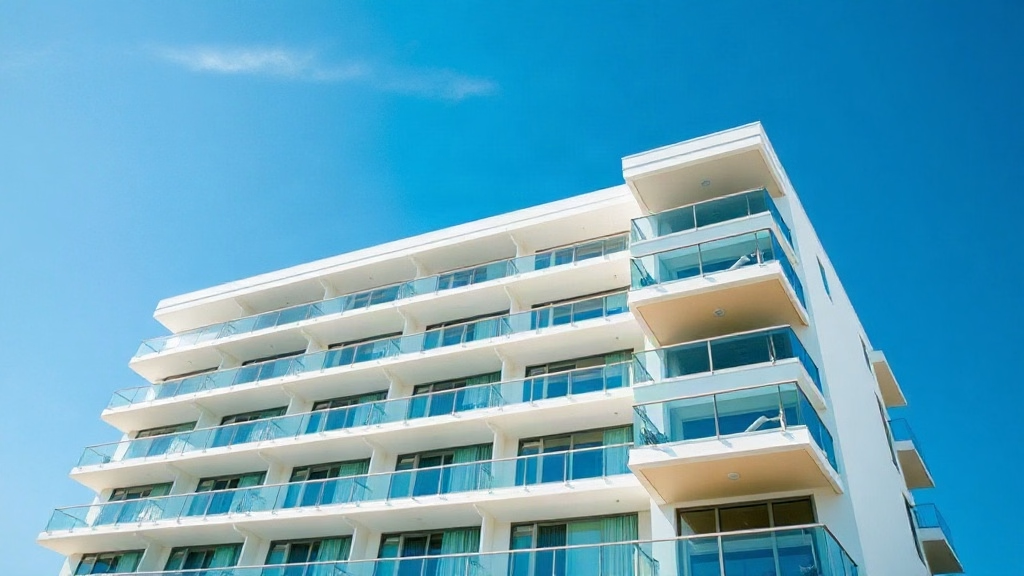
Why Water Damage Is a Board-Level Issue in Bay County Condominiums
A water loss rarely respects a unit boundary. It may begin with a neighbor’s appliance, an owner’s drain line, or a common-element pipe, yet quickly reach ceilings, walls, framing, and homes below. In Bay County’s coastal condominium towers — where shared plumbing, HVAC condensate lines, and high-rise construction multiply the pathways water can travel — a single failed wax ring or clogged condensate drain can cascade through multiple units and common areas before anyone notices.
For boards, this is not a routine maintenance call. It is a fiduciary event. The association has statutory obligations under Florida law to maintain common elements and prevent further damage. Owners look to the board for direction. Insurance carriers will examine the association’s response timeline, documentation, and maintenance history. A board that delays or deflects exposes the association — and potentially its directors — to claims of breach of fiduciary duty.
The board’s job is not to determine fault. For boards evaluating their current Bay County condo association management, the question is whether their firm has a protocol — or just a phone list. It is to ensure the association meets its maintenance obligations, coordinates the emergency response, and creates a clean record that insurers and counsel can work from.
The Three Most Common Water Loss Sources in Coastal Condominiums
HVAC Condensate Overflow
As an air conditioner cools humid air, moisture condenses on the evaporator coil and drains into a pan. In Bay County’s climate, where cooling systems run nearly year-round, the condensate path is under constant load. Slime, algae-like growth, and debris can collect in the pan, trap, and drain line. Because the system usually drains by gravity — with very little pressure — even a modest restriction can cause water to back up and overflow.
Once it escapes, gravity takes over. A slow leak can stain finishes, deteriorate materials, and support fungal growth. A larger overflow can travel through ceilings and walls into a lower unit. Shared collection piping may also become restricted when untreated condensate from several units converges, so maintaining the equipment inside one home is also a neighborly obligation.
Florida’s mechanical code provides several alternative overflow-protection arrangements when an overflow could damage building components. Depending on the installation, that may involve a secondary drain, an auxiliary pan, or a properly located shutoff device. The critical step is confirming the protection actually works: a disconnected, bypassed, or badly positioned switch cannot stop a loss.
Water Heater Failure
A tank water heater has a finite life, and it should be replaced before it fails — not after. Conventional tank heaters are commonly expected to last about eight to twelve years, although water quality, installation, maintenance, and design all matter. As a conservative risk-management benchmark, replacement no later than one-and-one-half times the original manufacturer’s warranty is a reasonable standard.
That benchmark is not a statutory lifespan or a guarantee. An association’s governing documents and any properly adopted inspection or replacement rule still control. If an owner keeps an aging heater beyond an applicable requirement, that decision may become important later when insurers examine maintenance, causation, and negligence.
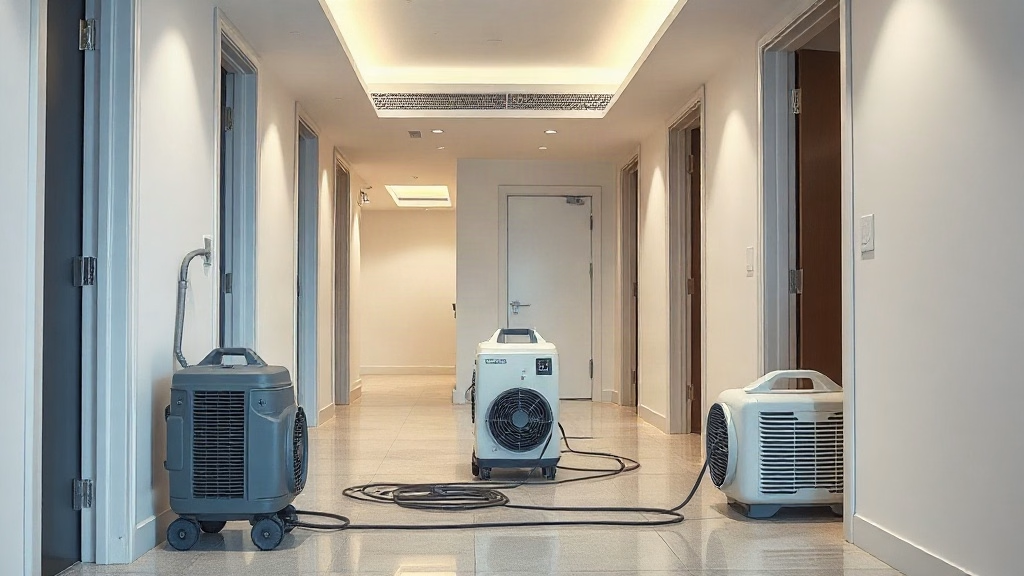
Toilet and Wet-Area Seal Failures
A toilet seal does not announce that it is failing. A well-installed wax ring may last for many years — sometimes for the life of the installation. In a multistory condominium, however, the consequence of a hidden seep can justify a more conservative approach. An eight-year preventive inspection and replacement interval is a reasonable risk-management standard for Bay County high-rise associations, not a statement that every wax ring naturally expires on that date.
Movement changes the equation. If a toilet rocks or its fasteners appear loose, the fixture should be pulled and reset, the one-time wax ring discarded, and the flange and surrounding floor inspected so the cause of the movement can be corrected. Water at the base, staining below, persistent odor, or a soft floor all call for prompt investigation.
Responsibility vs. Liability: Two Roads, Different Timelines
This is the most important distinction for boards to understand: responsibility determines who must act now. Liability determines who may ultimately pay. The two questions are connected, but they are not answered at the same time. Repairs and insurance notices should move forward while the cause and legal responsibility are investigated.
| Road One: Responsibility (Act Now) | Road Two: Liability (Determine Later) |
|---|---|
| Stop the source. Notify the association and insurer. Remove bulk water, dry the structure, repair common elements, and restore owner property. Each party moves the work assigned to it by the documents, law, and insurance policies. | Afterward, the carriers and affected parties investigate the source, maintenance history, rule compliance, causation, and negligence. Covered payments may lead to subrogation. Deductibles and uninsured losses are addressed separately. |
An affected owner should not wait for the neighbor, the association, or another carrier to volunteer payment. Either the owner funds the owner’s repairs or promptly presents the loss under the owner’s own policy. The association does the same for damage within its responsibility. If evidence later shows that someone was negligent or violated an enforceable requirement, insurers and the parties can pursue recovery through the legal and subrogation process. That later process should never hold the building — or a resident’s home — hostage to a debate over blame.
What the Association Must Do: Statutory Access and Common-Element Duty
Under Florida Statutes § 718.111(5), the association has an irrevocable right of access to each unit to maintain, repair, and replace common elements and to make emergency repairs. When a loss affects shared building components, the association ordinarily coordinates bulk water removal, structural drying, and common-element repair.
For a large, extensively spread, or prolonged loss, that work may require removing owner finishes — such as baseboard, drywall, flooring, or cabinet toe-kicks — to reach wet materials. Authority to remove a finish for necessary mitigation does not automatically decide who must pay to replace it. The association should document what was removed, why it was necessary, and the condition before and after, so the cost allocation can be resolved through insurance and the governing documents rather than by improvisation.
Under § 718.111(11), the association must maintain adequate insurance or self-insurance on common elements and property the association is obligated to maintain. Under § 718.113(1), modifications to common elements require board approval — but emergency mitigation does not wait for a board vote. The board’s emergency authority exists precisely for these situations.
What Owners Must Do: HO-6 Coverage and Personal Responsibility
Owners must stay engaged at the same time the association acts. Personal property and many unit finishes — often including floor and wall coverings, cabinetry, appliances, and the water heater — are commonly outside the association’s required property coverage. Exact boundaries depend on Florida law, the declaration, and the policies involved.
Once the building is dry and the association’s portion is addressed, the owner proceeds with the unit’s restoration, obtaining written association approval or permits when required. The owner’s HO-6 policy is their primary recovery vehicle for unit-level damage.
Three HO-6 coverage areas deserve board-level attention because gaps create delinquency and special-assessment pressure:
- Replacement cost vs. market value: Market value and purchase price are not substitutes for a current replacement-cost estimate. Owners should review their policy with a qualified agent and confirm it reflects the unit’s current replacement cost, improvements, finishes, contents, and actual occupancy.
- Loss-of-use and fair-rental-value coverage: In Bay County’s resort condominiums, a unit uninhabitable for even thirty days during peak season can create a serious financial loss. Selecting a dollar limit intended to protect approximately twelve months of reasonably supportable net rental income or additional living expense is prudent.
- Loss-assessment coverage: Florida policies must provide at least $2,000 for qualifying property-loss assessments under § 627.714, but that minimum may be far below an owner’s share of a large association deductible. Considering up to $10,000 — tested against the association’s master deductibles, property values, and the owner’s likely share — is a reasonable benchmark.
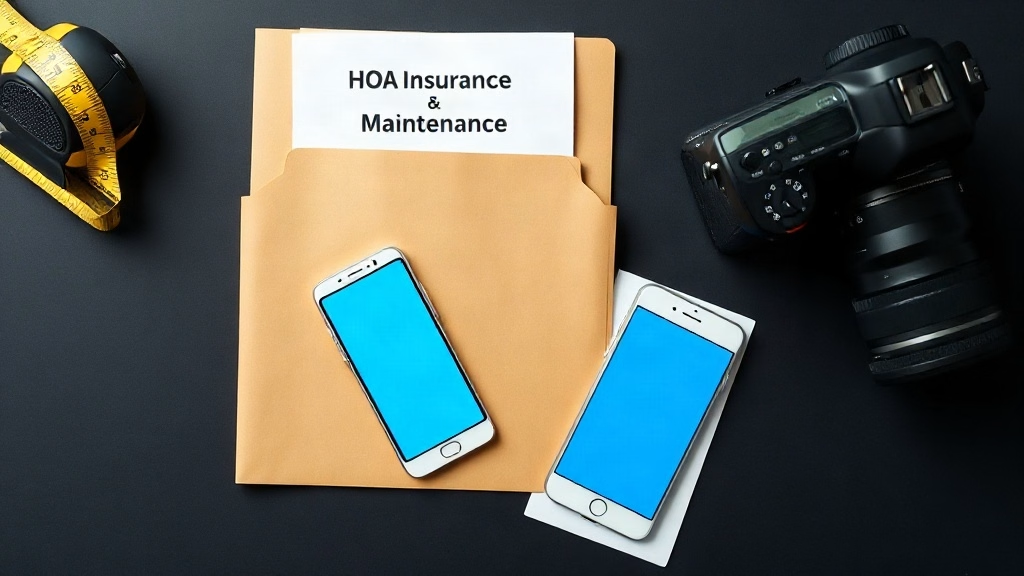
The Maxet Approach: Tech-Driven Incident Tracking
The difference between a well-managed water event and a fiduciary crisis is usually documentation. Legacy management firms rely on phone logs, email chains, and paper work orders that disappear when the next emergency arrives. Maxet takes a different approach.
When a water event is reported at a Maxet-managed association, the incident enters a digital tracking system that records the report timestamp, the responding staff member, the units and common areas affected, the mitigation vendor dispatched, and the drying-progress readings. The technology handles the data synthesis — automatically compiling the response timeline, vendor documentation, and insurance correspondence into a single incident file — while the community association manager provides the professional judgment and operational execution.
This matters for three reasons:
- Insurance recovery: Carriers need a clean, chronological record of what happened, what the association did, and when. A scattered email trail weakens the claim. A structured incident file strengthens it.
- Board transparency: Directors can review the response in real time without calling the manager for a status update. Decisions happen in minutes, not hours.
- Subrogation readiness: If the loss traces to a specific owner’s negligence, the documented timeline gives insurers the evidence they need to pursue recovery — protecting the association’s deductible and reserve balance.
Traditional Management vs. Maxet’s Tech-Driven Management
| Traditional Management | Maxet’s Tech-Driven Management |
|---|---|
| Phone calls and paper work orders | Digital incident tracking with timestamped records |
| Email chains scattered across inboxes | Single incident file with vendor docs, drying logs, and insurance correspondence |
| Response timeline reconstructed from memory | Automatic chronological timeline generated from system data |
| Board learns about the event days later | Board has real-time visibility into response status |
| Insurance claims supported by ad-hoc documentation | Subrogation-ready incident file with full audit trail |
FS 720 vs FS 718: Water Damage Responsibilities Compared
| Issue | FS 718 (Condominium) | FS 720 (HOA) |
|---|---|---|
| Association maintenance duty | Common elements only (§ 718.113); unit boundaries set by declaration | Common areas only; maintenance obligations defined by governing documents |
| Right of access to units | Irrevocable right to access units for emergency repairs and common-element maintenance (§ 718.111(5)) | No equivalent statutory right of access; depends on governing documents |
| Insurance requirements | Association must insure common elements and property it is obligated to maintain (§ 718.111(11)) | Insurance requirements vary by declaration; no uniform statutory mandate equivalent to § 718 |
| Owner-level coverage mandate | HO-6 policy expected; loss-assessment minimum $2,000 (§ 627.714) | No statutory HO-6 requirement; owner insurance obligations set by governing documents |
| Emergency repair authority | Board may act without membership vote for emergency mitigation | Board authority for emergency repairs depends on governing documents |
Building a Water Damage Response Protocol: What Bay County Boards Should Demand
A board shopping for better management — or auditing its current firm — should ask whether the manager has a written, practiced water damage response protocol. If the answer is “we handle it case by case,” that is a red flag. Here is what a professional protocol looks like:
1. Immediate Notification
When water is reported, the association office is notified immediately — not routed to a vendor first. The manager records the time, the reporting party, the affected units, and the suspected source. If the source is inside a unit, the owner and their rental manager or local contact are notified in writing.
2. Source Stop and Safety
The source is stopped if it can be done safely. People are protected from electrical and slip hazards. The area is photographed before any mitigation work begins. These photographs become evidence for insurance and liability determinations.
3. Mitigation Vendor Dispatch
A pre-qualified water mitigation vendor is dispatched under a standing contract — not sourced ad hoc during the emergency. The vendor’s scope includes bulk water removal, structural drying, and moisture mapping. Drying-progress readings are logged daily until moisture levels return to acceptable standards.
4. Insurance Notification
The association notifies its master insurance carrier the same day. The manager prepares a preliminary loss notice with the incident timeline, affected areas, mitigation steps taken, and vendor contact information. Owners are instructed to file under their HO-6 policies for unit-level damage.
5. Documentation and Closure
When drying is complete and common-element repairs are underway, the incident file is closed with: the full response timeline, vendor invoices and drying logs, photographs, insurance correspondence, and a cost-allocation summary showing what the association paid, what owners claimed, and what remains subject to subrogation.
A Local Resource for the Vacation Rental Side
Many Bay County condominium units are owned as short-term rental investments. When a water event occurs in a rental unit, the owner may need both the association’s common-element response and the rental management company’s unit-level coordination. Maxet’s role is community association management — maintaining common elements, coordinating insurance, and protecting the association’s fiduciary position. Maxet does not manage vacation rentals or unit interior restoration.
For owners who need vacation rental management support — including guest communication during a displacement, unit interior coordination, and rental logistics — Vacations Perfected serves the Panama City Beach market and can coordinate the rental side of a water event while the association handles the building.
Frequently Asked Questions
Does the association have to enter a unit to stop a water leak?
Yes. Under Florida Statutes § 718.111(5), the association has an irrevocable right of access to each unit to maintain, repair, and replace common elements and to make emergency repairs. If a leak inside a unit is damaging common elements or other units, the association may enter to stop the source, even if the owner is unavailable.
Who pays for drying and mitigation if the leak started in an owner’s unit?
Responsibility and liability are separate questions. The association coordinates mitigation of shared structures immediately — regardless of where the leak started. Who ultimately pays depends on the insurance policies, the governing documents, causation, and negligence. The association’s master policy may cover common-element drying. The owner’s HO-6 policy typically covers unit finishes and personal property. Subrogation between carriers resolves the final cost allocation.
What should a board demand from its management company after a water event?
A complete incident file: the report timestamp, response actions, vendor dispatch records, drying-progress logs, photographs, insurance correspondence, and a cost-allocation summary. If the management company cannot produce this within a reasonable period after the event, the board has a documentation gap that weakens insurance recovery and fiduciary protection.
Can an owner wait for the neighbor’s insurance to pay before repairing their unit?
No. An affected owner should not wait for the neighbor, the association, or another carrier to volunteer payment. Either the owner funds the repairs or promptly presents the loss under their own HO-6 policy. If evidence later shows negligence by another party, the owner’s insurer can pursue subrogation. Delaying repairs while waiting for fault determination can worsen the damage and weaken the claim.
Key Takeaways for Bay County Boards
- Act first, assign fault later. The association’s duty to mitigate common-element damage does not depend on who caused the leak. Stop the source, dry the structure, document everything.
- Know your statutory tools. § 718.111(5) gives access. § 718.111(11) sets insurance obligations. § 718.113(1) governs common-element work. § 627.714 sets loss-assessment minimums.
- Demand a written protocol. If your Bay County HOA management company cannot produce a water damage response protocol, that is a fiduciary gap — not a style preference.
- Educate owners on HO-6 coverage. Gaps in replacement cost, loss-of-use, and loss-assessment coverage become the association’s problem through delinquency and special assessments.
- Track incidents digitally. A timestamped, structured incident file is the difference between a clean insurance recovery and a subrogation dispute that drags for months.
Legal disclaimer: Maxet is a professional community association management firm providing business operational efficiency and administrative support. We are not a law firm, and the information provided in this article does not constitute legal advice or create an attorney-client relationship. For specific legal interpretation of Florida Statutes or governing documents, we strongly recommend consulting with a licensed attorney specializing in Florida community association law.