
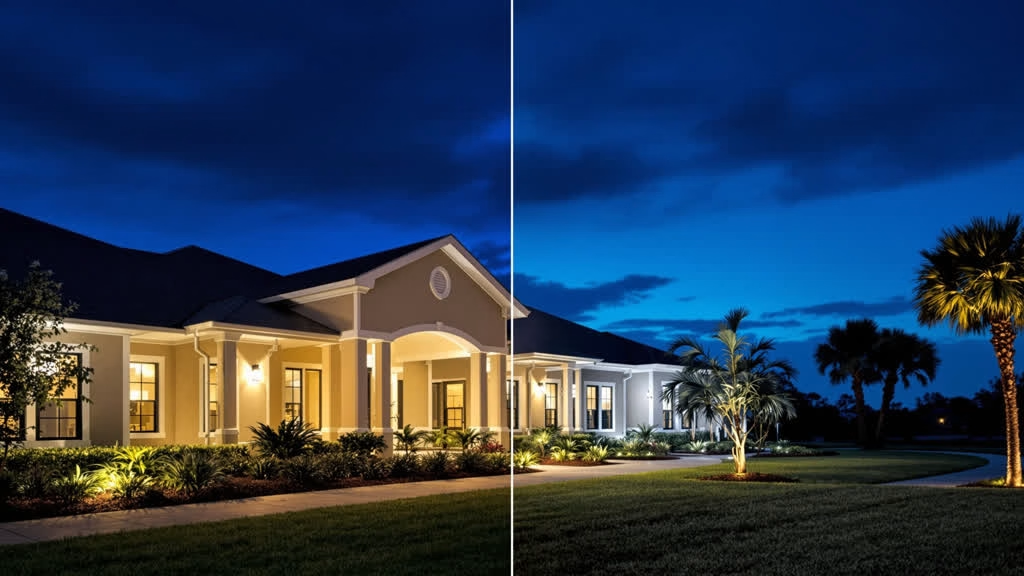
Short answer: An LED lighting retrofit can reduce common-area lighting energy costs by 50–70% for Bay County HOA communities, but boards must verify actual savings through metered data and post-installation audits rather than accepting vendor projections at face value. The technology handles consumption tracking and cost analysis, while the manager provides the professional judgment and operational execution to ensure the project delivers on its promises.
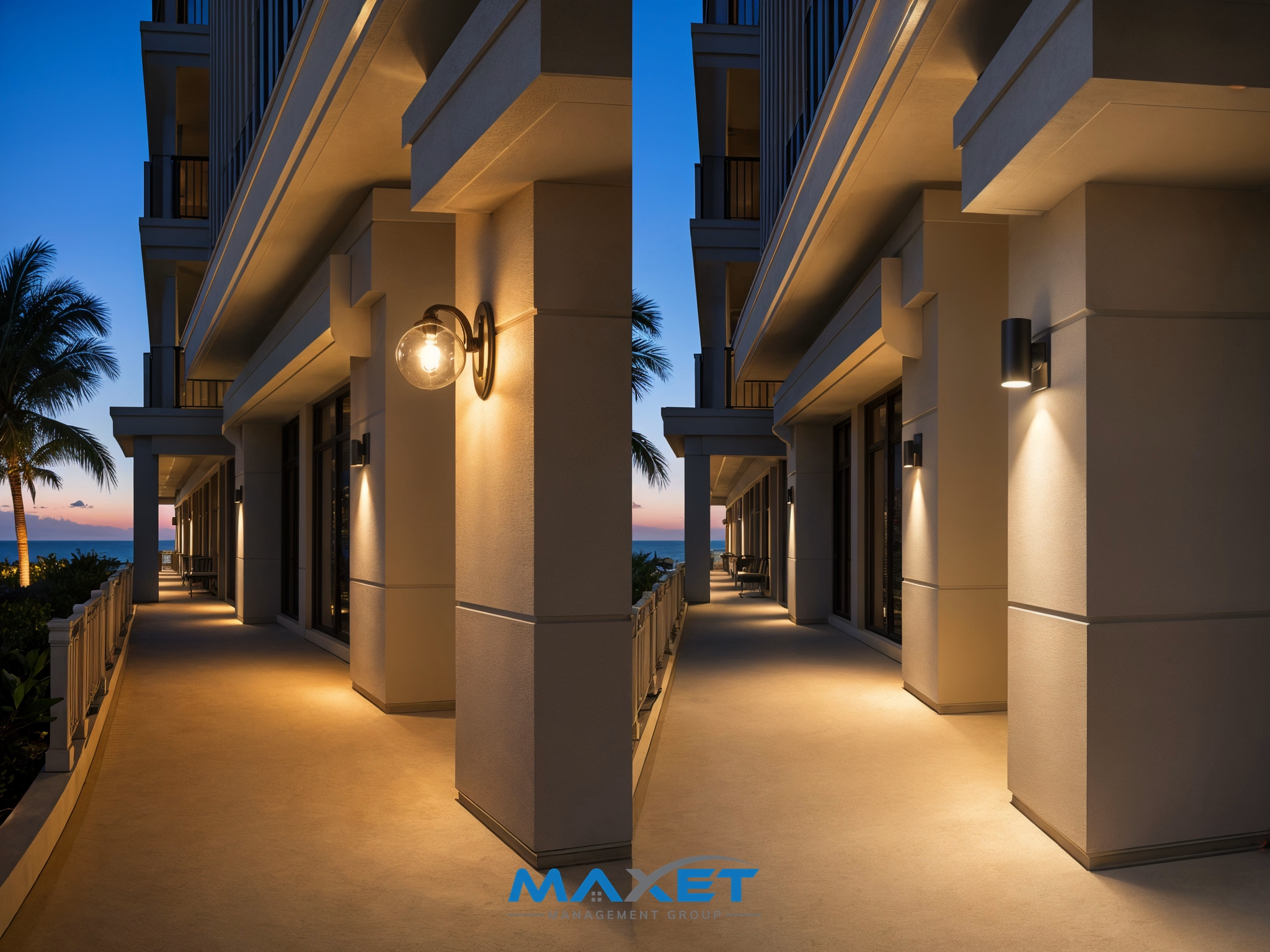
For HOA boards in Panama City, Panama City Beach, and unincorporated Bay County, lighting represents one of the largest line items in the common-area maintenance budget. Legacy high-pressure sodium (HPS) and metal halide fixtures consume significantly more electricity than modern LED alternatives, require more frequent bulb replacements, and produce inconsistent light quality that undermines community appearance and security. A properly executed LED retrofit addresses all three problems, but only when the board treats it as a procurement project with verified outcomes, not a vendor presentation to be rubber-stamped.
Why Bay County HOAs Are Replacing Legacy Lighting Now
Three forces are driving LED retrofits across Northwest Florida associations right now. First, utility rates in Bay County have continued their upward trend, making the energy cost gap between legacy and LED fixtures wider each year. Second, legacy fixture manufacturers are discontinuing replacement bulbs for older HPS and metal halide models, which means maintenance costs are rising as supply shrinks. Third, Florida Statute 720.305(2) reinforces board fiduciary obligations to maintain common areas cost-effectively, and an unaddressed energy inefficiency in common-area lighting is increasingly difficult to justify to owners questioning their assessments.
Bay County’s coastal environment adds another consideration. Salt air corrosion degrades older fixture housings faster than inland climates, meaning a retrofit that includes upgraded weatherproof enclosures delivers longer service life in Panama City Beach and coastal communities than it would in other regions.
Compliance Comes Before a Bulb Change
For any association near a sea-turtle nesting beach, the first retrofit question is not simply which LED saves the most energy. The association must first identify the applicable local ordinance, permit conditions, governing documents, and electrical-code requirements, then confirm the proposed fixture and placement comply before any bulb or fixture is replaced. Florida law directs the Department of Environmental Protection to establish guidance for local government beachfront-lighting regulations protecting hatching sea turtles. The Florida Fish and Wildlife Conservation Commission identifies adopted sea-turtle lighting ordinances in both Bay County and Panama City Beach.
Where turtle-lighting requirements apply, a conventional white LED specification may be inappropriate. FWC guidance emphasizes lighting that is low, long-wavelength, and shielded; it identifies amber, orange, or red long-wavelength light, the lowest necessary output, and complete downward shielding as core practices. Safety and security needs still matter, but the solution should be a compliant design—such as an appropriately specified, shielded fixture—not an informal bulb swap. The applicable ordinance and governing law take priority over energy-savings assumptions or a vendor’s standard recommendation.
Before approving a scope, obtain the local rule applicable to the property, verify whether the site is within a regulated beachfront or permit area, and have the licensed electrical contractor document fixture output, shielding, direction, and location. Consult association counsel or the enforcing jurisdiction when the legal or permit requirements are uncertain. This article is educational information, not legal advice.
What an LED Retrofit Project Actually Involves
A lighting retrofit is not simply swapping bulbs. A proper project includes four phases that a board should understand before signing a contract:
1. Audit and Inventory
Every existing fixture must be cataloged: location, wattage, mounting height, hours of operation, and condition. This baseline establishes the pre-retrofit energy consumption that savings will be measured against. Without this baseline, no vendor claim about savings can be verified. The audit should also identify fixtures that are redundant, poorly placed, or no longer needed due to changes in common-area usage.
2. Specification and Fixture Selection
LED fixtures vary widely in quality, color temperature, lumen output, shielding, and warranty terms. Fixture selection must begin with the applicable ordinance, permit conditions, governing documents, and electrical requirements—especially for beachfront or turtle-nesting areas. Only after that compliance review should the association compare output, color characteristics, moisture/dust ratings, and warranty terms. For coastal conditions, specify an enclosure and corrosion-resistance standard appropriate to the location and manufacturer instructions; do not assume a uniform fixture or color-temperature recommendation fits every property.
3. Installation and Commissioning
Installation should be performed by a licensed electrical contractor, not the fixture vendor’s general crew. The board should require a commissioning report that documents each fixture location, confirms proper operation, and records the post-installation wattage. This commissioning report is the evidence base for the savings verification step.
4. Savings Verification
This is the phase most boards skip, and it is the one that matters most. After installation, the association should compare metered energy consumption against the pre-retrofit baseline for at least 3–6 months. If the community has separate metering for common-area lighting, this is straightforward. If lighting shares a meter with other loads, the board should install a sub-meter or use the fixture-level wattage data from the commissioning report to calculate expected savings and compare against utility bills.
Traditional Management vs. Maxet’s Tech-Driven Management
| Aspect | Traditional Management | Maxet’s Tech-Driven Approach |
|---|---|---|
| Baseline Energy Data | Vendor projection based on manufacturer specs | Metered baseline established before retrofit begins |
| Fixture Selection | Whatever the vendor sells, with limited specification review | Board-facing spec comparison with IP rating, warranty, and lifecycle cost analysis |
| Savings Verification | Vendor’s post-installation report accepted as final | Independent metered verification over 3–6 months with variance reporting |
| Vendor Accountability | Single vendor presentation, no competitive benchmarking | Digital vendor performance scoring with cost-per-lumen and warranty tracking |
| Ongoing Monitoring | No post-installation tracking | Automated consumption tracking with anomaly detection for premature failures |
FS 720 vs FS 718: Lighting Retrofit Authority and Funding
The legal framework for undertaking a lighting retrofit differs between homeowners associations (Chapter 720) and condominium associations (Chapter 718). Boards must understand which statute governs their community before approving the project.
| Factor | FS 720 (HOA) | FS 718 (Condominium) |
|---|---|---|
| Common Area Authority | Board may approve maintenance projects within budget (FS 720.303(1)) | Board may approve within budget; major projects may require owner vote depending on governing docs |
| Reserve Funding | Reserve study may include lighting replacement (FS 720.303(6)) | SIRS and reserve study must include structural and reserve components (FS 718.112(2)(g)) |
| Competitive Bidding | Recommended but not always mandated; check governing docs | Required for contracts exceeding statutory thresholds (FS 718.3026) |
| Fiduciary Standard | Board owes fiduciary duty to members (FS 720.303(1)) | Board owes fiduciary duty to unit owners (FS 718.111(1)) |
How to Hold Your Vendor Accountable
The single most common failure in HOA lighting retrofits is not the technology — it is the absence of accountability mechanisms in the contract. A board that signs a retrofit agreement without the following provisions is accepting vendor claims on faith rather than evidence. This connects to broader vendor performance management practices that Maxet applies across all association contracts:
Performance Guarantee Clause
The contract should specify the expected energy savings as a percentage or dollar figure, tied to the metered baseline. If actual savings fall short after the verification period, the vendor should be obligated to either correct the installation (adding fixtures, adjusting output) or compensate the association for the shortfall.
Warranty Registration and Transfer
Fixture warranties must be registered with the manufacturer in the association’s name, not the vendor’s. A common practice is for vendors to register warranties under their own company, which means when the vendor goes out of business or changes ownership, the association has no recourse. The contract should require proof of manufacturer registration in the association’s name within 30 days of installation.
Commissioning Documentation
The vendor must deliver a commissioning report that includes: fixture make, model, and serial numbers; installation locations with a site map; post-installation wattage readings; and a certification that all fixtures meet the specified IP rating and color temperature. This document becomes the association’s asset for warranty claims and future maintenance planning.
Removal and Disposal of Legacy Fixtures
Older HPS and metal halide fixtures contain components that require proper disposal. The contract should specify that the vendor is responsible for removing and legally disposing of all legacy fixtures, with documentation of disposal for the association’s records.
Financing the Retrofit Without a Special Assessment
Many Bay County associations assume a lighting retrofit requires a special assessment. It often does not. Three financing approaches can fund the project within existing budgets:
Utility rebate programs: Gulf Power (now part of Florida Power & Light) and other Bay County utility providers offer commercial energy efficiency rebates for LED retrofits. These rebates can offset 20–40% of project cost. The board should confirm rebate eligibility before selecting fixtures, as some programs require pre-approval.
Operating budget reallocation: If the retrofit reduces monthly lighting costs by 60%, the savings can be applied to a short-term financing arrangement (12–36 months) that is fully covered by the reduced utility bills. This is effectively a self-funding project.
Reserve fund allocation: If the reserve study already includes a line item for lighting replacement, the board can allocate those reserves to the retrofit rather than waiting for fixture failure. This is a defensible use of reserves because the retrofit extends asset life and reduces ongoing operating costs.
The Sovereign AI Approach to Retrofit Oversight
Maxet uses a reasoning engine to synthesize the high-volume data that a lighting retrofit generates: fixture specifications, warranty terms, energy consumption logs, commissioning reports, and vendor performance metrics. The technology handles the data synthesis, cross-referencing manufacturer specifications against independent test data, and flagging consumption anomalies that indicate premature fixture failure. A human manager provides the professional judgment and operational execution, reviewing flagged items, negotiating with vendors, and making fiduciary recommendations to the board.
This approach means the board does not have to become lighting experts to make an informed decision. The synthesis layer surfaces the relevant tradeoffs: cost per lumen, warranty coverage, expected service life in a coastal environment, and verified savings against the metered baseline. The board’s role is to evaluate the options and direct the project, not to parse spec sheets.
Frequently Asked Questions
How much can a Bay County HOA save with an LED lighting retrofit?
Most associations see a 50–70% reduction in common-area lighting energy costs. The exact figure depends on the type and age of legacy fixtures, hours of operation, and the efficiency of the selected LED replacements. Savings should be verified through metered data, not vendor estimates.
Does an LED retrofit require a vote of the homeowners?
Under FS 720, the board can typically approve a lighting retrofit within the approved operating budget without a homeowner vote. If the project requires a special assessment or exceeds budgetary authority defined in the governing documents, a vote may be required. Condominium associations under FS 718 should check their declaration for contract threshold requirements.
How long do LED fixtures last in a coastal Bay County environment?
Quality LED fixtures with IP65+ ratings typically last 50,000–100,000 hours (equivalent to 10–20 years of nighttime operation). Coastal salt air exposure can reduce lifespan if fixtures are not properly rated. Warranty terms are the best indicator of expected service life in this environment.
What happens if the vendor’s savings claims do not materialize?
If the contract includes a performance guarantee clause, the vendor is obligated to correct the installation or compensate the association. Without this clause, the association has limited recourse. This is why the savings verification phase and the performance guarantee are the two most critical contract provisions.
Next Steps for Bay County Boards
If your association is spending more than expected on common-area lighting, or if your maintenance budget includes frequent bulb replacements for aging fixtures, an LED retrofit warrants a structured evaluation. The first step is a no-cost baseline audit to establish current consumption and identify the fixtures that are driving cost. From there, a board-facing specification comparison and vendor performance framework can be prepared, giving the board the evidence it needs to make a fiduciary decision with confidence.
Maxet provides community association management services to HOA and condominium boards in Bay County and across Northwest Florida. The technology handles data synthesis and consumption tracking; the manager provides professional judgment and operational execution. Contact Maxet to schedule a baseline lighting audit for your community.
Legal disclaimer: Maxet is a professional community association management firm providing business operational efficiency and administrative support. We are not a law firm, and the information provided in this article does not constitute legal advice or create an attorney-client relationship. For specific legal interpretation of Florida Statutes or governing documents, we strongly recommend consulting with a licensed attorney specializing in Florida community association law.