
Short answer: A condominium board is elected to govern the association’s shared business—not to manage a collection of personal preferences. In Florida, the association’s officers and directors have a fiduciary relationship to unit owners, and directors are expected to act in good faith, with prudent care, and in the association’s interests.[1][2] For Bay County boards, the practical work is disciplined oversight of money, common elements, records, vendors, meetings, and the professionals who help execute those decisions.
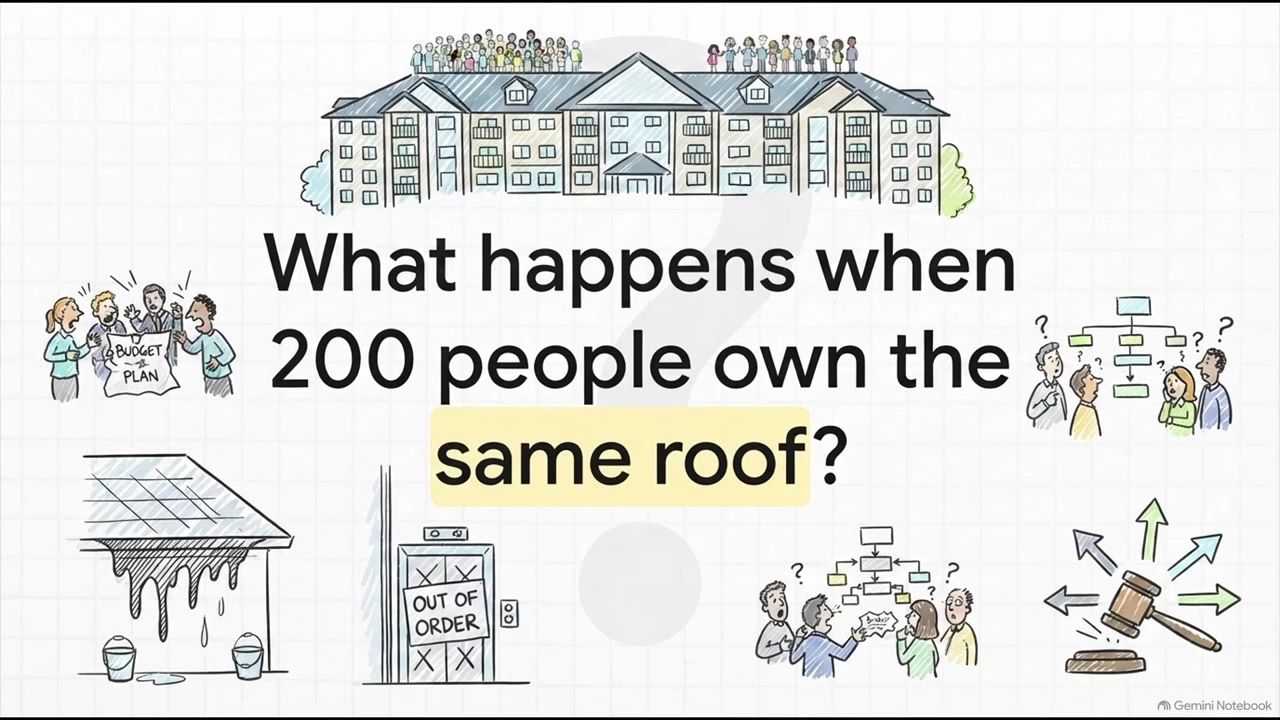
Condo ownership is shared ownership with a governance problem built in. A unit owner may own an individual unit, but the roof, elevators, structural systems, corridors, grounds, and other common elements require collective decisions. The board is the small elected body that makes those decisions through the association’s lawful authority.
That does not make a director the building’s chief technician, lawyer, accountant, or full-time property manager. It makes the director responsible for asking the right questions, making informed decisions, documenting the basis for those decisions, and holding the right professionals accountable.
Why a condominium board exists
Without a board, every repair, contract, rule, budget choice, and insurance decision could become a vote among all owners. That is not a workable operating model for a multi-unit property. The association is the corporate vehicle that operates the condominium, and Florida law gives the association powers and duties under the statute, its declaration, and bylaws.[1]
For a board member, the practical translation is simple: your job is to protect the community’s ability to make sound, timely, documented decisions about shared property and shared money.
FS 720 vs FS 718: the governing framework differs
This article addresses condominiums. Florida condominium associations operate principally under Chapter 718, while homeowners’ associations operate principally under Chapter 720. Both statutes establish an association structure and fiduciary relationship, but the property form, governing documents, reserve obligations, meeting procedures, and compliance questions can differ. Board members should confirm which statute and documents apply before acting.[1][4]
| Issue | Condominium association | Homeowners’ association |
|---|---|---|
| Primary Florida chapter | Chapter 718 | Chapter 720 |
| Shared-property context | Units plus common elements in a condominium regime | Parcels in a homeowners’ association community |
| Board baseline | Association officers and directors have a fiduciary relationship to unit owners. | Association officers and directors are subject to the director standard in F.S. 617.0830 and have a fiduciary relationship to members. |
| Practical board question | What do Chapter 718 and the condominium documents require? | What do Chapter 720 and the association’s governing documents require? |
What fiduciary duty looks like in practice
“Fiduciary duty” can sound abstract until a major contract, reserve decision, insurance renewal, or structural repair is in front of the board. Florida’s condominium statute states that officers and directors have a fiduciary relationship to unit owners.[1] Florida’s nonprofit corporation standards also require directors to act in good faith, in the corporation’s best interests, and with the care an ordinarily prudent person would consider appropriate under similar circumstances.[2]
That does not mean every decision has to be perfect. It does mean directors should avoid treating association decisions as personal disputes, rubber-stamping incomplete information, or making major calls without asking what the governing documents, financial records, experts, and legal counsel require.
Use a repeatable decision record
Before a consequential vote, a well-run board should be able to answer:
- What issue is the association solving?
- What authority, governing-document provision, budget line, or professional advice supports the action?
- What options were considered?
- What costs, risks, and owner impacts were discussed?
- What follow-up, owner communication, or vendor oversight is required after the vote?
That record does more than improve minutes. It makes board decisions easier to explain, easier to carry forward after an election, and less vulnerable to confusion later.
The four operating responsibilities of an effective condo board
1. Steward the association’s money
Boards approve budgets, monitor operating and reserve funds, review financial reporting, and make decisions that affect assessments and long-term capital needs. The board should expect clear financial information, not merely accept a balance sheet without context. A good monthly review connects cash, delinquencies, budget-to-actual performance, reserve obligations, major contracts, and pending maintenance decisions.
For a board facing a large project, the key question is not only “Can we pay the invoice?” It is “What does this choice do to the property, reserves, insurance posture, and owners over the next several years?”
2. Protect the common elements and plan beyond the current year
Common-element oversight is not a reactive maintenance queue. It is a long-term asset-management responsibility. Roofs, life-safety systems, mechanical equipment, paving, elevators, drainage, and structural components have different useful lives and risk profiles. A board should ask management and technical advisers for a visible project roadmap: condition, risk, estimated timing, projected cost, funding source, and next decision point.

3. Govern fairly and keep the community operable
Rules are not a tool for winning neighbor disputes. They are the operating framework for shared living. The board’s role is to apply the association’s governing documents consistently, follow required procedures, and distinguish between a legitimate association issue and a personal grievance.
That calls for a professional meeting culture: agendas that identify decisions, notices that meet applicable requirements, minutes that capture actions, conflict disclosures when needed, and communications that explain the association’s next step without inflaming the issue.
4. Maintain informed oversight of vendors and advisers
Boards select and oversee the people who help the association operate: a licensed community association manager, association counsel, accountants, insurance advisers, engineers, reserve specialists, and contractors. Florida defines community association management as work requiring specialized knowledge, judgment, and managerial skill when performed for compensation in qualifying associations; the definition includes financial administration, budgets, meeting support, contract negotiation subject to board approval, maintenance coordination, and compliance work.[3]
The board should not outsource its judgment. It should create clear scopes, review reporting, verify that work is completed, and hold regular decision points rather than waiting for an emergency.
Delegate tasks—do not abdicate oversight
Strong boards delegate. Florida’s director standards recognize that directors may rely on competent officers, employees, counsel, accountants, other experts, and properly constituted committees when the director does not have knowledge making that reliance unwarranted.[2]
That is the distinction between healthy delegation and abdication:
| Traditional Management approach | Maxet’s tech-driven management approach |
|---|---|
| A director tries to personally run every project. | The board assigns execution, receives milestones, and votes on defined decision gates. |
| Management sends information only when a problem becomes urgent. | Management provides a standing dashboard of finances, maintenance, vendor performance, and deadlines. |
| Experts are hired after a dispute escalates. | The board obtains the right professional input before high-risk commitments. |
| Records live in separate inboxes and memory. | Records, approvals, contracts, and meeting actions are organized for continuity and inspection. |
At Maxet, technology handles the data synthesis—organizing records, surfacing deadlines, and connecting operational reporting—while the board and manager provide the professional judgment and operational execution. Software should make oversight easier; it should never be used to replace fiduciary decision-making.
What Bay County boards should demand from management
A board does not need a manager who simply transmits emails. It needs an operational partner that makes the board’s responsibilities manageable. Ask whether the management process gives you:
- a monthly financial and project dashboard that directors can understand;
- a current contract, insurance, maintenance, and compliance calendar;
- clear owner communications around material decisions;
- documented vendor scopes, bids, approvals, and performance follow-up;
- a reliable record system that survives turnover; and
- a practical escalation path when engineering, legal, insurance, or reserve expertise is needed.
The point is not to create more process. It is to prevent the board from discovering critical information too late to make a good decision.

How should owners evaluate board candidates?
The best candidate is not necessarily the loudest voice at a meeting or the person with the strongest complaint. Look for judgment, willingness to prepare, financial and operational curiosity, respect for process, and the ability to work with other directors and qualified professionals. A board seat is stewardship of a shared asset and a shared community.
Frequently Asked Questions
Is a Florida condo board responsible for every day-to-day task?
No. The board governs and oversees the association’s affairs. It may rely on qualified managers and advisers for delegated work, but directors still need informed oversight of the association’s decisions and operations.[2]
Can a condo board make decisions based on an individual owner’s complaint?
A complaint can identify an issue, but board decisions should be grounded in the governing documents, applicable law, available facts, and the association’s interests—not in personal conflict or selective enforcement.
What should a new board member learn first?
Start with the declaration, bylaws, budget, recent financials, insurance summary, current contracts, reserve or capital-project information, meeting minutes, and the association’s open issues. For legal interpretation, use qualified Florida community-association counsel.
Does hiring a management company remove the board’s responsibility?
No. Management can perform specialized operational services, but the board remains responsible for governing, making informed decisions, and overseeing the association’s direction.
Need a more usable operating system for your board?
If your Bay County condominium board is buried in scattered records, unclear vendor accountability, budget surprises, or last-minute decisions, Maxet can help build a more orderly management rhythm. Start with a conversation about the information, reporting, and professional support your board needs to govern with confidence.
Sources
- [1] F.S. 718.111 — The association
- [2] F.S. 617.0830 — General standards for directors
- [3] F.S. 468.431 — Definitions
- [4] F.S. 720.303 — Association powers and duties
Boards evaluating their current provider can use Maxet’s Bay County condo association management standard as a benchmark for financial reporting, maintenance oversight, and owner communication.
Legal disclaimer: Maxet is a professional community association management firm providing business operational efficiency and administrative support. We are not a law firm, and the information provided in this article does not constitute legal advice or create an attorney-client relationship. For specific legal interpretation of Florida Statutes or governing documents, we strongly recommend consulting with a licensed attorney specializing in Florida community association law.