
Short answer: Automated HOA lien tracking uses digital systems to monitor delinquency thresholds, generate lien documentation, and record claims against property titles without manual spreadsheet work. For Bay County boards, this technology eliminates the gap between assessment default and lien filing, protecting association revenue and reducing fiduciary exposure under Florida Statutes 718 and 720.

Why Bay County Boards Need Automated Lien Tracking Now
If your Bay County association still tracks assessment delinquencies on a spreadsheet, you are carrying fiduciary risk that no board member should accept. Every missed deadline, every unrecorded lien, every stale delinquency report is a potential breach of the standard of care that Florida law expects from community association boards.
Bay County communities face a specific convergence of pressures: high transient ownership from vacation rentals along Panama City Beach, absentee owners who ignore assessment notices, and the post-hurricane financial strain that pushes more owners into delinquency. When the board relies on manual tracking, liens get filed late or not at all, and the association loses its priority position on the property title. That lost priority can mean the difference between recovering $8,000 in unpaid assessments and recovering nothing at all.
Automated lien tracking closes that gap. The technology monitors payment status in real time, triggers lien preparation at the exact statutory threshold, and maintains an auditable record of every action taken. The board gains certainty. The manager gains efficiency. The association gains revenue protection.
What Automated Lien Tracking Actually Does
Board members often hear “automation” and imagine a black box making legal decisions. That is not what this technology does. Automated lien tracking is a structured workflow engine that handles the repetitive, high-volume data work while keeping the board and the licensed community association manager in full control of every decision.

The Core Workflow
- Delinquency detection: The system flags accounts that cross the board-defined delinquency threshold (typically 30, 60, or 90 days past due) and generates an alert for the manager.
- Statutory notice generation: Automated templates produce the required pre-lien notices compliant with Florida Statute 720.3085 (HOAs) or 718.116 (condominiums), including the exact language and timing the law demands.
- Lien recording preparation: When the notice period expires without payment, the system prepares the claim of lien document with correct property legal descriptions, owner information, and amounts owed.
- Filing deadline tracking: The system tracks the one-year filing window under Florida law and alerts the board before that window closes, preventing the lien from expiring.
- Release and satisfaction monitoring: When an owner pays, the system generates the satisfaction of lien document and tracks its recording, closing the loop.
The technology handles the data synthesis and document generation. The manager provides the professional judgment, verifies statutory compliance, and authorizes each filing. The board reviews the summary reports and makes policy decisions. This is the human-in-the-loop model that Maxet applies across all its technology-driven operations.
The Fiduciary Risk of Manual Lien Tracking
Florida law gives associations the right to file liens for unpaid assessments, but that right comes with strict deadlines and procedural requirements. When tracking is manual, the risks compound:
- Missed filing deadlines: Florida Statute 720.3085(3) requires that a claim of lien be recorded within one year of the date the assessment became due. A spreadsheet that is updated monthly can easily miss this window.
- Incomplete notice compliance: Pre-lien notices must include specific statutory language and be sent to the correct address of record. Manual processes invite errors in address data, notice content, or delivery method.
- Lost priority: A lien recorded late may fall behind a subsequent mortgage or judgment lien, reducing or eliminating the association’s recovery.
- Fiduciary exposure: Board members who fail to pursue delinquencies consistently may face claims of breach of fiduciary duty, particularly if some owners are pursued while others are overlooked.
For Bay County associations with significant transient ownership, these risks are amplified. A vacation rental unit owner who defaults may not respond to mailed notices for weeks. By the time the board discovers the delinquency has aged past the filing window, the lien right is gone. Reserve funding suffers, and every paying owner absorbs the shortfall.
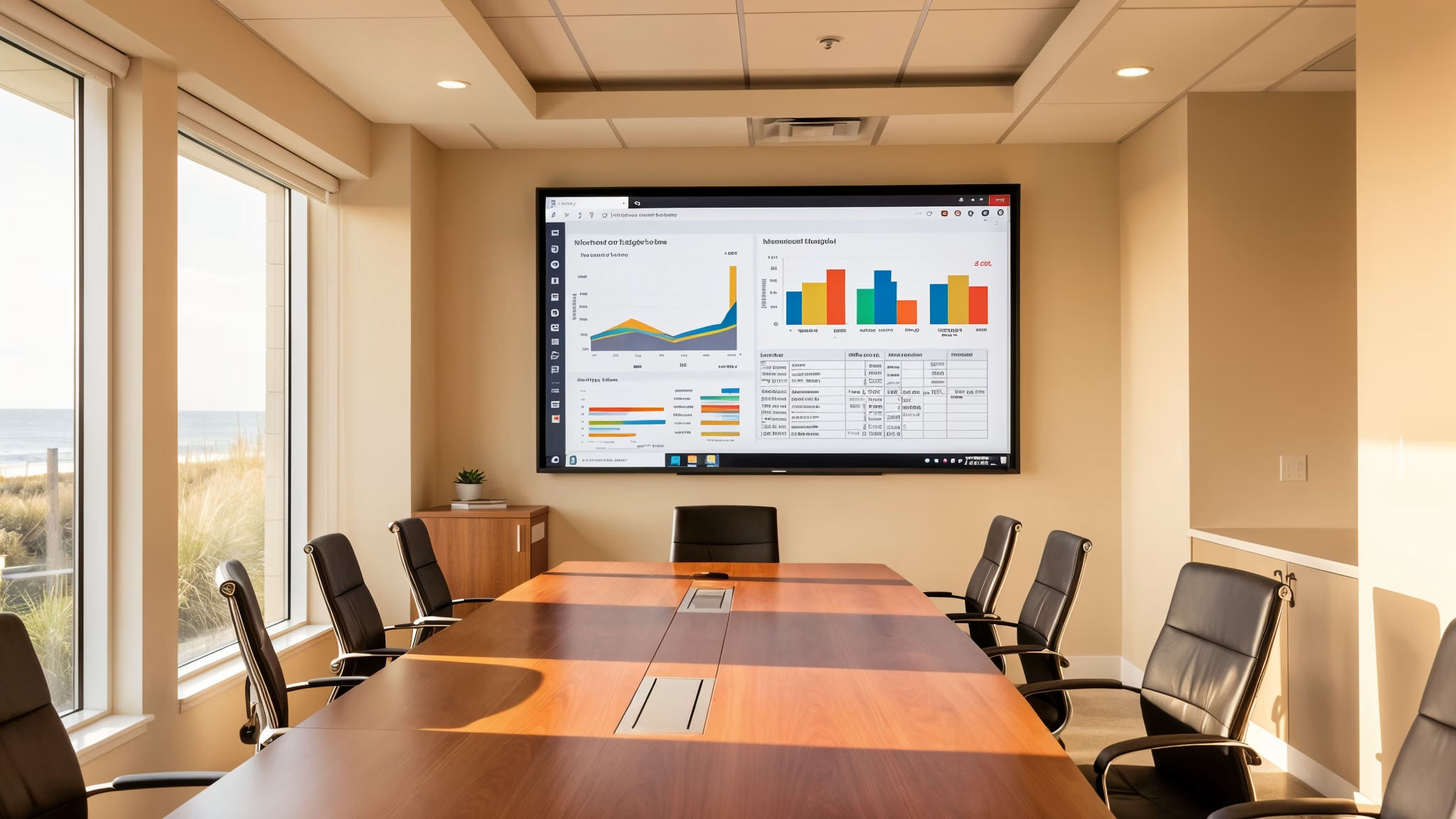
Traditional Management vs. Maxet’s Tech-Driven Lien Management
| Capability | Traditional Management | Maxet Tech-Driven |
|---|---|---|
| Delinquency detection | Monthly spreadsheet review; manual flagging | Real-time monitoring with automated threshold alerts |
| Pre-lien notices | Manual letter preparation; inconsistent timing | Statutory-compliant templates generated automatically at threshold |
| Filing deadline tracking | Calendar reminders; easily missed during turnover | Automated countdown with escalation alerts at 90, 60, and 30 days |
| Audit trail | Paper files, scattered emails, no centralized record | Complete digital audit log of every action, notice, and decision |
| Board reporting | Manual report compilation; delayed visibility | Live dashboard with delinquency aging, lien status, and recovery projections |
| Satisfaction recording | Often forgotten; creates title cloud on paid properties | Automatic satisfaction document generation and recording tracking |
FS 720 vs FS 718: Lien Authority Comparison for Bay County Boards
Bay County associations operate under different statutory frameworks depending on whether they are HOAs (FS 720) or condominiums (FS 718). The lien authority, notice requirements, and filing procedures differ in ways that directly affect how your tracking system must be configured.
| Requirement | FS 720 (HOAs) | FS 718 (Condominiums) |
|---|---|---|
| Assessment lien authority | Sec. 720.3085 — lien includes assessments, interest, late fees, costs | Sec. 718.116 — lien extends to all assessments and includes attorney fees |
| Pre-lien notice required | 45-day notice required before recording lien (720.3085(3)) | 30-day notice of intention to file lien (718.116(5)(b)) |
| Lien filing deadline | Within 1 year of assessment due date | Within 1 year of assessment due date |
| Lien duration | 1 year unless extended by recorded continuation | 1 year unless action to enforce is commenced |
| Foreclosure authority | Association may foreclose lien like a mortgage | Association may foreclose lien; mandatory mediation required |
An automated system configured for Bay County must account for these differences. A condominium association on Panama City Beach needs a 30-day notice workflow, while an HOA in unincorporated Bay County needs a 45-day workflow. Generic software that does not distinguish between FS 718 and FS 720 jurisdictions creates compliance risk rather than reducing it. Maxet configures each association’s tracking system to match the governing statute from the start.
How to Implement Automated Lien Tracking: A Board Roadmap
Step 1: Audit Your Current Delinquency Status
Before deploying any technology, the board needs a clear picture of where delinquencies stand today. Pull every account that is 30 days or more past due. Identify which accounts have pre-lien notices on file, which have liens recorded, and which are past the filing window. This baseline tells you how much revenue is at risk and where the manual process has already failed.
Step 2: Define Board Policy Thresholds
The board must establish clear, written thresholds for when the delinquency process begins, when pre-lien notices are sent, and when liens are recorded. These thresholds should align with both the governing statute and the association’s governing documents. A well-configured system enforces these thresholds consistently, eliminating the selective enforcement risk that creates liability under Florida law.
Step 3: Configure the Tracking System
Maxet configures the tracking system to match the association’s statute (FS 718 or FS 720), governing document requirements, and board policy thresholds. The system generates statutory-compliant notice templates, sets automated alert timelines, and creates the board reporting dashboard. Every configuration decision is documented for audit purposes.
Step 4: Execute and Monitor
Once live, the system runs continuously. Delinquency alerts fire automatically. Notices generate at the statutory threshold. The manager reviews each alert, verifies the data, and authorizes the next action. The board sees a live dashboard showing delinquency aging, active liens, filing deadlines, and recovery projections. No more waiting for a monthly report that is already out of date.
The Bay County Context: Why This Matters Here
Bay County associations face delinquency patterns that are distinct from inland Florida communities. The high concentration of vacation rental properties along Panama City Beach means many unit owners live out of state and are slow to respond to assessment notices. Hurricane recovery cycles create concentrated financial stress for owners who may already be stretched thin. And the growth in new associations transitioning from developer control often brings uncovered delinquencies that the previous management did not track.
For associations in Panama City, Panama City Beach, and unincorporated Bay County, automated lien tracking is not a luxury. It is the difference between protecting the community’s financial health and letting revenue leak away through procedural gaps that a manual process cannot close fast enough.
Frequently Asked Questions
Can automation file liens without board approval?
No. Automated lien tracking prepares documents and flags deadlines, but the licensed community association manager reviews and authorizes each lien recording. The board retains full control over policy decisions, including when to escalate to foreclosure. The technology handles data and document preparation; the human provides professional judgment and statutory verification.
What happens if a lien is filed late under Florida law?
Under both FS 720.3085 and FS 718.116, a lien that is not recorded within one year of the assessment due date may expire. Once expired, the association loses its lien rights for that assessment, though the debt itself may still be collectible through other means. Automated tracking prevents this by alerting the board well before the deadline closes.
Does automated lien tracking work for both HOAs and condominiums in Bay County?
Yes, but the system must be configured differently for each. FS 720 (HOA) requires a 45-day pre-lien notice period, while FS 718 (condominium) requires a 30-day notice. Maxet configures the tracking workflow to match the governing statute for each association, ensuring compliance with the correct notice timeline, filing requirements, and lien duration rules.
How long does it take to implement automated lien tracking?
For a Bay County association with clean owner data and current delinquency records, implementation typically takes 2-4 weeks. The process includes the delinquency audit, board policy configuration, system setup, and manager training. Associations with significant legacy delinquencies may require an initial cleanup phase before the automated system goes live.
Take the Next Step
If your Bay County association is tracking liens on a spreadsheet, you are one missed deadline away from a revenue loss that your board will have to explain to the membership. Automated lien tracking is the operational upgrade that protects your fiduciary position, recovers revenue faster, and gives the board real-time visibility into the association’s financial health.
Contact Maxet to schedule a delinquency audit and see how automated lien tracking fits your association’s statute, governing documents, and board policy. The technology handles the data synthesis. The manager provides the professional judgment and operational execution. The board gets the certainty it needs.
Boards evaluating their current provider can use Maxet’s Bay County HOA management standard as a benchmark for financial reporting, vendor oversight, and owner communication.
Legal disclaimer: Maxet is a professional community association management firm providing business operational efficiency and administrative support. We are not a law firm, and the information provided in this article does not constitute legal advice or create an attorney-client relationship. For specific legal interpretation of Florida Statutes or governing documents, we strongly recommend consulting with a licensed attorney specializing in Florida community association law.