
Short answer: Florida condominium associations operating in Bay County must maintain detailed financial records and make them available for unit owner inspection under Florida Statute 718.111(12). Boards that rely on paper binders and ad hoc spreadsheet responses create liability gaps, frustrate owners, and risk statutory penalties. A technology-driven financial transparency dashboard turns a reactive, paper-heavy obligation into a proactive compliance tool that builds owner trust and protects board members from fiduciary breach claims.
What FS 718.111(12) Requires of Bay County Condominium Boards
Florida Statute 718.111(12) establishes the financial recordkeeping and inspection rights that every condominium association in Bay County must follow. The statute requires associations to maintain accounting records for the association and make them available for inspection by unit owners. This is not optional. It is a statutory obligation tied to the fiduciary duty that board members owe to the association and its members.
Specifically, the statute mandates that associations keep:
- All written accounting records of the association
- All source documents and accounting records supporting those entries
- Minutes of all meetings of the board of directors and unit owners
- A current copy of the declaration, articles, bylaws, and rules
- All insurance policies and contracts
- Bills, receipts, and other records that support the financial statements
Unit owners have the right to inspect these records, and the association must make them available within a reasonable time. For Bay County condominium boards, the challenge is not whether to comply but how to comply efficiently without burying board members and management staff in paperwork.
Why Traditional Recordkeeping Fails Bay County Condominium Boards
Most Bay County condominium associations still rely on a combination of physical binders, emailed spreadsheets, and scattered PDF files to satisfy their FS 718.111(12) obligations. This legacy approach creates three specific problems:
1. Inspection requests become fire drills. When a unit owner requests to inspect financial records, the board or management company must locate, assemble, and present the documents. With paper-based systems, this means hours of searching through binders, printing copies, and scheduling in-person reviews. The result is a delayed response that frustrates owners and creates the appearance of opacity, even when the board has nothing to hide.
2. Recordkeeping gaps create fiduciary exposure. Paper records get lost. Spreadsheets get overwritten. Email threads disappear when a board member rotates off. When the association cannot produce required documents during an audit or owner dispute, board members face personal liability for fiduciary breach. The statute does not distinguish between “we lost the records” and “we never kept them.”
3. No real-time visibility into financial health. Legacy systems are backward-looking. They tell the board what happened last quarter, not what is happening right now. By the time a reserve shortfall or budget overrun surfaces in a monthly financial packet, the damage is done. Bay County coastal condominiums face escalating insurance premiums, rising maintenance costs, and mounting reserve requirements. Boards need forward-looking visibility, not just historical snapshots.

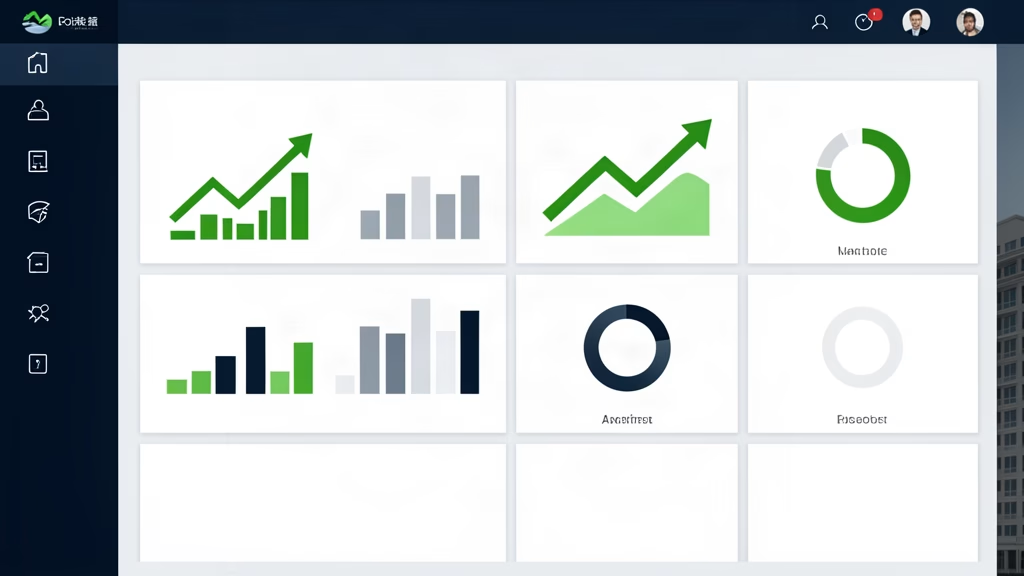
How a Financial Transparency Dashboard Solves These Problems
A financial transparency dashboard is not a replacement for professional judgment. The technology handles the data synthesis and presentation, while the manager provides the professional judgment and operational execution. What changes is the speed and clarity with which boards can respond to their statutory obligations.
Automated Inspection Response
Instead of assembling physical binders for each owner request, a dashboard allows the association to grant controlled, auditable access to financial records through a secure portal. Owners can view budget reports, expense breakdowns, reserve fund status, and contract summaries without requiring staff time to compile and present documents. Every access is logged, creating an audit trail that demonstrates compliance with FS 718.111(12).
Real-Time Financial Health Monitoring
Rather than waiting for monthly financial packets, board members can see current cash positions, reserve fund balances, budget-to-actual variances, and upcoming obligations in real time. This allows the board to identify problems early. If landscaping expenses are running 15% over budget in Q2, the dashboard surfaces that variance before it becomes a year-end crisis requiring a special assessment.
Document Retention and Retrieval
A dashboard serves as a centralized, searchable repository for all documents required under FS 718.111(12). Contracts, insurance policies, meeting minutes, and source documents are stored digitally with version control. When a unit owner requests inspection, the board can produce the documents in minutes, not days. When a board member rotates off, the institutional knowledge does not walk out the door.
Reserve Study Integration
For Bay County condominiums subject to SIRS requirements under FS 718, the dashboard can integrate reserve study data alongside operating budget performance. This gives the board a unified view of both short-term operating health and long-term capital reserve adequacy. Boards can model the impact of different funding scenarios and present clear, data-backed recommendations to unit owners.

Traditional Management vs. Maxet’s Tech-Driven Management
| Aspect | Traditional Management | Maxet’s Tech-Driven Management |
|---|---|---|
| Record Inspection | Manual binder assembly, in-person review, days to fulfill | Secure digital portal, auditable access, minutes to fulfill |
| Financial Visibility | Monthly packets, backward-looking, reactive | Real-time dashboard, forward-looking, proactive |
| Document Retention | Paper binders, email threads, lost when members rotate | Centralized digital repository with version control |
| Reserve Tracking | Separate spreadsheet, disconnected from operating budget | Integrated reserve and operating view in one dashboard |
| Audit Readiness | Weeks of preparation, manual document gathering | Always audit-ready, documents searchable on demand |
| Owner Trust | Opaque processes, slow responses, suspicion | Transparent processes, fast responses, confidence |
FS 720 vs. FS 718: Recordkeeping Requirements Comparison
Bay County has both HOA-governed communities (under Florida Statute 720) and condominium associations (under Florida Statute 718). While both require financial transparency, the specific obligations differ. Boards must understand which statute governs their association to ensure they meet the correct standard.
| Requirement | FS 720 (HOA) | FS 718 (Condominium) |
|---|---|---|
| Financial records maintenance | FS 720.303(5): Maintain accounting records | FS 718.111(12): Maintain detailed accounting records |
| Owner inspection rights | FS 720.303(5)(b): Right to inspect official records | FS 718.111(12)(a): Right to inspect and copy official records |
| Timeframe for production | Reasonable time, not to exceed 10 business days | Within 5 business days for accounting records |
| Reserve study requirements | Not required by statute | Required per FS 718.112(2)(g) for buildings 3+ stories |
| Penalty for noncompliance | Possible damages and attorney fees | Statutory damages, attorney fees, fiduciary liability |
The Compliance Risk of Inaction for Bay County Boards
Ignoring or delaying financial transparency modernization is not a neutral choice. Bay County condominium boards that continue with legacy recordkeeping face escalating risks:
Fiduciary breach exposure. Under Florida law, board members owe a fiduciary duty to the association and its unit owners. Failure to maintain and produce required financial records is a direct violation of that duty. Unit owners can sue individual board members for damages, and courts have consistently held that ignorance of the statute is not a defense.
Statutory penalties. FS 718.111(12) provides for damages when an association fails to produce records within the statutory timeframe. In addition to the direct costs, the association may be liable for the unit owner’s attorney fees and costs.
Erosion of owner trust. When unit owners cannot access financial information, they assume the worst. Suspicion breeds hostility, hostility breeds proxy battles, and proxy battles breed expensive litigation. A transparency dashboard removes the suspicion by making information accessible before it becomes a demand.
Audit failures. As Florida tightens condominium oversight in the wake of Surfside and SB 154, the scrutiny on financial recordkeeping will only increase. Associations that cannot produce clean, organized financial records during a regulatory audit face penalties and reputational damage that affects property values.
Steps to Implement a Financial Transparency Dashboard in Your Bay County Association
For Bay County condominium boards ready to modernize their recordkeeping, the implementation follows a structured path:
Step 1: Conduct a Records Audit
Before implementing new technology, assess what records exist, where they are stored, and what gaps need to be filled. A records audit identifies missing documents, expired contracts, and incomplete financial histories that need to be reconstructed before the dashboard can provide an accurate picture.
Step 2: Digitize and Centralize
Convert all physical records to digital format and upload them to the dashboard repository. This includes historical financial statements, contracts, insurance policies, meeting minutes, and reserve studies. The digitization process creates a baseline from which ongoing maintenance becomes manageable.
Step 3: Configure Access Controls
Set up role-based access so that board members see complete financial data while unit owners see the documents they are entitled to under FS 718.111(12). The access control system should log every view, download, and export to create a defensible audit trail.
Step 4: Train Board Members and Management
A dashboard only works if the people using it understand how to navigate, interpret, and respond to the information it presents. Training should cover reading financial summaries, responding to owner inspection requests through the portal, and using variance alerts to catch budget issues early.
Step 5: Establish a Maintenance Cadence
Financial data is only useful if it is current. Establish a schedule for uploading new financial statements, updating reserve tracking, and archiving expired contracts. A monthly maintenance cadence keeps the dashboard accurate and ensures that inspection requests can always be fulfilled from current data.
What Bay County Boards Should Demand from a Management Company
If your association works with a professional management company, financial transparency should be a baseline expectation, not a premium add-on. Bay County boards should demand:
- Digital access to financial records on demand, not monthly packets delivered by mail
- Real-time budget-to-actual reporting with variance alerts
- Reserve fund tracking integrated with the operating budget view
- A documented, auditable response process for unit owner inspection requests
- Proactive alerts when expenses deviate from budget or reserve contributions fall below planned levels
If your current management company cannot provide these capabilities, the gap between their service and your statutory obligations is a fiduciary risk that the board is absorbing on their behalf.
Frequently Asked Questions
What records must a Bay County condominium association make available for owner inspection?
Under FS 718.111(12), associations must maintain and make available all accounting records, source documents, minutes of meetings, contracts, insurance policies, and any other records that support the financial statements. The statute provides a complete list of “official records” that must be accessible to unit owners within five business days of a written request.
Can a condominium board charge a fee for record inspection?
Yes, but the fee must be reasonable and based on the actual cost of producing the copies. Under FS 718.111(12)(c), the association may charge a reasonable fee for the cost of copying and providing the records. A digital dashboard reduces this cost significantly because electronic copies can be generated without staff time for manual assembly.
What happens if a Bay County condominium association fails to produce records on time?
Failure to produce records within the statutory timeframe can result in damages payable to the unit owner, plus attorney fees and costs. Repeated failures can expose individual board members to fiduciary breach claims. The statute treats recordkeeping as a non-negotiable obligation, not a best practice.
How does a financial transparency dashboard differ from the accounting software our management company uses?
Most management companies use accounting software to generate monthly financial statements, but those statements are backward-looking snapshots delivered in a packet. A transparency dashboard provides real-time visibility, integrates reserve tracking with operating budgets, enables owner self-service inspection, and maintains a searchable document repository with audit trails. The dashboard transforms compliance from a periodic task into a continuous capability.
Taking the Next Step Toward Financial Transparency
Bay County condominium boards have a choice: continue absorbing the fiduciary risk of legacy recordkeeping, or modernize with technology that makes FS 718.111(12) compliance automatic and auditable. The technology handles the data synthesis and document management, while experienced association professionals provide the judgment and operational execution that boards need.
If your board is ready to move beyond paper binders and monthly packets, explore how Maxet’s tech-driven approach can bring financial transparency to your Bay County condominium association. The cost of modernization is modest. The cost of noncompliance is not.
Financial transparency is a core expectation within Maxet’s model for managing Bay County condominium associations.
Legal disclaimer: Maxet is a professional community association management firm providing business operational efficiency and administrative support. We are not a law firm, and the information provided in this article does not constitute legal advice or create an attorney-client relationship. For specific legal interpretation of Florida Statutes or governing documents, we strongly recommend consulting with a licensed attorney specializing in Florida community association law.