

Short answer: Waterfront HOA boards in Bay County overseeing marina and dock facilities need a component-level reserve plan that accounts for tidal wear, storm exposure, and permitting cycles specific to Northwest Florida. Without it, boards face emergency special assessments, insurance gaps, and potential fiduciary liability whenpilings fail or decks reach end-of-life. A tech-driven reserve model turns reactive crisis spending into predictable, board-approved capital planning.

Why Marina and Dock Facilities Are a Blind Spot for Many HOA Boards
Marina and dock infrastructure is not a standard building. It lives in a saltwater environment where corrosion, marine borers, and storm surge accelerate deterioration far beyond what a typical reserve study assumes. Many Bay County HOA boards inherit dock facilities that were built during community development and then largely ignored in annual reserve allocations. The result is a common pattern: a dock that looks fine until a piling collapses, a deck board gives way, or a hurricane exposes structural weakness that was developing for years.
The problem is not negligence by any single board. It is a systematic gap in how reserve studies treat waterfront assets. Generic reserve templates often list “dock” as a single line item with a 20-year replacement cycle. In reality, a Bay County marina facility has at least five distinct components, each with a different lifespan and cost trajectory.
The Five Core Components of a Waterfront HOA Marina Reserve
- Wooden or concrete pilings: 15 to 25 years in saltwater, shorter if marine borer activity is present in St. Andrew Bay or West Bay.
- Decking and framing: 12 to 18 years for pressure-treated lumber; longer for composite materials, but fastener corrosion often dictates the real replacement timeline.
- Utility runs (power, water, lighting): 10 to 15 years for marine-grade wiring and conduit; saltwater intrusion degrades connections faster than the wire itself.
- Floating dock systems and gangways: 15 to 20 years for flotation cells and aluminum framing; hinges and rollers need replacement every 5 to 8 years.
- Shore-side amenities (cleats, bumpers, railings, signage posts): 7 to 12 years depending on material and storm exposure.
What Bay County Boards Should Demand From a Marina Reserve Study
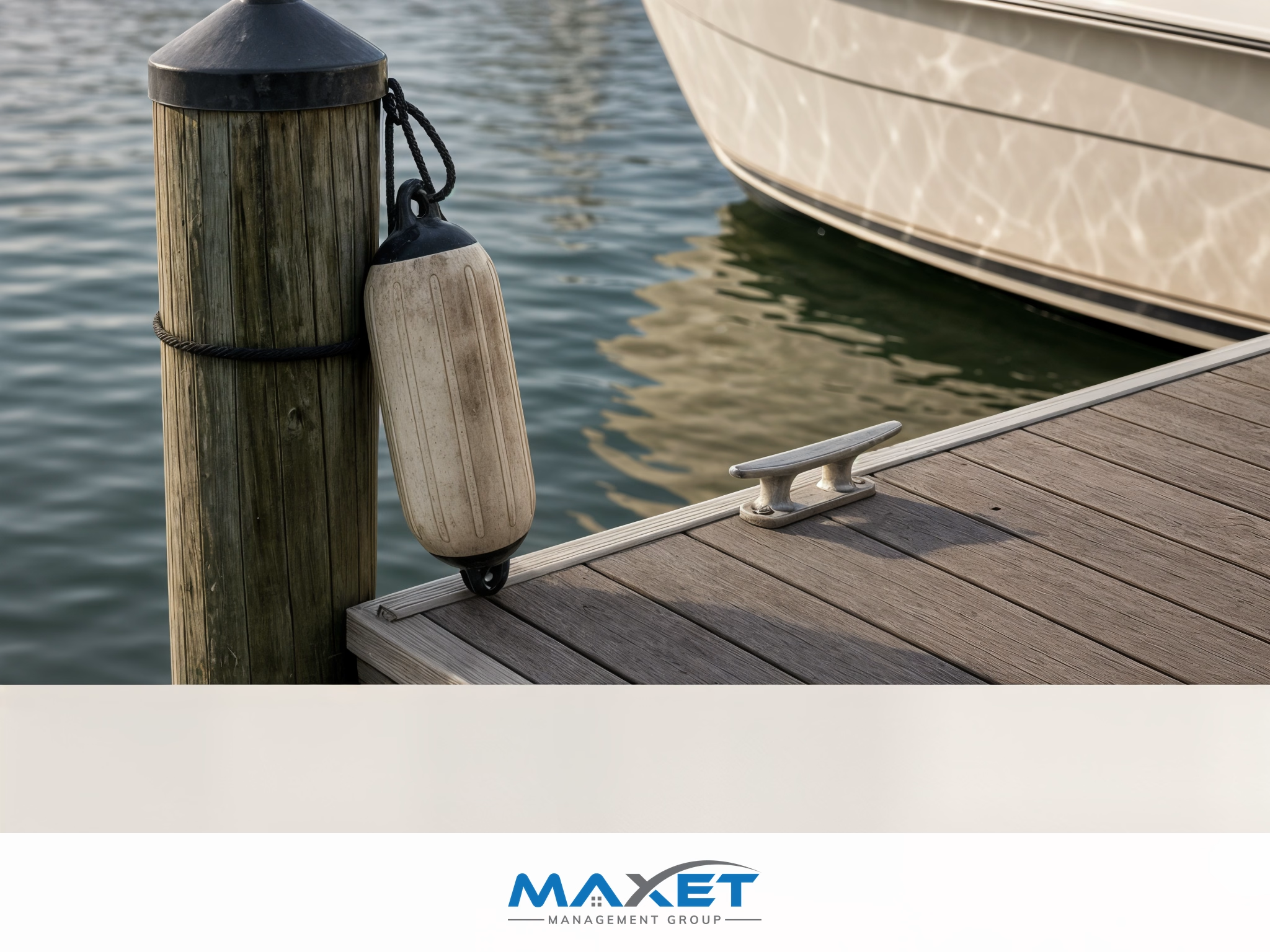
A reserve study is only as useful as the assumptions behind it. For waterfront HOA communities in Bay County, including Panama City Beach and unincorporated bayfront areas, boards should require the following from any reserve study or reserve update that covers dock and marina facilities.
Component-Level Breakdown, Not a Single Line Item
Each of the five core components listed above should be tracked separately with its own replacement cost, remaining useful life, and annual contribution target. A single “dock replacement” line item hides the fact that pilings, decking, and utilities fail on different timelines. When a board sees only one number, it cannot plan phased repairs and ends up reactive when any single component fails early.
Local Environmental Factors in the Cost Model
Bay County waterfronts face specific environmental stressors that a national reserve template will not capture. Hurricane storm surge can destroy or compromise dock systems in a single event. Saltwater corrosion rates in the Gulf and bays differ from freshwater or brackish environments. Marine borer activity in St. Andrew Bay has damaged pilings in communities that assumed a 25-year piling life. A credible reserve study for a Bay County marina facility must reflect these local conditions, not a national average.
Permitting and Compliance Cost Projections
Repairs and replacements to dock facilities in Bay County often require permits from the Florida Department of Environmental Protection and potentially the U.S. Army Corps of Engineers for structures below the mean high water line. These permits carry application fees, environmental assessments, and timeline delays that add 10 to 20 percent to project costs. A reserve plan that ignores permitting costs will underfund every dock project it triggers.
How to Build a Defensible Marina Reserve Plan: A Board Roadmap

Step 1: Commission a Marina-Specific Condition Assessment
Before adjusting reserve allocations, the board needs a current condition assessment from a qualified marine contractor or structural engineer with experience in Florida coastal facilities. This assessment should inspect every piling, document corrosion or borer damage, test decking integrity, evaluate electrical systems for saltwater intrusion, and identify any storm damage from recent hurricane seasons. The deliverable is a component-by-component condition report with recommended replacement timelines.
Step 2: Translate Findings Into Component-Level Reserve Contributions
Once the condition assessment establishes remaining useful life for each component, the board should direct its management company or reserve specialist to build a contribution schedule that funds each component to its replacement date. This is where technology matters. A spreadsheet with a single “dock” line item cannot model phased replacement across five components with overlapping timelines. A modern reserve platform tracks each component independently, calculates monthly contribution targets, and flags underfunded components before they become emergencies.
Step 3: Build a Storm Recovery Contingency Into the Reserve
Bay County waterfront facilities will face hurricane exposure. Rather than relying solely on insurance to cover dock damage, boards should build a storm contingency allocation into the reserve plan. This is a board-designated fund within reserves, not a separate assessment, that covers deductibles, uninsured repairs, and permitting costs for post-storm reconstruction. A target of 15 to 20 percent above the baseline component contribution is a reasonable starting point for Gulf-facing communities.
Step 4: Establish a Vendor Pre-Qualification and Bid Rotation Process
When a dock component reaches replacement, the board should not be sourcing a marine contractor for the first time. Pre-qualify two to three marine contractors familiar with Bay County permitting and waterfront construction. Maintain current bids on file for standard replacement scenarios. This cuts weeks off project timelines and prevents the premium pricing that comes with emergency contracting after a failure or storm.
Traditional Management vs. Tech-Driven Marina Reserve Management
| Dimension | Traditional Management | Maxet Tech-Driven Approach |
|---|---|---|
| Reserve tracking | Single “dock” line item in an annual spreadsheet | Component-level tracking with independent lifecycles for pilings, decking, utilities, flotation, and amenities |
| Condition data | Visual walk-through every 3 to 5 years, no documentation | Annual condition assessment with photographic evidence and digital records tied to each component |
| Storm contingency | Reliance on insurance alone; special assessment after storms | Board-designated storm contingency fund built into baseline reserves |
| Vendor readiness | Emergency sourcing after failure or storm | Pre-qualified marine contractors with current bids on file |
| Board visibility | Annual report with limited detail | Real-time reserve dashboard showing each component’s funding status and projected replacement date |
The Fiduciary Risk of Underfunded Marina Reserves
Under Florida law, HOA board members owe a fiduciary duty to the association and its members. For waterfront communities in Bay County, this duty extends to maintaining common-area marina and dock facilities in a safe, functional condition. When a reserve plan systematically underfunds dock maintenance and a structural failure causes injury or property damage, the board’s fiduciary exposure increases materially.
The risk is not theoretical. Dock failures in Florida waterfront communities have resulted in personal injury claims, insurance coverage disputes, and owner lawsuits against boards. A defensible reserve plan with component-level tracking demonstrates that the board exercised reasonable diligence in planning for facility maintenance and replacement. This documentation is the strongest protection against claims that the board ignored known infrastructure risks.
Boards should also understand the relationship between reserve adequacy and reserve deficiency recovery. If a prior board underfunded the marina reserve, the current board inherits both the infrastructure gap and the fiduciary obligation to correct it. A tech-driven reserve platform can model multiple correction scenarios, showing the board exactly how different contribution increases close the gap over time.
Frequently Asked Questions
How often should a Bay County HOA inspect its marina and dock facilities?
At minimum once per year, with a post-storm inspection after any named tropical system affects the Bay County area. Annual inspections should be conducted by a qualified marine contractor or structural engineer, not by the landscaping or maintenance vendor. Document each inspection photographically and link it to the reserve component record.
What happens if our reserve study does not break out dock components separately?
The board should direct its reserve specialist or management company to update the study with a component-level breakdown. This is not a full reserve study replacement; it is a targeted update for the dock and marina section. The cost is modest compared to the risk of underfunding a single large replacement that the blended line item obscures.
Can a Bay County HOA use a special assessment to fund emergency dock repairs?
Yes, but it should be the exception, not the planning model. Under Florida Statute 720, associations can levy special assessments for unexpected repairs, but owners have procedural rights including notice and meeting requirements. A reserve plan that anticipates dock maintenance needs eliminates most emergency special assessments and preserves board credibility with owners. See the budget ratification process for how reserve changes interact with owner approval requirements.
Does insurance cover dock and marina damage in Bay County?
Partially. Most HOA property insurance covers dock structures, but coverage limits, deductibles, and exclusions vary significantly by policy. Wind and named-storm deductibles in coastal Bay County can be substantial, meaning the association may bear a large out-of-pocket cost even when insurance applies. Boards should review their policy’s dock coverage annually and ensure the reserve storm contingency covers the deductible gap.
Building Board Confidence Through Data, Not Guesswork
The boards that manage Bay County waterfront facilities most effectively share one trait: they make reserve decisions from documented condition data, not visual impressions or legacy assumptions. A dock that looks solid can have pilings hollowed by marine borers. A deck that feels stable can have fasteners corroded past their holding capacity. Without component-level tracking, the board is guessing, and guessing is not a defensible fiduciary position.
Maxet brings technology-driven reserve management to Bay County waterfront communities, replacing single-line-item spreadsheets with component-level tracking, real-time funding status, and documented condition assessments. The technology handles the data synthesis and lifecycle modeling, while the board retains full authority over contribution decisions and vendor selection. This is the standard of care that waterfront owners should expect from their management partner.
Related resources: Resolving HOA Reserve Deficiencies in Bay County | Stormwater System Maintenance Audit | Insurance Claims History Tracking
Waterfront reserve planning works best when inspections, vendor scopes, budgets, and board decisions stay connected through disciplined Bay County HOA management.
Legal disclaimer: Maxet is a professional community association management firm providing business operational efficiency and administrative support. We are not a law firm, and the information provided in this article does not constitute legal advice or create an attorney-client relationship. For specific legal interpretation of Florida Statutes or governing documents, we strongly recommend consulting with a licensed attorney specializing in Florida community association law.