
Short answer: Florida’s HB 1203 (2024) made HOA election fraud a criminal offense, meaning board members in Bay County can face personal liability for manipulated ballots, suppressed voter turnout, or improper proxy use. Technology-driven election integrity tools — encrypted digital voting, automated audit trails, and real-time eligibility verification — protect your board from fraud accusations while ensuring every homeowner’s vote counts. Here’s what Bay County boards need to demand from their management company.

Why HOA Election Fraud Is Now a Criminal Matter in Florida
If your board still runs elections with paper ballots collected in a shoebox, you’re sitting on a liability time bomb. Florida’s Homeowners’ Association Bill of Rights (HB 1203, effective July 1, 2024) didn’t just tighten procedural rules — it created criminal penalties for election fraud. That means a board member who tampers with ballots, manipulates proxies, or deliberately suppresses voter turnout isn’t just facing a civil dispute. They’re facing potential criminal charges.
For Bay County boards, the stakes are even higher. Coastal communities in Panama City Beach and unincorporated Bay County often have high turnover among part-time residents, making elections vulnerable to low quorum exploitation and proxy manipulation. A tech-driven approach to election integrity isn’t a luxury — it’s a fiduciary obligation.
The most common election fraud patterns in Florida associations include:
- Ballot tampering: Discarding, altering, or duplicating ballots before counting
- Proxy manipulation: Forging proxy forms or overriding a homeowner’s designated choice
- Voter suppression: Providing inadequate or late notice to reduce turnout among specific groups
- Eligibility manipulation: Allowing non-owners or delinquent accounts to vote while blocking eligible members
- Counting irregularities: “Losing” ballots, counting duplicates, or announcing results without a verifiable count
What Florida Law Actually Requires for Board Elections
Florida operates under two separate statutory frameworks for community association elections. Your obligations depend on whether your association is governed by Chapter 720 (HOAs) or Chapter 718 (condominiums). In Bay County, many communities fall under one or the other — and some master associations touch both.
FS 720.306: HOA Election Requirements
Chapter 720 sets the baseline for homeowners’ association elections. Key requirements include:
- Members must receive advance written notice of elections (at least 60 days for the first notice)
- Candidate names and contact information must be submitted at least 40 days before the election
- The association must include candidate information with the second notice at its own expense
- An election is not required unless more candidates are nominated than vacancies exist
- Proxies may be permitted if the governing documents allow them, but boards must follow proper execution and submission procedures
FS 718.112: Condominium Election Requirements
Chapter 718 imposes stricter rules for condominium associations:
- Secret ballots are mandatory for board member elections
- Proxies are prohibited in the election of board members for residential condominiums (with limited exceptions for associations of 10 or fewer units)
- Limited proxies may be used for non-election votes (waiving financial reporting, amending documents, etc.)
- Any challenge to the election process must be commenced within 60 days after results are announced
- Newly elected directors must submit written certification and complete educational requirements within 90 days
FS 720 vs. FS 718: Election Requirements Comparison
| Requirement | FS 720 (HOA) | FS 718 (Condo) |
|---|---|---|
| Secret ballots | Recommended but not mandated | Mandatory |
| Proxies in board elections | Permitted if governing docs allow | Prohibited (except 10 or fewer units) |
| Election challenge window | Per governing documents | 60 days after results announced |
| Director education | Required (HB 1203) | Required within 90 days of election |
| Criminal penalties for fraud | Yes (HB 1203, 2024) | Yes (existing + HB 1203) |
| Notice timeline | 60-day first notice | 14 days minimum for meetings |
How Technology Closes the Election Integrity Gap
Most Bay County associations still rely on manual election processes that create blind spots at every step. Paper ballots can be lost. Proxy forms can be forged. Vote counts happen behind closed doors. And when a homeowner challenges the result, the board has no defensible audit trail to prove the election was clean.
Technology-driven election management changes that equation. Here’s what a modern, tech-forward approach looks like for Bay County boards:
1. Encrypted Digital Balloting
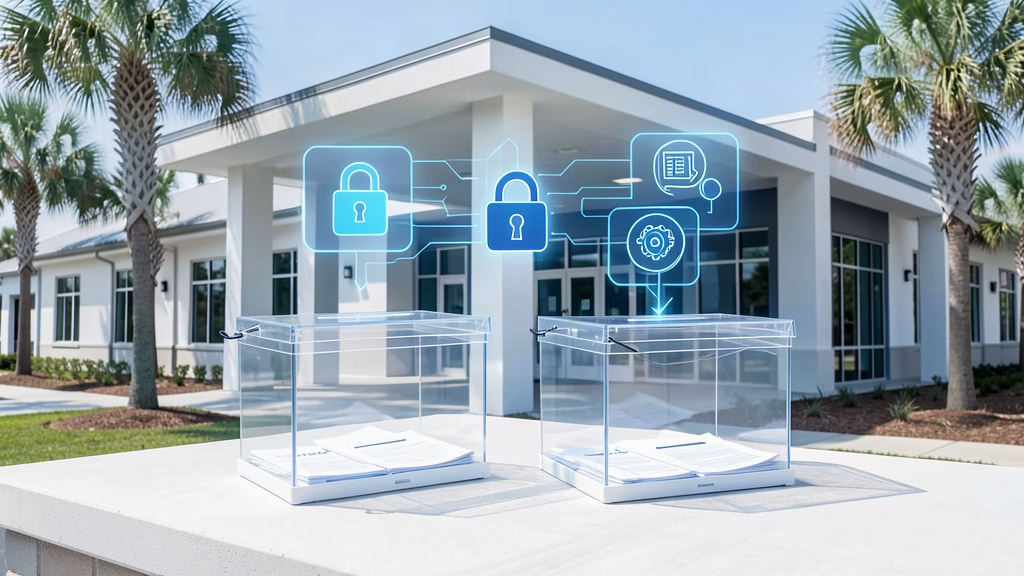
Digital voting platforms use encryption to protect each ballot from the moment it’s cast until the moment it’s counted. Every vote generates a unique cryptographic receipt that the homeowner can verify independently. This eliminates the “lost ballot” problem and makes tampering detectable — not just suspected.
2. Automated Eligibility Verification
Instead of manually checking a spreadsheet to see who’s eligible to vote, technology cross-references ownership records, assessment status, and voting rights in real time. This prevents both intentional manipulation and accidental errors — like allowing a delinquent account to vote or blocking a qualified owner who just paid their dues.
3. Immutable Audit Trails
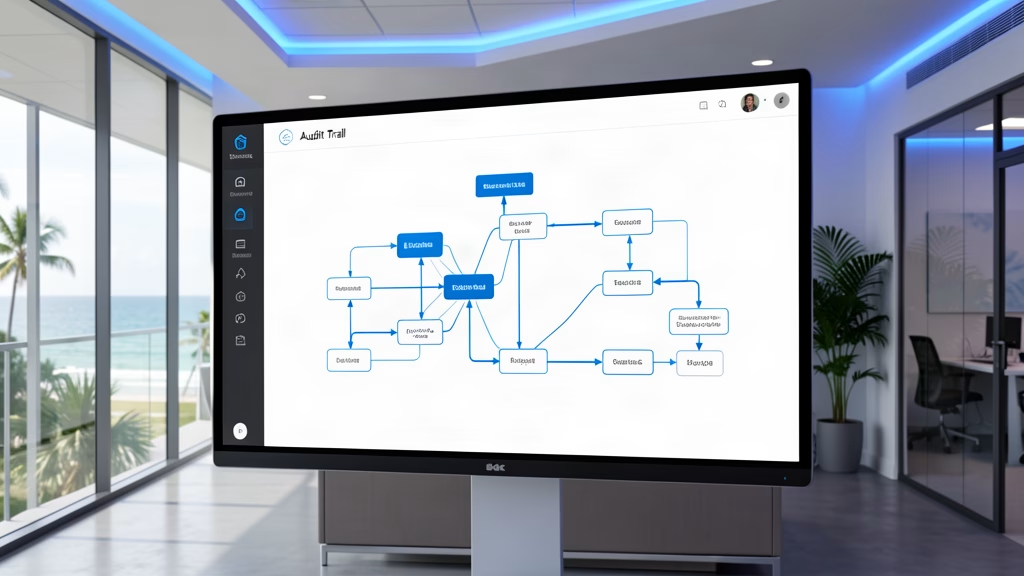
Every action — notice sent, ballot cast, vote counted, result announced — is logged with a timestamp and user identifier. If a homeowner files a challenge within the 60-day window under FS 718.112, your board can produce a complete, verifiable record showing the election was conducted properly. That’s not just protection against disputes. It’s protection against criminal liability under HB 1203.
4. Real-Time Quorum Tracking
One of the most common election failures in Bay County is not reaching quorum. Digital platforms track participation in real time, sending automated reminders to non-voters and alerting the board when quorum is achieved. This eliminates the scenario where a small group manipulates a low-turnout election.
5. Proxy Management and Compliance
For HOAs governed by FS 720 where proxies are permitted, digital proxy management ensures every proxy form is properly executed, time-stamped, and stored. For condos under FS 718 where proxies are prohibited in board elections, the system can flag and block any proxy attempt automatically — protecting the board from an honest mistake that could invalidate the entire election.
Traditional Management vs. Maxet’s Tech-Driven Election Integrity
| Election Process | Traditional Management | Maxet’s Tech-Driven Approach |
|---|---|---|
| Ballot collection | Paper ballots in a box, counted by hand | Encrypted digital ballots with cryptographic receipts |
| Eligibility verification | Manual spreadsheet check, prone to error | Automated real-time cross-reference of ownership and assessment records |
| Audit trail | None, or scattered paper records | Immutable timestamped log of every election action |
| Proxy management | Paper forms, easy to forge or lose | Digital proxy execution with FS 718/720 compliance flags |
| Quorum tracking | Hope enough people show up | Real-time participation dashboard with automated reminders |
| Dispute defense | “Trust us, it was fine” | Complete verifiable audit trail produced on demand |
The Board Member’s Standard of Care: What to Demand
If you’re a board member in Bay County, election integrity isn’t just about following the rules. It’s about demonstrating a standard of care that protects you personally. Under Florida law, board members have a fiduciary duty to act in the best interests of the association. An election that can’t be verified is a breach of that duty — and under HB 1203, it could be a criminal one.
Here’s what every Bay County board should demand from their management company:
- Verifiable vote counts: Every ballot must be traceable from cast to count, with no manual intervention that could alter the result.
- Automated notice compliance: Election notices must be sent automatically within statutory deadlines, with proof of delivery.
- Proxy compliance flags: The system must automatically block prohibited proxies under FS 718 and validate permitted proxies under FS 720.
- Independent audit capability: A third party (or challenging homeowner) must be able to verify the election outcome without relying on the board’s word.
- Permanent record retention: All election records must be stored for the statutory retention period (7 years for condo director certifications under FS 718.112) in a format that can’t be altered retroactively.
This is where the gap between legacy management and a tech-forward firm like Maxet becomes visible. Traditional managers treat elections as a paperwork exercise. Maxet treats them as a compliance and governance event that requires the same rigor as financial reporting or reserve funding.
Recovering From a Compromised Election
If your Bay County association discovers that a past election was compromised — whether through fraud, procedural error, or negligence — the recovery path matters as much as the prevention. A tech-driven management company can help you:
- Document the breach: Reconstruct what happened using available records, digital logs, and witness statements
- Notify affected owners: Communicate transparently about what occurred and what corrective action is being taken
- Conduct a verified re-election: Run a new election using encrypted digital balloting with full audit trail
- Update governing documents: Amend election procedures to close the vulnerability that allowed the breach
- Implement ongoing monitoring: Deploy technology that prevents recurrence and provides continuous compliance verification
This recovery approach mirrors the same disciplined methodology Maxet applies to budget correction and covenant enforcement recovery. The pattern is the same: identify the breach, document everything, fix the root cause, and build a system that prevents recurrence.
Frequently Asked Questions
Can a Bay County HOA board member go to jail for election fraud?
Yes. Under Florida’s HB 1203 (2024), HOA election fraud is a criminal offense. Board members who tamper with ballots, manipulate proxies, or deliberately suppress voter turnout can face criminal charges in addition to civil liability. The severity depends on the nature of the fraud, but the law treats HOA election manipulation with the same seriousness as other forms of fraud involving fiduciary duty.
Are proxies allowed in Florida condominium board elections?
No. Under FS 718.112, proxies are prohibited in the election of board members for residential condominiums, with a limited exception for associations of 10 or fewer units that have adopted alternate election procedures in their bylaws. Limited proxies may still be used for non-election votes, such as waiving financial reporting requirements or amending governing documents.
How long does a homeowner have to challenge an election in Florida?
For condominium associations under FS 718.112, any challenge to the election process must be commenced within 60 days after the election results are announced. For HOAs under FS 720, the challenge window is typically defined by the governing documents. Boards should maintain complete election records for at least 7 years to defend against any challenge.
What technology should Bay County boards use to prevent election fraud?
Boards should look for platforms that offer encrypted digital balloting, automated eligibility verification, immutable audit trails, real-time quorum tracking, and proxy compliance management. The technology should flag prohibited proxies under FS 718, validate permitted proxies under FS 720, and produce a verifiable record that can be shared with homeowners or legal counsel if a dispute arises. The goal is not to replace board judgment but to provide a defensible, transparent process that protects every board member’s fiduciary position.
Take Action: Protect Your Board and Your Community
Election integrity is not a back-office detail. It’s a fiduciary obligation with criminal consequences under Florida law. If your Bay County association is still running elections with paper ballots and manual counts, you’re exposing every board member to personal liability and every homeowner to a compromised vote.
Maxet brings technology-driven election management to Bay County and Northwest Florida associations — encrypted voting, automated compliance, and audit trails that hold up under legal scrutiny. The technology handles the data synthesis and verification, while your board provides the governance judgment and operational oversight.
Ready to modernize your association’s election process? Contact Maxet today for a consultation on how technology-driven management can protect your board, your community, and your fiduciary duty.
Boards evaluating their current provider can use Maxet’s Bay County HOA management standard as a benchmark for financial reporting, vendor oversight, and owner communication.
Legal disclaimer: Maxet is a professional community association management firm providing business operational efficiency and administrative support. We are not a law firm, and the information provided in this article does not constitute legal advice or create an attorney-client relationship. For specific legal interpretation of Florida Statutes or governing documents, we strongly recommend consulting with a licensed attorney specializing in Florida community association law.