
Short answer: Bay County HOA boards relying on padlocks, shared gate codes, and manual keypads face real liability exposure from unauthorized access, vendor tracking gaps, and emergency-response delays. Modernizing entrance gate systems with credential-based access, audit trails, and remote management tools eliminates those blind spots while reducing the board’s operational burden. The technology handles access logging and credential management, while the manager provides the professional judgment and operational execution.
Why Legacy Gate Systems Create Board Liability in Bay County
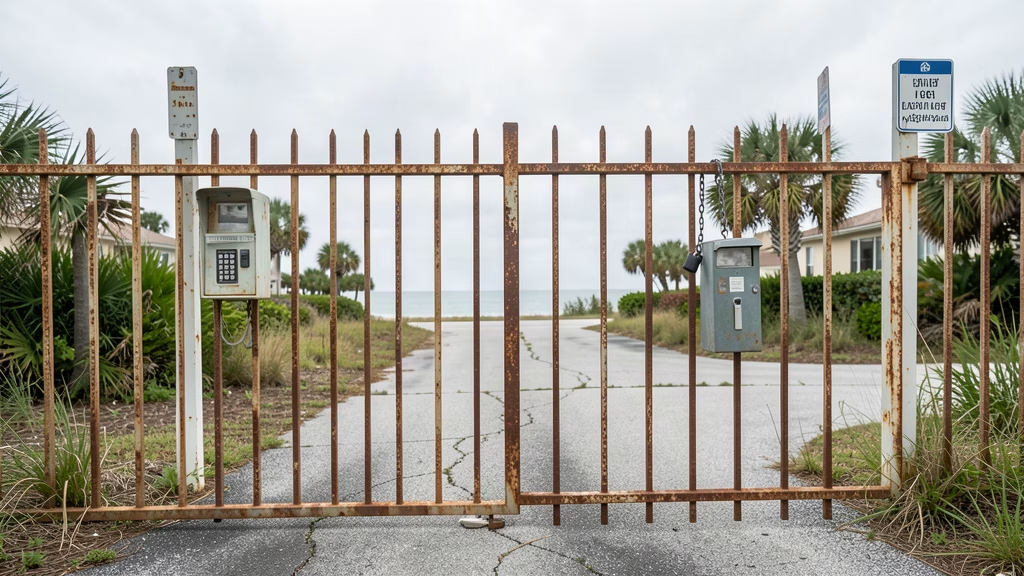
Many community entrances in Panama City Beach, Panama City, and unincorporated Bay County still operate on access infrastructure installed a decade or more ago. Shared gate codes circulate through neighborhood social media groups. Padlocks get duplicated at the local hardware store with no tracking. Vendor keys change hands between property management companies. The result is an access system that nobody actually controls.
For a board member, this is not just an inconvenience. It is a fiduciary exposure. If a contractor enters through a shared code and causes property damage, the association’s insurance carrier may question whether reasonable access controls were in place. If a non-resident uses a code posted in a Facebook group to access the pool or clubhouse, the board’s amenity liability increases. Florida’s standard of care for volunteer directors under Florida Statute 720.303 requires boards to operate the association in a manner consistent with the governing documents and applicable law. A gate system with no audit trail makes that standard difficult to demonstrate.
The Real-World Problems Bay County Boards Report
Board members at Bay County associations describe a recurring set of headaches with legacy gate systems:
- Stale codes: Gate codes assigned years ago are never rotated. Real estate agents, delivery drivers, and former residents may still know them.
- No vendor accountability: Landscaping crews, pool service technicians, and pest control vendors share a single code. There is no way to confirm who entered or when.
- Emergency access delays: First responders may need a physical key or code. In a fire or medical emergency, minutes matter.
- Maintenance blind spots: When the gate motor fails or the keypad burns out, the board finds out from resident complaints, not from a monitoring system.
- No access logs: If vandalism occurs in the common area, there is no electronic record to cross-reference with entry times.
What Modern Gate Access Looks Like for Northwest Florida Communities
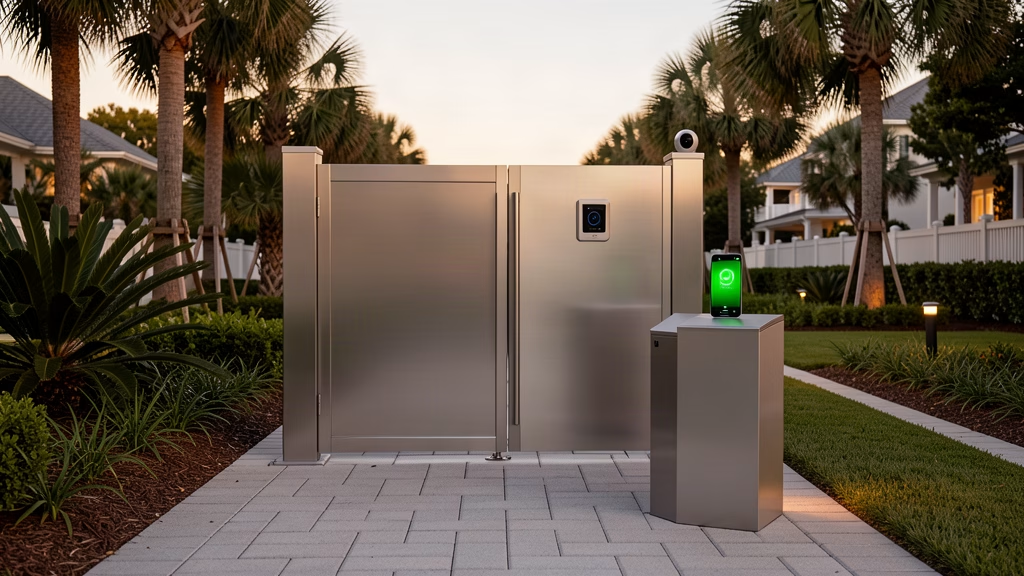
Modern access control does not require a full rebuild. Many Bay County gated communities can upgrade their existing gate operators with credential-based readers, cloud-managed controllers, and audit-trail software. The core components a board should evaluate:
Credential-Based Entry
Replace shared codes with individual credentials. RFID fobs, smartphone-based virtual keys, and license-plate recognition (LPR) cameras each offer different trade-offs between cost and convenience. The key principle is that every entry is tied to a specific person or vehicle, not a shared code that outlives its purpose.
Audit Trails and Access Logs
Every credential-based system generates a timestamped log of who entered, through which lane, and at what time. For a board member investigating a vandalism incident or a dispute over amenity usage, that log is the difference between an evidence-based response and a guess.
Remote Management
Cloud-connected controllers allow a community association manager to grant temporary vendor access, deactivate a lost fob, or open the gate for a delivery from a phone or laptop. This eliminates the board president driving to the gate at 11 PM to let a resident back in.
Emergency Responder Access
Modern systems support Knox Box integration or automatic emergency override protocols that comply with local fire marshal requirements. Panama City Beach Fire Rescue and Bay County Emergency Services have established protocols for gated community access. Boards should confirm any upgrade maintains compliance with those protocols.
The Board’s Decision Roadmap: What to Demand From a Gate Upgrade
Board members evaluating gate modernization should approach the project with the same rigor as a reserve study or insurance review. Here is a practical roadmap:
- Assess the current system: Document what exists today. Gate operator brand and model, keypad type, intercom system, any existing credentials. Note what works and what has failed.
- Review governing documents: Check the declaration, articles, and rules for any provisions about gate access, security obligations, or amenity hours. The board cannot adopt an access policy that contradicts the governing documents.
- Identify user categories: Residents, seasonal owners, rental guests, recurring vendors, one-time service providers, delivery vehicles, emergency responders. Each category may need a different credential type and access schedule.
- Specify audit requirements: Determine how long access logs must be retained. Florida’s records-retention requirements under Florida Statute 720.303(4) require associations to maintain financial and operational records for at least seven years. Access logs should align with that retention window.
- Get vendor bids: Solicit proposals from at least three access control vendors serving the Bay County market. Require each bid to specify equipment brand, warranty, installation timeline, and a monthly service plan.
- Plan the transition: Schedule credential distribution, resident communication, and a cutoff date for old codes. A phased rollout over two weeks minimizes disruption.
- Document the policy: Adopt a written access control policy as a board resolution. Specify who administers credentials, how to request temporary access, and the process for deactivating credentials when a resident moves or a vendor contract ends.

Traditional Gate Management vs. Tech-Driven Gate Management
| Aspect | Traditional Management | Tech-Driven Management |
|---|---|---|
| Access Method | Shared gate code, physical keys | Individual RFID fobs, smartphone credentials, LPR |
| Audit Trail | None — no electronic record of entry | Timestamped log per credential, exportable for incidents |
| Vendor Access | Shared code given to all vendors | Time-limited credentials per vendor, auto-expiring |
| Lost Credential | Change the gate code and notify everyone | Deactivate single credential remotely in seconds |
| Emergency Response | Physical key or code relayed by phone | Knox Box integration, automatic emergency override |
| Board Oversight | Resident complaints, manual checks | Dashboard summary, access anomaly alerts |
| Liability Posture | Difficult to demonstrate reasonable controls | Documented audit trail supports fiduciary compliance |
FS 720 vs FS 718: Gate Access Authority in Florida Associations
Gate access obligations differ depending on whether the community is an HOA governed by Florida Statute 720 or a condominium association governed by Florida Statute 718. Boards should understand the distinction:
| Aspect | FS 720 (HOA) | FS 718 (Condominium) |
|---|---|---|
| Common Areas | HOA owns and maintains common areas including gates | Association controls common elements; unit owners own interior |
| Records Retention | FS 720.303(4) — 7 years minimum | FS 718.111(5) — 7 years minimum |
| Board Duty | Operate per governing documents; fiduciary to members | Same fiduciary standard; condo-specific operational rules |
| Access Logs | Operational records — retain per FS 720.303(4) | Official records — retain per FS 718.111(5) |
| Statutory Citation | FS 720.303 — association operation requirements | FS 718.111 — association operation requirements |
How Technology Supports Fiduciary Compliance Without Replacing Judgment
Modern gate access systems generate data. Access logs, credential counts, entry frequency patterns, and anomaly alerts are all byproducts of a credential-based system. But data alone does not protect the board. The board needs professional judgment to interpret that data and act on it.
This is where the division of labor matters. The technology handles the data synthesis — logging every entry, flagging unusual access patterns, generating weekly summaries, and producing audit-ready reports. The community association manager provides the professional judgment — reviewing the summary, investigating flagged anomalies, coordinating with the gate vendor, and recommending policy adjustments to the board.
For example, if the access log shows a vendor credential used at 2 AM on a Sunday, the system flags it. The manager reviews the flag, contacts the vendor to confirm whether the entry was authorized, and reports the finding to the board. The technology surfaces the signal. The manager applies judgment. The board makes the decision.
Bay County Considerations: Coastal Environment and Vendor Availability
Bay County’s coastal environment presents specific challenges for gate hardware. Salt air, humidity, and storm exposure accelerate corrosion on electronic components. Boards should specify marine-grade enclosures and conformal-coated circuit boards in any equipment proposal. Panama City Beach communities along Front Beach Road and Thomas Drive face the harshest conditions; inland Panama City neighborhoods have more moderate exposure but should not skip the protection.
The local vendor market for access control in Bay County includes providers serving both residential and light-commercial clients. Boards should confirm the vendor maintains a local service presence, not just a sales representative. Gate downtime during hurricane season is a safety issue, not just an inconvenience.
Cost and Budgeting: What Bay County Boards Should Expect
Gate modernization costs vary widely based on the existing infrastructure, the number of entry points, and the credential technology selected. A reasonable range for a single-entry community:
- Hardware and installation: $8,000 to $25,000 per entry point, depending on whether the existing gate operator can be retrofitted or needs replacement.
- Cloud management software: $50 to $200 per month, typically billed annually.
- Credential distribution: $5 to $25 per household for RFID fobs or smartphone credentials.
- Annual maintenance: $500 to $2,000 per year for preventive service and warranty support.
For communities with reserve studies, gate system replacement may already be a line item. If not, the board should work with its reserve specialist to add access control infrastructure to the study. Under Florida Statute 720.303(5), HOA boards are encouraged to maintain reserve accounts for major maintenance and replacement of common-area components.
Frequently Asked Questions
Can a Bay County HOA board require residents to use a smartphone-based gate credential?
A board can adopt a credential policy as a rule amendment if the governing documents grant rule-making authority over common-area access. However, the policy should provide alternatives (RFID fobs, license-plate recognition) for residents who do not use smartphones. Forcing a single technology may create accessibility concerns and resident pushback.
Are access logs considered official association records that residents can request?
Yes. Under both FS 720.303(4) and FS 718.111(5), operational records of the association are subject to member inspection. Access logs maintained by the association or its management company fall within this scope. Boards should establish a policy for handling log requests that protects individual privacy while complying with the statutory inspection right.
What happens to gate access during a hurricane evacuation in Bay County?
Gate systems should be configured to fail-safe (open) mode during emergency evacuations. Bay County Emergency Management protocols require that gated communities do not impede evacuation routes. Boards should coordinate with the Bay County Emergency Management office and confirm the gate vendor’s storm protocol before hurricane season begins on June 1.
How long should a Bay County association retain gate access logs?
Florida statutes require associations to retain operational and financial records for at least seven years. Access logs should follow the same retention schedule. Cloud-based systems typically allow indefinite retention, but boards should specify a retention period in the access control policy to avoid scope creep in records requests.
Next Steps for Bay County Boards
If your association’s entrance gate still runs on a shared code and a padlock, the board is carrying unnecessary risk. The path forward does not require a complete overhaul on day one. Start with an assessment of the current system, review the governing documents for access control authority, and engage a qualified vendor for a site evaluation.
The technology handles the data synthesis and access logging. The manager provides the professional judgment and operational execution. The board sets the policy and oversees the standard. That division is what turns a neglected gate into a managed asset.
If your Bay County association needs a professional management partner who understands both the technology and the fiduciary obligations, Maxet provides tech-driven community association management for Northwest Florida boards ready to move beyond legacy operations.
Legal disclaimer: Maxet is a professional community association management firm providing business operational efficiency and administrative support. We are not a law firm, and the information provided in this article does not constitute legal advice or create an attorney-client relationship. For specific legal interpretation of Florida Statutes or governing documents, we strongly recommend consulting with a licensed attorney specializing in Florida community association law.