
Short answer: Bay County condominium boards must ensure fire safety systems — including alarm panels, sprinkler systems, fire doors, and emergency lighting — are inspected, tested, and documented annually under Florida Statute 718.112(2)(n), the Florida Fire Prevention Code (NFPA 101 and NFPA 72), and local fire marshal requirements. When inspections lapse, boards face personal liability exposure, insurance complications, and potential fines. Technology-driven compliance tracking transforms this from a reactive scramble into a managed, audit-ready process.
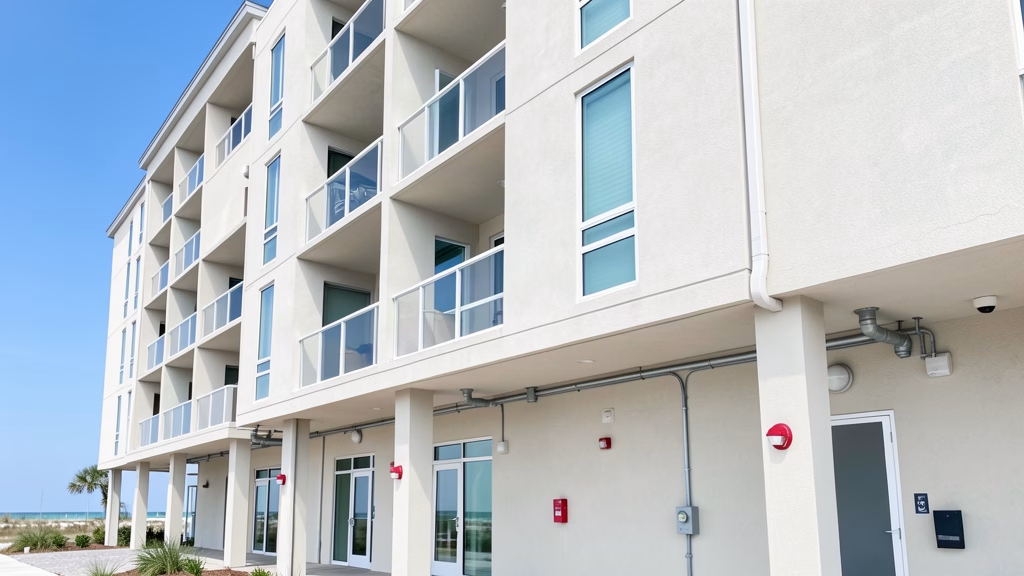
Why Fire Safety Compliance Is a Board Member Problem, Not a Manager Problem
If your Bay County condominium association’s fire alarm system hasn’t been inspected in the last 12 months, the liability sits with the board — not the management company. Florida law places the duty to maintain life safety systems squarely on the association, which means the board members who approved the budget, signed the vendor contracts, or simply assumed someone else was handling it.
Here is what makes fire safety different from other maintenance items on your reserve study: a missed landscaping appointment costs you curb appeal. A missed fire alarm inspection costs you insurance coverage, exposes board members to personal liability claims, and in a worst-case scenario, creates criminal exposure if someone is injured and the system was non-functional due to neglect.
The boards that get into trouble are not the ones who deliberately cut corners. They are the ones who relied on a vendor calendar that was never set up, trusted a verbal “we’re on it” from a prior manager, or had a fire safety line item in the budget that was quietly reallocated to something more visible. By the time the fire marshal shows up for an unannounced inspection or an insurance underwriter requests documentation, the board is already behind.
What Bay County Condo Boards Are Actually Required to Inspect
Florida condominium associations in Bay County — whether in Panama City Beach, Panama City, or unincorporated areas — must comply with a layered set of fire safety requirements. The primary regulatory stack includes Florida Statute 718.112(2)(n) for sprinkler and life safety system requirements, the Florida Fire Prevention Code (which incorporates NFPA 101: Life Safety Code and NFPA 72: National Fire Alarm and Signaling Code), and Florida Statute 633 governing fire prevention standards statewide.
Annual Inspection Requirements
Most condominium fire alarm systems require annual testing and inspection under NFPA 72. Some components — including batteries, smoke detectors in high-dust environments, and certain initiating devices — may require semi-annual or quarterly testing. High-rise buildings in Bay County often have additional requirements for voice evacuation systems, emergency communication systems, and smoke control systems that go beyond the standard annual inspection.
Sprinkler and ELSS Requirements
Under FS 718.112(2)(n), high-rise condominium associations that have not retrofitted with a full fire sprinkler system must either install one or implement an Engineered Life Safety System (ELSS) designed by a Florida-licensed engineer and approved by the local authority having jurisdiction (AHJ). Associations could previously vote to opt out of full sprinkler retrofit, but those that opted out must still implement an ELSS. The compliance deadline has been extended multiple times by the legislature, but the trajectory is clear: full life safety system compliance is mandatory, and boards that delay are accumulating liability.
Coastal Environment Accelerates Deterioration
Bay County’s salt-air coastal environment is particularly harsh on fire safety components. Corrosion on fire door hardware, sprinkler heads, and alarm panel connections accelerates faster than in inland communities. A fire door that passed inspection two years ago may have corroded hinges that prevent proper latching today. This means Bay County condominiums cannot rely on the standard inspection intervals alone — they need a maintenance philosophy that accounts for coastal deterioration between scheduled inspections.
The Real Cost of Non-Compliance for Bay County Boards
Board members often underestimate their personal exposure when fire safety compliance lapses. The fiduciary duty owed to unit owners under Florida Statute 718.111(1) includes the obligation to maintain the common elements in a safe condition. When a board fails to maintain fire safety systems, that failure can be characterized as a breach of fiduciary duty — and Florida law allows unit owners to sue board members individually for such breaches.
Insurance Consequences
Insurance underwriters for coastal condominiums in Bay County are increasingly requiring documented proof of fire safety inspections as a condition of coverage. A lapse in inspection records can trigger premium increases, coverage exclusions for fire-related claims, or outright policy non-renewal. In a market where coastal condo insurance is already expensive and difficult to place, losing coverage over a missed fire alarm inspection is a self-inflicted wound that no board should tolerate.
Fire Marshal Enforcement
The Bay County fire marshal and Panama City Beach fire department have the authority to conduct unannounced inspections and issue violations. Fines for fire code violations can accumulate daily until corrected. In severe cases, the fire marshal can order portions of a building vacated until life safety systems are brought into compliance — a scenario that creates immediate displacement costs, owner outrage, and potential litigation against the board.
Traditional Management vs. Tech-Driven Fire Safety Management
| Aspect | Traditional Management | Maxet Tech-Driven Approach |
|---|---|---|
| Inspection Scheduling | Paper calendar, vendor-managed, often missed | Automated compliance calendar with 30/60/90-day alerts |
| Documentation | Physical binders, lost during management transitions | Digital audit trail with cloud-stored inspection reports |
| Deficiency Tracking | Verbal notes, email threads, no follow-up system | Work-order generation with deadline tracking and board visibility |
| Insurance Readiness | Scramble to assemble records when underwriter asks | One-click compliance report covering all assets and inspections |
| Board Oversight | Board learns of failures during annual meeting or violation | Real-time dashboard showing compliance status across all systems |

FS 718 vs FS 720: Fire Safety Requirements Compared
| Requirement | FS 718 (Condominiums) | FS 720 (HOAs) |
|---|---|---|
| Sprinkler Retrofit | Required for high-rise condos; opt-out available with ELSS alternative (718.112(2)(n)) | Not mandated at state level; governed by local fire code and governing documents |
| Fire Alarm Inspection | Required under FFPC/NFPA 72 for condo buildings with alarm systems | Required if HOA owns/maintains common area buildings with alarm systems |
| Board Fiduciary Duty | 718.111(1) — explicit duty to maintain common elements safely | 720.303(1) — fiduciary duty to maintain common areas |
| Documentation | 718.111(12) — official records must include maintenance and inspection records | 720.303(4) — similar official records retention for maintenance records |
| Local Enforcement | Bay County fire marshal + Panama City Beach fire department | Same local authorities; enforcement depends on common area infrastructure |
A Tech-Driven Fire Safety Recovery Roadmap for Bay County Boards
If your Bay County condominium association has fallen behind on fire safety inspections — or you suspect your current management has not been maintaining documentation — the recovery process does not have to be chaotic. The technology handles the data synthesis, while the manager provides the professional judgment and operational execution.
Step 1: Conduct a Fire Safety System Audit
Before scheduling any inspections, you need to know what systems your building actually has and when they were last inspected. This means inventorying every fire safety asset: alarm panels, sprinkler systems, fire doors, emergency lighting, fire extinguishers, standpipes, smoke detectors, and any ELSS components. For each asset, identify the last known inspection date, the inspecting vendor, and the current compliance status. If records are missing — which is common after management transitions — this gap itself is a finding that needs board attention.
Step 2: Build a Compliance Calendar
Each fire safety asset has a specific inspection frequency mandated by code. A digital compliance calendar maps every asset to its required inspection interval, generates automated reminders at 90, 60, and 30 days before due dates, and flags overdue items in real time. This replaces the paper calendar that lives in a vendor’s truck and disappears when the contract changes.
Step 3: Schedule and Document Remediation
Inspections will identify deficiencies — corroded fire door hinges, failed smoke detector sensitivity tests, sprinkler heads with paint obstruction. Each deficiency needs a work order with a remediation deadline, assigned vendor, and board-visible status tracking. The system should escalate overdue remediation items automatically so the board knows about problems before the fire marshal does.
Step 4: Maintain an Audit-Ready Documentation Trail
Every inspection report, remediation work order, and vendor certification should be stored in a centralized digital repository tied to the specific asset it covers. When an insurance underwriter or fire marshal requests documentation, the board should be able to produce a complete compliance history for every fire safety system in the building within minutes — not days of searching through physical files.
How Sovereign AI Supports Fire Safety Compliance Without Replacing Judgment
Artificial intelligence is not a substitute for a licensed fire protection engineer or a certified fire alarm inspector. What it does is handle the high-volume synthesis work that boards and managers cannot keep up with manually: cross-referencing inspection due dates across dozens of assets, flagging patterns of recurring deficiencies, summarizing inspection reports into board-ready briefs, and generating audit documentation packages on demand.
The technology handles the data synthesis, while the manager provides the professional judgment and operational execution. A well-designed system can tell the board that three fire doors on the east stairwell have failed their last two inspections and that the vendor’s response time has degraded over the past six months. But the decision to change vendors, reallocate budget, or schedule a special meeting to address a systemic deficiency — that remains a human fiduciary judgment that no algorithm should make for the board.
Frequently Asked Questions
How often do fire alarm systems need to be inspected in Bay County condos?
Under NFPA 72, most fire alarm systems require annual inspection and testing. However, specific components like batteries, smoke detectors in harsh environments, and certain initiating devices may require semi-annual or quarterly testing. High-rise condominiums in Panama City Beach may have additional requirements for voice evacuation and emergency communication systems. Your compliance calendar should reflect the specific requirements for each component, not just a single annual date.
Can a Bay County condo board be held personally liable for fire safety violations?
Yes. Under Florida Statute 718.111(1), board members owe a fiduciary duty to unit owners, which includes maintaining common elements in a safe condition. A failure to ensure fire safety systems are inspected and maintained can constitute a breach of that fiduciary duty. Unit owners can sue board members individually for such breaches. While directors and officers insurance may provide coverage, policies often exclude willful or grossly negligent conduct — and ignoring known fire safety lapses can cross that line.
What happens if our fire safety inspection records are missing from a prior management company?
Missing inspection records are a compliance gap that needs immediate action. The board should schedule a baseline inspection with a licensed fire protection contractor to establish current system status, then build a new documentation trail from that point forward. Do not assume the systems were inspected just because the prior manager said they were. In Bay County’s coastal environment, systems can deteriorate significantly between inspections, making a baseline assessment critical for both safety and liability protection.
Does our condo need a sprinkler system or an ELSS in Bay County?
Under FS 718.112(2)(n), high-rise condominium associations (buildings 75 feet or more above ground) must either have a full fire sprinkler system or an Engineered Life Safety System (ELSS). Associations could previously vote to opt out of full sprinkler retrofit, but those that opted out must still implement an ELSS designed by a Florida-licensed engineer and approved by the local fire marshal. Lower-rise condominiums should consult their local fire marshal and governing documents, as requirements vary based on building height, occupancy type, and local code adoption.
What Bay County Boards Should Demand From Their Management Company
If your current management company cannot produce a current fire safety compliance calendar, cannot show you inspection reports for every life safety system in your building, or cannot demonstrate a system for tracking remediation deadlines, your association is carrying unmanaged risk. The standard of care for condominium management in 2026 includes digital compliance tracking — not paper binders and vendor goodwill.
Bay County boards should demand: a documented inventory of all fire safety assets, a compliance calendar with automated deadline alerts, digital storage of all inspection reports, board-visible remediation tracking, and the ability to produce a complete compliance package within 24 hours of an insurance or fire marshal request. If your management company cannot deliver these basics, it is time to evaluate whether your association’s fiduciary obligations are being met.
Maxet provides Bay County condominium associations with technology-driven compliance management that transforms fire safety from a liability into a managed operational process. Contact Maxet to learn how our digital compliance tracking and recovery protocols can close your fire safety documentation gaps before the next inspection — scheduled or not.
A Local Resource for the Vacation Rental Side
Maxet’s role is community association management — we do not manage vacation rentals. However, many Bay County condominium buildings have a mix of full-time residents and short-term rental units, and fire safety compliance applies equally to both. If your building has owners who use their units as vacation rentals and you need a resource for the rental management side of that operation, Vacations Perfected handles property management for Panama City Beach rental properties and can coordinate with your association on guest safety communications and access protocols.
Boards evaluating their current provider can use Maxet’s Bay County condo association management standard as a benchmark for financial reporting, maintenance oversight, and owner communication.
Legal disclaimer: Maxet is a professional community association management firm providing business operational efficiency and administrative support. We are not a law firm, and the information provided in this article does not constitute legal advice or create an attorney-client relationship. For specific legal interpretation of Florida Statutes or governing documents, we strongly recommend consulting with a licensed attorney specializing in Florida community association law.