
Short answer: Pool and aquatic facility lifecycle management is the structured oversight of a community pool from construction through renovation, covering safety compliance, equipment replacement cycles, vendor contracts, and reserve funding. For Bay County HOA and condo boards, this means moving from reactive patch-and-repair cycles to a technology-driven maintenance schedule that tracks inspections, certifications, and capital reserves in one dashboard. The technology handles data synthesis and compliance tracking, while the manager provides professional judgment and operational execution.

Why Pool Lifecycle Management Matters for Bay County Associations
A community pool is one of the most visible amenities a Bay County HOA offers — and one of the most expensive to maintain when things go wrong. A single pump failure during peak season can cost $15,000 to $40,000 in emergency repairs, lost access days, and member complaints. A failed health inspection can shut the pool down entirely during the busiest months.
The problem most Bay County boards face is not a lack of vendors or contractors. It is a lack of structured lifecycle planning. Many associations operate on a reactive model: wait for something to break, call a repair company, approve an emergency invoice, and repeat. This approach costs 30% to 50% more over a pool’s lifespan than a planned maintenance schedule with defined replacement cycles.
What Pool Lifecycle Management Actually Covers
Effective pool lifecycle management spans five operational domains. Each one has specific compliance requirements under Florida law and local Bay County regulations.
1. Safety and Health Compliance
Florida Statute 514 governs public swimming pools, and many community association pools fall under its scope. The Florida Department of Health in Bay County conducts routine inspections that check water chemistry, circulation rates, drain covers, fencing, signage, and lifeguard requirements. A single failed inspection triggers a closure notice that can last days or weeks.
At the federal level, the Virginia Graeme Baker Pool and Spa Safety Act requires compliant anti-entrapment drain covers. These covers have a defined service life — typically 5 to 7 years — and must be replaced and documented on schedule. Boards that cannot produce replacement records face liability exposure.
2. Equipment Replacement Cycles
Pool equipment has predictable lifespans. Pumps last 5 to 8 years, heaters 7 to 10 years, filters 5 to 12 years depending on type, and controllers 8 to 12 years. A lifecycle management plan maps each piece of equipment to its replacement year and estimated cost, then feeds those numbers into the reserve study.
Without this mapping, Bay County boards face two failure modes: replacing equipment reactively at premium prices, or deferring replacement until catastrophic failure damages adjacent systems. Both scenarios cost more than planned replacement.
3. Vendor Contract Management
Most Bay County associations use separate vendors for weekly pool cleaning, chemical service, equipment repair, and seasonal opening/closing. Each contract has different terms, renewal dates, and service level expectations. A lifecycle management approach consolidates these into a single oversight framework with performance benchmarks and contract expiration tracking.
4. Reserve Funding Integration
Pool resurfacing costs $8,000 to $30,000 depending on pool size and finish type. Deck replacement runs $15,000 to $50,000. These are reserve-funded expenses, not operating budget items. A lifecycle plan feeds accurate replacement timelines and cost estimates into the reserve study so the board can set adequate funding levels without sudden special assessments.
5. Documentation and Audit Readiness
Every inspection report, equipment service record, chemical log, and drain cover replacement must be documented and retrievable. When Bay County boards cannot produce these records during an audit, insurance claim, or member dispute, the association absorbs the risk. Digital record-keeping eliminates the boxes-of-paper problem that plagues legacy-managed associations.
Traditional Management vs Maxet’s Tech-Driven Management
The difference between reactive pool maintenance and lifecycle management is the difference between a cost center and a controlled asset. Here is how the approaches compare:
| Operational Area | Traditional Management | Maxet’s Tech-Driven Management |
|---|---|---|
| Inspection tracking | Paper files, missed deadlines | Digital calendar with automated alerts 30/60/90 days before expiration |
| Equipment lifecycle | No replacement schedule; reactive breakdowns | Equipment registry with service life tracking and reserve integration |
| Vendor oversight | Multiple contracts, no performance benchmarking | Consolidated vendor scoring with contract renewal tracking |
| Compliance records | Boxes of paper, no search capability | Digital archive with audit-ready retrieval |
| Reserve planning | Rough estimates, frequent special assessments | Data-driven reserve contributions tied to equipment lifecycles |
FS 720 vs FS 718: Pool Compliance Differences for Bay County Boards
Bay County associations operate under different statutory frameworks depending on whether they are an HOA (Chapter 720) or a condominium association (Chapter 718). Pool compliance obligations differ in key areas:
| Compliance Area | FS 720 (HOAs) | FS 718 (Condominiums) |
|---|---|---|
| Reserve study requirement | Not mandated by statute; recommended by fiduciary standard | Required for buildings 3+ stories; SIRS applies to structural components |
| Pool inspection records | Board discretion; FS 720.303(5) governs official records retention | FS 718.111(12) mandates official records including inspection reports |
| Maintenance obligation | Defined by governing documents; board has broad discretion | FS 718.113 requires board approval for material alterations or substantial additions |
| Insurance for pool area | Governing documents define coverage scope | FS 718.111(11) defines master insurance obligations |
Both statutes reference FS 514 for pool safety standards, meaning all Bay County associations — whether HOA or condo — must meet the same Department of Health inspection requirements regardless of their governance structure.
How Technology Transforms Pool Compliance for Bay County Boards
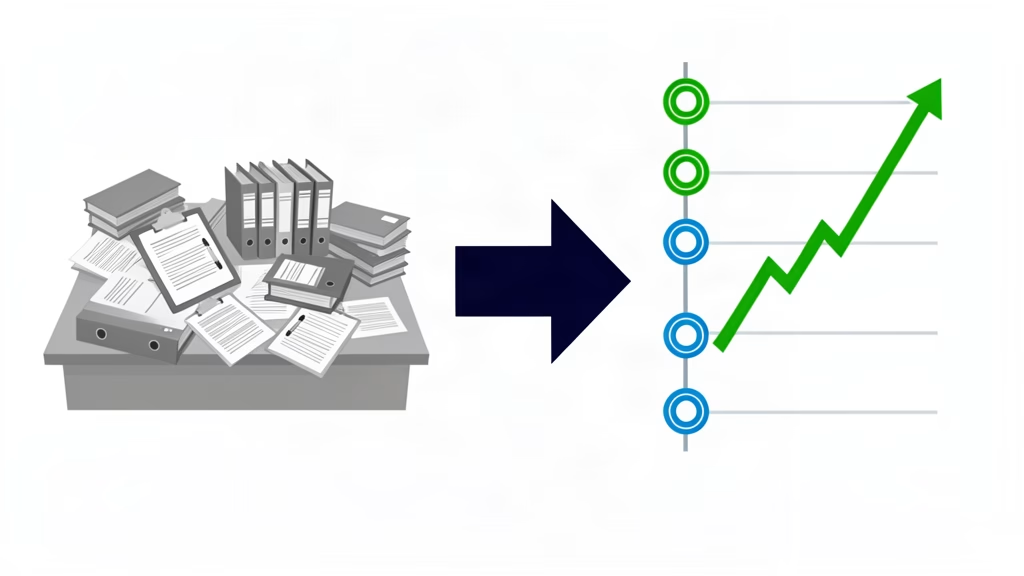
The shift from paper-based tracking to digital lifecycle management is not about replacing the pool manager — it is about giving the board visibility into a system that was previously opaque. The technology handles the data synthesis, compliance tracking, and alert generation, while the manager provides the professional judgment and operational execution.
Automated Compliance Calendar
Instead of discovering that a health department permit expired last month, a digital lifecycle system sends automated alerts 90, 60, and 30 days before every inspection deadline, equipment service date, and contract renewal. Bay County boards see a single calendar view of all upcoming compliance events.
Equipment Registry with Service Life Tracking
Every pump, heater, filter, and controller gets an entry in a digital registry with installation date, expected service life, maintenance history, and replacement cost estimate. When a piece of equipment enters its final 20% of expected life, the system flags it for evaluation — before it fails during peak season.
Reserve Integration
Pool resurfacing, deck replacement, and equipment replacement timelines flow directly from the equipment registry into the reserve study. This means reserve contributions are based on actual asset conditions, not rough guesses that lead to shortfalls and special assessments.
What Bay County Boards Should Demand from Pool Management
Whether your Bay County association currently has a pool management vendor or is evaluating a new management company, these are the standards that separate professional oversight from vendor complacency:
- Documented inspection history: Every health department inspection, chemical log, and equipment service record should be digitally archived and retrievable within minutes.
- Equipment replacement schedule: A clear timeline showing each major component, its age, expected remaining service life, and projected replacement cost.
- Vendor performance benchmarks: Regular scoring of pool service vendors against defined metrics — response time, inspection pass rate, cost per service call.
- Reserve study integration: Pool capital expenses mapped to the reserve study with annual review against actual conditions.
- Proactive compliance alerts: Automated notifications before permits, certifications, and contracts expire — not after.
Frequently Asked Questions
How often should a Bay County HOA pool be inspected by the health department?
The Florida Department of Health typically inspects public swimming pools twice per year in Bay County. However, the exact frequency depends on the facility’s inspection history and any complaint-triggered visits. Associations should track inspection dates and ensure compliance items are resolved before the next scheduled visit.
What happens if a Bay County association pool fails a health inspection?
A failed inspection can result in immediate pool closure until the violation is corrected and a re-inspection is passed. Common violations include water chemistry imbalances, inadequate circulation, damaged drain covers, and missing safety signage. The closure can last from a few days to several weeks depending on the severity and contractor availability.
Who is responsible for pool compliance — the board or the management company?
The board holds ultimate fiduciary responsibility for pool compliance, even when a vendor or management company handles day-to-day operations. The management company executes the operational tasks, but the board must verify that inspections are current, equipment is maintained, and records are retained. Failing to oversee this is a fiduciary gap.
How much should a Bay County HOA budget annually for pool maintenance and reserves?
Annual operating costs for a typical community pool in Bay County range from $12,000 to $35,000 depending on pool size, season length, and equipment age. Reserve contributions for resurfacing, deck replacement, and equipment replacement should add $5,000 to $15,000 per year. A lifecycle management plan produces the specific numbers for your association’s pool.
The Bottom Line for Bay County Boards
Pool lifecycle management is not a luxury — it is a fiduciary obligation. A Bay County board that cannot show a documented maintenance schedule, equipment replacement timeline, and compliance record history is exposed to liability, higher costs, and member dissatisfaction. The technology exists to make this oversight manageable. What it requires is a management approach that prioritizes data-driven planning over reactive crisis response.
If your Bay County association’s pool management consists of a stack of paper invoices and a phone number for a repair company, that is a signal — not of a pool problem, but of a management gap. The right approach brings structure, visibility, and proactive planning to one of your community’s most valuable and most visible assets.
Pool compliance and lifecycle planning are part of the operating discipline Maxet brings to HOA management in Bay County.
Legal disclaimer: Maxet is a professional community association management firm providing business operational efficiency and administrative support. We are not a law firm, and the information provided in this article does not constitute legal advice or create an attorney-client relationship. For specific legal interpretation of Florida Statutes or governing documents, we strongly recommend consulting with a licensed attorney specializing in Florida community association law.